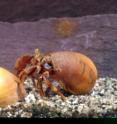
Hermit crabs don't send text messages while scurrying, but human technology may be distracting them all the same.
When boat noise roared over a beach, the crabs weren't as quick as usual to hide inside their shells to avoid a potential predator, says behavioral ecologist Daniel T. Blumstein of UCLA.
The boat roar may not be masking the sound of an approaching predator so much as distracting the crabs from looking out for danger, Blumstein and his students propose in an upcoming Biology Letters.
Distraction makes sense, they contend, because boat noise had an effect even during tests with a mock predator that made no noise to mask. For a silent menace, the researchers used poles to swing a black T-shirt covering an inflatable doughnut toward the crabs. Without boat noise, hermit crabs popped back into their shells briskly as the scary shirt drew near. During a boat roar, though, the crabs didn't respond as quickly, the researchers report.
People have added all kinds of new roars and rumbles to nature's original sounds, and a growing body of research looks at how the increasingly loud world affects animals. The new study takes an approach very different from others that have looked at how animal communication changes in noisy places, says Hans Slabbekoorn of Leiden University in the Netherlands. He has studied birds that sing differently in the midst of urban cacophony, for example, than they do in quiet settings.
Slabbekoorn points out that one of the previous studies of human noise and animal vigilance found that birds called chaffinches spend extra time scanning for predators and less time eating when they forage in noisy places. The new concern about distraction from sudden noise in the hermit crab study "can apply to any species that has to be on the lookout for looming predators," he says.
Blumstein and his colleagues tested crabs in the wild on St. John in the U.S. Virgin Islands by playing recordings of boat noise provided by a Hollywood sound engineer. On a quiet beach, the crabs typically snapped back into their shells before the T-shirt had swung within 80 centimeters. During the playbacks of noise, though, the T-shirt could approach to almost 60 centimeters on average.
Now, Blumstein says, he'd like to know whether crabs would eventually get used to the blasts of boat noise.
"Ingenious," comments Richard Fuller, an ecologist at the University of Queensland in Brisbane, Australia. He and his colleagues have found that urban noise pollution has a stronger effect than light pollution on whether European robins switch from daytime singing to nocturnal serenades. The new hermit crab study "opens the way for much more work on the effects of human noise on complex behavioral systems, not just the simple drowning out of acoustic signals," he says.
When boat noise roared over a beach, the crabs weren't as quick as usual to hide inside their shells to avoid a potential predator, says behavioral ecologist Daniel T. Blumstein of UCLA.
The boat roar may not be masking the sound of an approaching predator so much as distracting the crabs from looking out for danger, Blumstein and his students propose in an upcoming Biology Letters.
Distraction makes sense, they contend, because boat noise had an effect even during tests with a mock predator that made no noise to mask. For a silent menace, the researchers used poles to swing a black T-shirt covering an inflatable doughnut toward the crabs. Without boat noise, hermit crabs popped back into their shells briskly as the scary shirt drew near. During a boat roar, though, the crabs didn't respond as quickly, the researchers report.
People have added all kinds of new roars and rumbles to nature's original sounds, and a growing body of research looks at how the increasingly loud world affects animals. The new study takes an approach very different from others that have looked at how animal communication changes in noisy places, says Hans Slabbekoorn of Leiden University in the Netherlands. He has studied birds that sing differently in the midst of urban cacophony, for example, than they do in quiet settings.
Slabbekoorn points out that one of the previous studies of human noise and animal vigilance found that birds called chaffinches spend extra time scanning for predators and less time eating when they forage in noisy places. The new concern about distraction from sudden noise in the hermit crab study "can apply to any species that has to be on the lookout for looming predators," he says.
Blumstein and his colleagues tested crabs in the wild on St. John in the U.S. Virgin Islands by playing recordings of boat noise provided by a Hollywood sound engineer. On a quiet beach, the crabs typically snapped back into their shells before the T-shirt had swung within 80 centimeters. During the playbacks of noise, though, the T-shirt could approach to almost 60 centimeters on average.
Now, Blumstein says, he'd like to know whether crabs would eventually get used to the blasts of boat noise.
"Ingenious," comments Richard Fuller, an ecologist at the University of Queensland in Brisbane, Australia. He and his colleagues have found that urban noise pollution has a stronger effect than light pollution on whether European robins switch from daytime singing to nocturnal serenades. The new hermit crab study "opens the way for much more work on the effects of human noise on complex behavioral systems, not just the simple drowning out of acoustic signals," he says.