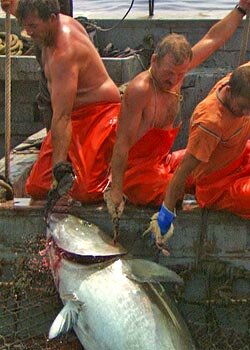
Showing posts with label blue fin tuna. Show all posts

Sunday, June 06, 2010

Spawning Habitat of Bluefin Tuna in Gulf of Mexico: Critical Area Intersects Deepwater Horizon Oil Spill


Electronic tagging and fisheries catch data have revealed pronounced differences in preferred habitat of Atlantic bluefin tuna and yellowfin tuna in the Gulf of Mexico, despite their close ancestry, according to a new study published today in the peer-reviewed journal PLoS ONE. Bluefin tuna return to the same regions of the Gulf of Mexico during spring months to spawn. The bluefin are selecting a particular habitat along the slope waters of the Gulf of Mexico, which has unique oceanographic properties that are predictable and can be seen from satellites. Yellowfin tuna are more widely distributed throughout the warm Gulf waters and occupy the region throughout the year.


"The bluefins' habitat requirements are relatively exact so we can predict with reasonable accuracy where bluefin tuna are likely to be spawning at any given time based on oceanographic data continually being gathered by satellites and weather buoys," said lead author Steven Teo of the University of California at Davis. "This is in stark contrast to yellowfin tuna, which exhibit much more generalized environmental preferences." The fidelity to breeding areas over time detected in this study is reminiscent of salmon returning to their natal stream to spawn.
Bluefin tuna are among the most valuable fish in global markets. The International Commission for the Conservation of Atlantic Tunas (ICCAT, http://www.iccat.int/) currently manages the Atlantic bluefin tuna as two distinct populations, with western Atlantic spawners of the Gulf of Mexico forming a distinct population genetically from the eastern spawners of the Mediterranean Sea. The western Atlantic stock has suffered a significant decline in spawning stock biomass since 1950, and a 20-year rebuilding plan has failed to revive the population or the North American fishery. The failure of the Gulf of Mexico spawning population to rebuild, as well as the scope of illegal and under-reported catches -- particularly in the Mediterranean Sea -- are of such major concern that the species was recently considered by the United Nations for endangered species listing in March of 2010.
Targeted bluefin fishing has been banned in the Gulf for over twenty years, but bluefin continue to be captured accidentally on pelagic longlines, often resulting in mortality. The study shows that bluefin tuna are captured in the Gulf of Mexico from January through June each year, and the highest pelagic longline catch rates are in April and May, during the bluefin spawning season.
The authors compared environmental preferences and spatio-temporal distributions of bluefin and yellowfin tuna as revealed by pelagic longline catch rates and scientific tagging cruise conducted by the Stanford University and Monterey Bay Aquarium team coupled with oceanographic data sets. Drawing on these data, a model was developed to determine the relative probability of catching bluefin and yellowfin tuna at a given place and time. This model showed that there are two major hotspot regions within the Gulf where bycatch occurs -- one in the eastern Gulf of Mexico to the north of the Loop Current, and the other in the western Gulf of Mexico. Both regions are along the slope where the shallow continental shelf depth changes rapidly to the deep sea. It is within these hotspots that bluefin tuna prefer to spawn in circular, swirling water masses called "cyclonic eddies." These eddies are more productive and slightly cooler than surrounding warm Gulf ocean currents. Yellowfin tuna, however, are much more widely dispersed throughout the Gulf of Mexico throughout the year.
These findings indicate that it would be possible to utilize spatial management techniques to protect western Atlantic bluefin tuna on their breeding grounds in the Gulf of Mexico without compromising the yellowfin tuna fishery, which could be carried out in other areas during the critical bluefin tuna breeding times.
Unfortunately, these findings also give cause for concern in light of the recent Deepwater Horizon oil spill. "Both catch data and electronic tags indicate the Gulf of Mexico along the continental shelf is the preferred habitat of this majestic fish. I think it is amazing how precisely we can predict where the bluefin are. Unfortunately their spawning habitat overlaps the Deepwater Horizon oil accident site, and the timing of the spill coincides with the time when we expect them to be there spawning" said senior author Dr. Barbara Block of Stanford University.
Funding for this study was provided by the Lenfest Ocean Program, the Tag-A-Giant Foundation, the David and Lucile Packard Foundation, the Monterey Bay Aquarium Foundation, the National Oceanographic and Atmospheric Administration and the Disney Foundation.
Steven L. H. Teo, Barbara A. Block, Sharyn Jane Goldstien. Comparative Influence of Ocean Conditions on Yellowfin and Atlantic Bluefin Tuna Catch from Longlines in the Gulf of Mexico. PLoS ONE, 2010; 5 (5): e10756 DOI: 10.1371/journal.pone.0010756

Saturday, March 06, 2010

Mercurial Tuna: Study Explores Sources of Mercury to Ocean Fish


With concern over mercury contamination of tuna on the rise and growing information about the health effects of eating contaminated fish, scientists would like to know exactly where the pollutant is coming from and how it's getting into open-ocean fish species.

A new study published in the journalEnvironmental Science & Technology uses chemical signatures of nitrogen, carbon and mercury to get at the question. The work also paves the way to new means of tracking sources of mercury poisoning in people.

The study, by researchers at the University of Michigan, Harvard School of Public Health, the Louisiana Universities Marine Consortium and the National Institute of Nutrition and Seafood Research in Norway, appears in the journal's March 1, 2010 issue.

Mercury is a naturally occurring element, but some 2,000 tons of it enter the global environment each year from human-generated sources such as coal-burning power plants, incinerators and chlorine-producing plants. Deposited onto land or into water, mercury is picked up by microorganisms, which convert some of it to methylmercury, a highly toxic form that builds up in fish and the animals -- and people -- that eat them.

The primary way people in the United States are exposed to methylmercury is by eating fish and shellfish. Health effects include damage to the central nervous system, heart and immune system, and the developing brains of young and unborn children are especially vulnerable.

In the current study, the researchers wanted to know if tuna and other open-ocean fish pick up methylmercury by eating contaminated fish that live closer to shore or by some other means. They studied 11 species of fish, including red snapper, speckled trout, Spanish mackerel and two species of tuna. Seven of the species studied live in the shallow, coastal waters of the Gulf of Mexico; the two tuna species live far out in the ocean and are highly migratory; the remaining two species spend parts of their lives in both habitats.

It's no mystery how the coastal fish acquire methylmercury, said Joel Blum, who is the John D. MacArthur Professor of Geological Sciences at U-M. "We know that there's a lot of mercury pollution in the coastal zone. A large amount of mercury comes down the Mississippi River, and there's also air pollution and deposition of mercury from the highly industrialized coastal Gulf region." In this environment, methylation occurs in the low-oxygen conditions of the lower water column and sediments, and the methylmercury wends its way up the food web, becoming more concentrated at each step along the way.

"It's much less clear how methylmercury gets into open-ocean fish species, some of which don't come anywhere close to shore but can still have very high levels," said the study's lead author, David Senn, formerly of the Harvard School of Public Health, and now a senior researcher at the Swiss Federal Institute of Aquatic Science and Technology. Scientists have proposed three possibilities.

One is that open-ocean fish visit coastal areas to feed, picking up methylmercury from the coastal food web. Another possibility is that small organisms that acquire methylmercury in coastal regions are washed out to sea, where they enter the open-ocean food web. In the third scenario, mercury is directly deposited into the open ocean, where it undergoes methylation.

By looking at three chemical signatures in the fish -- nitrogen isotopes, carbon isotopes and mercury isotopes -- Senn, Blum and colleagues learned that coastal fish and open-ocean fish are feeding from two separate food webs.

"That rules out the first explanation, that these tuna were getting their methylmercury by feeding off coastal fish," Senn said.

"We think it's unlikely that the mercury is being methylated in coastal sediments and then washed out to the open ocean, so the most likely alternative is that there is deposition and methylation of mercury in the open ocean," Blum said. The finding runs counter to the long-held view that the open ocean is too oxygen-rich to support methylation, but it is consistent with recent studies suggesting more methylation may be occurring in that environment than was previously thought.

"It turns out there are probably low-oxygen microenvironments on tiny particles of organic matter, where methylation may be able to occur," Blum said.

One of the biggest differences the researchers found between coastal and open-ocean fish was in their mercury "fingerprint." The fingerprint is the result of a natural phenomenon called isotopic fractionation, in which different isotopes of mercury react to form new compounds at slightly different rates. In one type of isotopic fractionation, mass-dependent fractionation (MDF), the differing rates depend on the masses of the isotopes. In mass-independent fractionation (MIF), the behavior of the isotopes depends not on their absolute masses but on whether their masses are odd or even.

The researchers found that open-ocean fish have a much stronger MIF fingerprint than do coastal fish, a discovery that opens the door to new ways of analyzing human exposure to mercury.

"We can do an isotopic analysis of the mercury in your hair, and by looking at this mass-independent signal, tell you how much of the mercury is coming from inorganic sources, such as exposure to mercury gas or amalgams in your dental fillings, versus how much is coming from the fish that you eat," Blum said. "We think this could become a widespread technique for identifying sources of mercury contamination."

Senn and Blum's coauthors are Edward Chesney of the Louisiana Universities Marine Consortium; Michael Bank and James Shine of Harvard School of Public Health; and Amund Maage of Norway's National Institute of Nutrition and Seafood Research.

The research was funded by a National Oceanic and Atmospheric Administration grant to Harvard School of Public Health and by the University of Michigan.

Wednesday, January 06, 2010

Giant tuna fetches $177,000 at Japan fish auction


A giant bluefin tuna fetched 16.3 million yen ($177,000) in an auction Tuesday at the world's largest wholesale fish market in Japan.
The 513-pound (233-kilogram) fish was the priciest since 2001 when a 440-pound (200 kilogram) tuna sold for a record 20.2 million yen ($220,000) at Tokyo's Tsukiji market.
The gargantuan tuna was bought and shared by the owners of two Japanese sushi restaurants and one Hong Kong-based sushi establishment, said a market representative on condition of anonymity because he was not authorized to disclose the information.
Caught off the coast of northern Japan, the big tuna was among 570 put up for auction Tuesday. About 40 percent of the auctioned fish came from abroad, including from Indonesia and Mexico, the representative said.
Japan is the world's biggest consumer of seafood with Japanese eating 80 percent of the Atlantic and Pacific bluefins caught. The two tuna species are the most sought after by sushi lovers.
However, tuna consumption in Japan has declined because of a prolonged economic slump as the world's second-largest economy struggles to shake off its worst recession since World War II.
"Consumers are shying away from eating tuna ... We are very worried about the trend," the market representative said.
Apart from falling demand for tuna, wholesalers are worried about growing calls for tighter fishing rules amid declining tuna stocks.
The International Commission for the Conservation of Atlantic Tunas in November slashed the quota for the 2010 catch by about one-third to 13,500 tons (12,250 metric tons) — a move criticized by environmentalists as not going far enough.

Wednesday, November 11, 2009

'Last chance' for tuna authority


Tsukiji market in Tokyo is the final destination for a large proportion of bluefin The annual meeting of the body charged with conserving Atlantic tuna opens on Monday to warnings that this is its "last chance" to manage things well.The International Commission for the Conservation of Atlantic Tunas (Iccat) is criticised for setting high quotas and not tackling illegal fishing. Stocks of bluefin tuna are at about 15% of pre-industrial fishing levels. US Commissioner Rebecca Lent said her country and others feel this is Iccat's last chance to put things right. "We think Iccat is the body that should be managing bluefin tuna, and this is its chance to prove it can do so effectively," she told BBC News from the meeting in Recife, Brazil.For over 30 years, Iccat has wasted countless opportunities to set science-based catch limits and curb overfishing of Atlantic bluefin Dr Sue Lieberman, Pew "We'd like to have science-based management that has a good chance of stopping overfishing and rebuilding the stock, with effective compliance and monitoring." In recent years, Iccat has routinely set quotas higher than its scientific advisers have recommended, and illegal fishing has put even more pressure on the species. It is estimated that the illegal take adds about 30% to the legal catches. In its last assessment, Iccat scientists noted that the rapid expansion of the fishing industry around the Mediterranean Sea meant "there appears to no longer exist any refuge for bluefin in the Mediterranean during the spawning season". Down to zeroA number of European countries share US reservations about the ineffectiveness of Iccat. This led Monaco to propose regulating the tuna trade through the Convention on International Trade in Endangered Species (CITES), an idea that has garnered support from most EU nations. Others, including the US, would prefer Iccat to allocate quotas that the stock can withstand and then enforce them - but will back the trade ban if it does not.Large modern boats pose a danger to seabirds, say conservationists Conservation groups, meanwhile, are pressing for a complete suspension of the fishery - a measure that was recommended by an independent review of Iccat published last year. "For over 30 years, Iccat has wasted countless opportunities to set science-based catch limits and curb overfishing of Atlantic bluefin," said Sue Lieberman, director of international policy with the Pew Environment Group. "A zero quota will show the world that Iccat is ready to heed the science, and recognise the importance of fully alleviating fishing pressure on Atlantic bluefin until stocks recover." The Royal Society for the Protection of Birds (RSPB) is campaigning for Iccat to tighten regulation of longline fishing for tuna and swordfish. It says threatened species such as albatrosses are routinely caught on hooks deployed by these vessels. "We will be urging delegates to approve rules that make it mandatory for all vessels fishing for tuna and swordfish in the Atlantic to abide by simple measures which lower the risk of albatrosses and other seabirds dying in these fisheries," said Cleo Small, an albatross specialist working with the RSPB. Pew is also pressing Iccat to ban the removal of shark fins at sea - a measure that they say would reduce the toll on sharks, many of which are recent additions to the threatened species list. Richard.Black-INTERNET@bbc.co.ukBBC By Richard Black Environment correspondent, BBC News website

Wednesday, July 29, 2009

Monaco seeks global bluefin tuna trade ban


Monaco has tabled a formal proposal to place overfished Atlantic and Mediterranean bluefin tuna on the list of the world's most endangered species -- a move that could ban all trade of the fish.According to a draft proposal released on the website of CITES, the UN agency against illegal wildlife trade, Monaco wants the species to be entered straightaway on Appendix I, the agency's top grade of protection.Appendix I lists species threatened with extinction and for which all international trade is prohibited except for non-commercial purposes."At this stage we believe that the time for CITES to intervene is long overdue," said Monaco in its submission."We are further convinced that the status of the species had passed the point where listing it on Appendix II of that convention will be sufficient."Regrettably, an Appendix I listing of all stocks -- this closing international commercial trade in the species -- is what is required at this stage," the Mediterranean principality added.CITES's lower level Appendix II lists species that are not necessarily currently threatened with extinction but could become so unless trade is closely controlled.The Convention on International Trade in Endangered Species of Wild Fauna and Flora (CITES) is the only global body with the authority to limit or ban global trade in animal and plant species.Bluefin tuna has no form of protection under CITES at the moment.Attempts by other bodies, including the European Union, to limit fishing have met strong opposition, notably in France and Italy.Monaco argued that tuna spawning stock in the Mediterranean has declined by 74.2 percent between 1957 to 2007, of which 60.9 percent happened in the last decade.Meanwhile, tuna stock in the west Atlantic has plunged 82.4 percent between 1970 to 2007.Continued fishing would drive the spawning stock to just about 18 percent of the 1970 levels or just 6 percent of the historical level, Monaco said in its submission.Even with a near-complete ban on bluefin tuna fishing until 2022, the population would still fall to record lows in the coming years, it added.Late last year, a meeting of the International Commission for the Conservation of Atlantic Tunas (ICCAT) agreed to cut bluefin tuna fishing by 30 percent over two years in the Mediterranean Sea and Atlantic Ocean.However, Monaco argued that ICCAT -- a organisation including major fishing nations -- has "consistently set catch quotas... above levels recommended by its scientists and the failure of its management measures is demonstrated by the continously decreasing population."Monaco is seeking comments to its draft proposal before it submits a final document that would be considered when the 175-member states of CITES meet during next March's general assembly in Qatar.The CITES secretariat itself would make its position known in February.

Friday, June 05, 2009

Bluefin Tuna: "The End Of The Line"


The Atlantic bluefin tuna is a dark, steel-blue teardrop of a fish which migrates across whole oceans and can swim at speeds of up to 45mph. Its acceleration, as it locks on to a ball of bait-fish, has been likened to a supercar.The bluefin can turn on this electric display because it is one of the most highly developed fish, and warms its blood through a heat-exchanger so more energy can be released on a whim.This top-level predator's only problem is that its flesh is one of the most delicious things on earth, eaten raw as sushi or sashimi. It is only marginally less delicious the Mediterranean way, seared with a dressing of oil and vinegar.Bluefin flesh was eaten by Roman legionaries before battle. Its entrails, treated with herbs, were a delicacy known as garum, pots of which have been found throughout the former Roman Empire and as far north as the garrison town of York.The British until recently called the bluefin "tunny" (from the Latin, Thunnus thynnus). Tunny hunted shoals of herring off Scarborough, where well-heeled anglers sought but never caught a 1,000lb specimen – the world rod-caught record is 1,496lb, off Nova Scotia in 1979. The run of North Sea tunny had mysteriously disappeared by the 1950s.There are two remaining populations of bluefin; a western one, which spawns in the Gulf of Mexico, and an eastern one that spawns in the Mediterranean. The western stock was hammered close to extinction before the United States and Canada protected it and allowed only anglers to catch it, though the skippers make a fortune by exporting the carcasses to Japan.The eastern stock is now close to collapse, mainly because of rampant overfishing for tuna "farms" that supply the Japanese market.Scientists discovered only recently though that some of the eastern and the western stocks mix and interbreed, swimming the whole Atlantic ocean to do so. So the collapse of the bluefin now being predicted is a crisis of Atlantic proportions.For conservationists, it is the front line. The bluefin is the blue whale for our time.The End of the Line, the film based on Charles Clover's book, has its national premiere on 8 June, World Oceans Day

Friday, April 17, 2009

EU cuts Mediterranean tuna fishing


The Mediterranean tuna fishing season will be 15 days shorter this year with quotas and fleets also cut, EU sources said Wednesday: but environmentalists complained it was too little, too late.The bluefin fishing season begins officially on Thursday and will end on June 15, two weeks earlier than the scheduled 2008 season.At the same time the European Commission has reduced allowed quotas by 27 percent overall. It has also negotiated a cut in fishing capacity for the industrial fishing 'purse seiners' which use huge cylindrical nets to scoop up their catch.Last year's season was cut short when in mid-June the European Commission ordered a halt to industrial fishing of bluefin tuna two weeks early because quotas for 2008 had already been reached.Both France and Italy opposed that decision, questioning the commission's figures and saying that their fishing industries had not reached even half their quotas.The biggest fishing fleet reductions have been agreed by the biggest tuna fishing nations in the EU, with Italy scrapping 19 boats to leave a total of 68 and France getting rid of eight to leave a fleet of 36 purse seiners.Of the other European Union members only Spain and Malta retain smaller tuna fleets, which will remain unchanged, while Greece has recently scrapped the last of its tuna ships.The EU has also decided to freeze the capacity of tuna farms, mainly in Malta, and to boost inspections at sea to avoid the kind of fraud whereby fishing ships sell their wares to the farms before coming into port."It's the last chance" to avoid the end of Mediterranean bluefin tuna, which has been heavily overfished in the past, an EU official said.However he estimated that "scrapping another 10 vessels would help to eliminate overfishing."The lobby group Oceana saw the problem as much more serious, calling for "the immediate closure of the fishery, as stocks are condemned to collapse even if the fleet complies with 100 percent of the agreed quotas and management measures.""Over-exploitation, illegal fishing and the irresponsibility of the member states that reap the benefits from this fishery have taken this species to the brink of commercial collapse," said Xavier Pastor, executive director of Oceana in Europe."Under the leadership of the EU, a new recovery plan has been implemented in 2009 that once again ignores scientific recommendations," he added.

Thursday, April 16, 2009

Bluefin tuna will be wiped out by overfishing: WWF


OVERFISHING will wipe out the breeding population of Atlantic bluefin tuna, one of the ocean's largest and fastest predators, in three years unless catches are dramatically reduced, conservation group WWF said today.As European fishing fleets prepare to begin the two-month Mediterranean fishing season tomorrow, WWF said its analysis showed the bluefin tuna that spawn - those aged four years and older - will have disappeared by 2012 at current rates. "For years people have been asking when the collapse of this fishery will happen, and now we have the answer," said Sergi Tudela, Head of Fisheries at WWF Mediterranean. The fish, which can weigh over half a tonne and accelerate faster than a sports car, are a favourite of sushi lovers. Demand from Japan has triggered an explosion in the size of the Mediterranean fleet over the past decade and many of those boats use illegal spotter planes to track the warm-blooded tuna. "Mediterranean (Atlantic) bluefin tuna is collapsing as we speak and yet the fishery will kick off again tomorrow for business as usual. It is absurd and inexcusable to open a fishing season when stocks of the target species are collapsing," added Tudela. Environmental groups condemned an agreement signed in November by states setting bluefin quotas - a body dominated by EU members. The groups called it "a disaster" and "a disgrace," saying the states again chose to ignore their own scientists and set quotas 47 per cent higher than recommended. Illegal fishing is also rife for the bluefin, the dried, dark red meat of which once fed Roman armies on the march. Growing numbers of restaurants and retailers including Carrefour's Italian supermarkets are boycotting it. WWF said that analysis of official data showed the average size of mature tunas had more than halved since the 1990s and that this has had a disproportionately high impact since bigger fish produced many more offspring. The bluefin can only be saved by a compete halt to fishing in May and June as the fish rush through the Straits of Gibraltar to spawn in the Mediterranean, WWF and other campaign groups say.

Wednesday, November 05, 2008

One thousand tags reveal mysteries of giant bluefin tuna

A giant Atlantic bluefin tuna weighing more than half a ton had the honor of being fitted with the 1000th electronic tracking tag placed on this threatened species when it was caught and released on Monday (October 20) in the Gulf of St. Lawrence off Port Hood, Nova Scotia.The prized fish, which measured 10 feet in length, was tagged by a scientific team from the Tag-A-Giant (TAG; www.tagagiant.org) campaign of Stanford University, Dalhousie University and the Monterey Bay Aquarium, working in collaboration with Canadian fishermen from Prince Edward Island and Nova Scotia. The field team was led by Drs. Mike Stokesbury of Dalhousie University and Steve Wilson of Stanford University.The TAG team has been tagging bluefin tuna since 1996, when the first tag was put out on a bluefin tuna off North Carolina's Outer Banks. Led by Stanford University professor Barbara Block, the team has traveled from the Gulf of St. Lawrence to the Gulf of Mexico and from Ireland to Spain to tag Atlantic bluefin tuna.Placing 1,000 tags on giant bluefin has been a long quest for TAG researchers, whose work has helped to reveal the life histories of these amazing, elusive creatures at a time when their commercial value is soaring and their population has declined to a fraction of its historic levels - prompting calls for a moratorium on the commercial fishery so the Atlantic giants can recover.The tagging data assembled by the TAG researchers have been vital in identifying how populations of bluefin tuna use the North Atlantic, leading to new discoveries about their physiology, their migratory patterns and their population structure.Electronic tagging is a carefully orchestrated process, refined through years of experience in the field and in the Tuna Research and Conservation Center in Pacific Grove, California, which is operated jointly by Stanford University and the Monterey Bay Aquarium.In the field, fish are caught using rod and reel and brought aboard the fishing vessel, where tags are externally attached, or surgically implanted inside the tuna. Each tag, ranging in price from US$1,500-$3,500, records sunrise and sunset, pressure (or depth), water temperature and body temperature. When months or years later a fisherman catches the tagged tuna, the fisherman receives a handsome reward for returning the electronic tag to scientists who then download the data into a computer for analysis.Some tags do not even need to be physically retrieved but rather transmit their data to researchers via satellite. Using astronomical techniques similar to those used by 17th century mariners, the tuna's position on earth can be calculated from sunrise and sunset data, revealing the migratory track of individual fish as they swim throughout the North Atlantic Ocean and adjacent seas. The longest migration recorded to date was from a fish caught, tagged and released in North Carolina that over the course of 4.8 years traveled across the North Atlantic and into the Mediterranean.Bluefin tuna are often described with superlatives: largest, fastest, most powerful. They are long-lived, among the largest fish on earth-weighing up to 1,500 lbs-and make trans-oceanic migrations in as few as 20 days.The same muscles that power their locomotion across ocean basins are at the heart of the sushi economy that has made the bluefin so prized by diners. Global demand for bluefins has grown dramatically in recent years, and sushi connoisseurs revere bluefin tuna above all else. A single fish sold at auction in Japan for $173,000 - pricing that has fueled industrial fishing pressure and has led to the near-collapse of bluefin populations in both the West and East Atlantic.Tag-A-Giant research is providing fisheries managers with the information needed to design and implement sustainable limits for commercial and recreational fisheries for bluefin tuna to reverse the decline and put the species on the road to recovery.Data from the tagged fish have revealed that bluefin tuna routinely swim across the Atlantic, with fish tagged off the coast of North America visiting spawning grounds in the Mediterranean and in the Gulf of Mexico. The data show that the western and eastern populations forage together on common fishing grounds, then move to distinct spawning grounds when it is time to breed. As a result, fish from both populations are affected by fisheries on both sides of the Atlantic.The tagging data were recently confirmed using a completely different technique, based on chemical analysis of the tunas' "otoliths," or ear bones, which retain a characteristic chemical signature depending upon where the tuna was originally spawned.A unique aspect of this study, published in the journal Science, shows that the large fish that visit the northern waters of Canada are derived primarily from the Gulf of Mexico breeding stock, and that and that there is a mixture of fish from both Gulf of Mexico and Mediterranean stocks in waters along the U.S. continental shelf.The electronic tags have also revealed these giant tuna dive to depths of nearly a mile and range through waters from the tropics to frigid polar seas. They can do so because bluefins are among the rare ocean animals that have the capacity to maintain a warm, stable body temperature throughout their wide thermal niche - much like a mammal or bird.TAG data have also helped to uncover where, when and how bluefin tuna spawn, at what age they mature, and are helping to increase the accuracy of population estimates for Atlantic bluefin tuna.The 1,000th tag is riding on the back of a bluefin tuna, recording its every move. Of the 1,000 tags deployed since 1996, approximately half have been recovered or reported back, documenting more than 21,000 days of tuna behavior. The remaining tags are still at large on giants swimming in the North Atlantic, Mediterranean and Gulf of Mexico.The TAG team continues to pursue its work, collecting new information that will help ensure a future for Atlantic bluefin tuna.Source: The Ocean Foundation

Monday, October 13, 2008

Italy's bluefin tuna fishing 'out of control'

Italy's fishing of bluefin tuna is "totally out of control," the Worldwide Fund for Nature charged Tuesday, calling for a three-year moratorium on fishing for the species in the Mediterranean. In a statement, the Italian section of the WWF denounced "widespread and repeated lawlessness over the course of years" in fishing for the lucrative species, which is highly prized in Japan.WWF blamed Italy's overfishing on a "lack of control, clandestine fishing boats, unregistered transfers of live tuna to foreign fish farms (and) a presence of organised crime" among other factors.In conclusions addressed to the European Commission and the Italian agriculture and fisheries ministry, WWF recalled the EU decision to halt industrial fishing of bluefin tuna in mid-June, two weeks early, because quotas for 2008 were already reached.But Italy has exceeded the allowed catch for 2008 by "at least 700 tonnes," WWF said.Both Italy and France opposed the decision, questioning the European Commission's figures and asserting that their fishing industries had not reached even half their quotas.Large quantities of fish including bluefin tuna "are not registered at ports when they arrive," WWF said, adding that fish "are also sold illegally on markets infiltrated by the mafia."The environmental group said fishermen also make illegal use of aircraft to spot schools of bluefin.It said 283 Italian boats are plying the waters for bluefin, nearly 100 more than the authorised number.Calling for the moratorium, WWF said 2007 was already a "dire" year for bluefin, with quotas exceeded by 40 percent.An independent panel said last month that the management of bluefin tuna fishing in the Mediterranean was "an international disgrace."After reviewing the performance of the International Commission for the Conservation of Atlantic Tunas (ICCAT), it recommended an immediate suspension of all fishing for East Atlantic and Mediterranean bluefin tuna.Today more than 50,000 tonnes of bluefin tuna are caught every year in the Mediterranean. To prevent stocks from collapsing, that figure should be limited to 15,000 tonnes in the short term, according to ICCAT.