Fifty manatees have died from the effects of cold weather this year in Brevard County, surpassing the previous record of 28 cold weather-related deaths for all of 1990.Manatee counts in recent years show that the population has grown since 1990. Still, the deaths show how one of the coldest Florida winters in recent years continues to put a strain on sea cows."The next cold front comes before it gets a chance to warm up, and that's certainly a problem," said Andy Garrett, a biologist with the Fish and Wildlife Research Institute in St. Petersburg.The 50 manatee deaths are part of a preliminary report by the institute for Jan. 1 through Feb. 19, so the toll could rise.In Brevard and throughout the state, "cold stress syndrome," which can result in death, occurs as a result of long exposure to water temperatures below 68 degrees. The illness lasts weeks, causes manatees to stop eating and shuts down their immune systems.Researchers think many recent deaths can be attributed to the lingering effects of the syndrome, with many manatees actually affected during January's cold snap, when temperatures averaged about 16 degrees below normal."Earlier this year, the deaths were acute, but we're seeing more chronic cases of long-term illness," Garrett said.Manatees that aren't too sick and can hang on until it finally gets warm -- and stays warm -- will be able to turn themselves, feed and survive, Garrett said. But he predicted more cold-related deaths despite an eventual warming of the weather. Cold weather is keeping teams from the state's manatee rescue network busy.During a recent weekend, rescuers tried to save 10 manatees from different locations in Florida, including offshore in Indian Harbour Beach, where an adult manatee eluded rescue. That animal and others showed signs of cold stress.Other wildlife in Florida are stressed by the cold, including types of fish and sea turtles. Researchers attribute 300 sea turtle deaths in Brevard to January's cold snap.Most sea turtles recover from cold more easily compared with manatees because they don't experience long-lasting effects.Sea turtles rescued in January that survived are doing well, said Blair Witherington, a research scientist with the institute in Melbourne Beach.It becomes dangerous for turtles when the water dips below 50 degrees, which hasn't happened since the January cold snap, he said.
Showing posts with label Manatees. Show all posts
Showing posts with label Manatees. Show all posts
Tuesday, March 02, 2010


Monday, February 15, 2010
Cold temps further endanger Florida's manatees
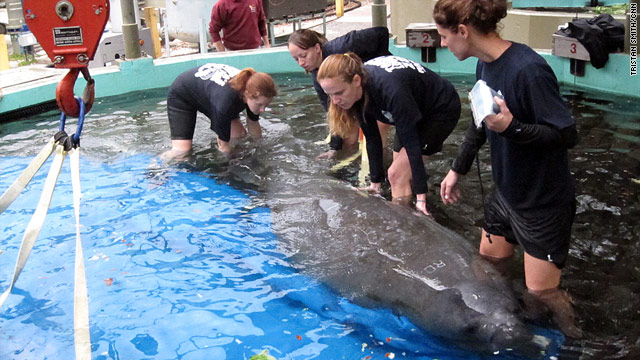
Workers at Tampa's Lowry Park Zoo treat 3-year-old Baby Coral for cold stress.Cold has killed at least 5 percent of West Indies manatees this year, 280 in allWildlife official: Manatees can't cope when water is colder than 68 degreesManatee are already endangered, and 2009 known deaths were a record 429Necropsy lab official says she fears more may die in spring from lingering effects of coldTampa, Florida (CNN) -- The unusually cold weather that struck Florida in January did more than damage crops and citrus trees. It has also caused an unprecedented number of deaths among Florida's beloved residents, the endangered West Indies manatees. Twisting and flopping in the shallow water, Baby Coral probably doesn't realize just how lucky she is. When this 3-year-old female manatee was brought into Tampa's Lowry Park Zoo last month, she was 300 pounds underweight, unable to eat. Her skin was covered with small white, blister-like lesions known as "Florida frostbite," the result of exposure to cold temperatures. Lowry Park Zoo is one of the three facilities in the state that provide medical treatment and a place for manatees to recover from cold stress, as well as other injuries. "It's an exceptionally bad year for the manatee," said Dr. David Murphy, the zoo's veterinarian. So far this year, a record 280 or more manatees have died from cold stress-related illnesses. That's estimated to be 5 percent of the total population in Florida. Add that to last year's record mortality rate of 429 deaths from boat strikes and other causes, and that number may be as high as 10 percent. Marine biologist Andy Garrett says he's never seen anything like this before. The full impact of the cold weather on the manatee population is still unclear, according to Garrett, who works for Florida's Fish and Wildlife Conservation Commission.He says that when water temperatures dip below 68 degrees Fahrenheit, these subtropical animals simply can't cope with the cold. Last month, Florida's water temperatures dropped as low as the 40s. While manatees are round and plump like seals and other marine mammals, their fat is not designed to insulate them from the cold, Garrett said. West Indies manatees roam the warm waters of the Caribbean, and in the summer have been known to migrate as far north as the New Jersey, and as far west as Texas. It's an exceptionally bad year for the manatee.--Dr. David Murphy, veterinarianBut those wintering in Florida are at the marginal edge of their habitat, and are always susceptible to the cold. On the other side of Tampa Bay, manatees have found a practical solution: Hundreds gather in a canal warmed by water discharged from a Tampa Electric Co. power plant. There, they are able to escape the cold, floating in waters that stay around 78 degrees. The carcasses of manatees who weren't able to find a warm water refuge have been turning up daily. Most end up at the Florida Fish and Wildlife Conservation Commission's necropsy lab in St. Petersburg. The lab has been busy in recent weeks, at times examining a dozen manatees a day. There, Dr. Martine de Wit and her staff determine cause of death. It's normally the young manatees that are most stressed by cold weather, but this year, full-size adults are dying."That is a very bad sign," she said.The cold water shuts down their internal systems. Many were unable to eat; others drowned because they were unable to breathe. Garrett and de Wit believe that this may just be the beginning. They fear that more manatees will die during the spring, unable to recover from the trauma of Florida's deep freeze.
Monday, January 11, 2010
Manatees crowd springs for warmth

There are 100 and counting just in Three Sisters Springs alone, and wildlife authorities are urging spectators to stay away from the mammals. They're worried human contact may scare them back into cold waters.Michael Lusk, a U.S. Fish and Wildlife refuge manager, was shocked by the large numbers of manatees in the spring."What you're seeing here is a true phenomenon. Our biologist who has been here for over 20 years says that she's never seen so many manatees in this area," Lusk said.The springs are nature's version of a spa for the manatees, a place where they go to stay warm.The spring has a constant water temperature of 72 degrees year-round, and manatees will typically get sick once the water temperature drops below 68 degrees.Lusk believes most manatee tour groups and residents are complying with requests to stay out of the springs, although we spotted one snorkeler who seemed to be keeping a safe distance.But that may be even too close, some manatee advocates say. Tracy Colson, an advocate who volunteers for the U.S. Fish and Wildlife refuge explains why."The swimmers' interaction with them is an issue with me, because there's a lot of harassment that goes on and that prevents them from resting and using the springs to keep warm," she said.Some nearby manatee tour operators say they're feeling the crunch of cancellations -- not because of the recent warning, but because the cold weather is keeping people away.At Manatee Tour and Dive, owner Charles Slider hopes to keep booking trips."I'd hate to see them close it completely, and it's better if everybody understands and cooperates with Fish and Wildlife to protect the animals," he said.U.S. Fish and Wildlife officers say they're diligently patrolling, on the lookout for offenders: swimmers and boaters who get too close. They're encouraging everyone to look and not touch these creatures who inspire so much awe and wonder. Fox News
Saturday, January 09, 2010
Manatees huddle, turtles stunned

More than 200 manatees are wintering in a balmy canal outside a power plant, the latest exotic Florida animals seeking refuge from the state's frigid temperatures.
Giant eagle rays and spinner sharks joined them in the 70-degree waters Thursday as onlookers watched them frolic.
"This is a spa for them," said Wendy Anastasiou, an environmental specialist for the Tampa Electric Company.
With temperatures up to 20 degrees below normal, some less resourceful animals needed help from humans to survive.
Along Florida's Atlantic Coast, 93 sea turtles were found floating a lagoon and experts said the cold water shocked their tropically inclined systems. Most were endangered green sea turtles who were sent to research facilities for some TLC.
"We try to collect them and get them to a warm location so we can check them out," said Roger Pszonowsky, a volunteer with the Sea Turtle Preservation Society in Brevard County, Fla.
Freshwater turtles can go into mud and hibernate, he said, but sea turtles don't have the same advantage and that's why they suffer from "cold stunning."
Animals that live in the water weren't theonly ones affected. Iguanas fell out of trees in South Florida because the cold-blooded reptiles become immobilized and lose their grip when the temperature falls into the 40s or below.
Things are less dire for the manatees, which are not in immediate danger. On Thursday, the gentle giants at the Big Bend Power Plant in Apollo Beach - some weighing 3,000 pounds - floated slowly to the water's surface to sip air. Every so often, one would surface on its belly, making the crowd on a viewing platform ooh and ahhh.
Anastasiou said it's typical for the giant, vegetarian mammals to seek warmer water in the winter when the temperature of Tampa Bay dips below 68 degrees. Even when it is chilly, the sea cows swim out to the Gulf of Mexico to graze on grass during the day. During cold spells, the animals congregate in massive numbers, which is impressive for the humans who flock to the viewing centers to gawk.
"This is amazing," said Sharon Carpenter of Pinellas Park, who visited Tampa Electric's Big Bend Power Station on Thursday.
She wasn't so impressed with the cold, or the forecast - which isn't discounting flurries for parts of the state.
"I don't like it at all," said the Ohio retiree. "I dreamt about snow last night."
Giant eagle rays and spinner sharks joined them in the 70-degree waters Thursday as onlookers watched them frolic.
"This is a spa for them," said Wendy Anastasiou, an environmental specialist for the Tampa Electric Company.
With temperatures up to 20 degrees below normal, some less resourceful animals needed help from humans to survive.
Along Florida's Atlantic Coast, 93 sea turtles were found floating a lagoon and experts said the cold water shocked their tropically inclined systems. Most were endangered green sea turtles who were sent to research facilities for some TLC.
"We try to collect them and get them to a warm location so we can check them out," said Roger Pszonowsky, a volunteer with the Sea Turtle Preservation Society in Brevard County, Fla.
Freshwater turtles can go into mud and hibernate, he said, but sea turtles don't have the same advantage and that's why they suffer from "cold stunning."
Animals that live in the water weren't theonly ones affected. Iguanas fell out of trees in South Florida because the cold-blooded reptiles become immobilized and lose their grip when the temperature falls into the 40s or below.
Things are less dire for the manatees, which are not in immediate danger. On Thursday, the gentle giants at the Big Bend Power Plant in Apollo Beach - some weighing 3,000 pounds - floated slowly to the water's surface to sip air. Every so often, one would surface on its belly, making the crowd on a viewing platform ooh and ahhh.
Anastasiou said it's typical for the giant, vegetarian mammals to seek warmer water in the winter when the temperature of Tampa Bay dips below 68 degrees. Even when it is chilly, the sea cows swim out to the Gulf of Mexico to graze on grass during the day. During cold spells, the animals congregate in massive numbers, which is impressive for the humans who flock to the viewing centers to gawk.
"This is amazing," said Sharon Carpenter of Pinellas Park, who visited Tampa Electric's Big Bend Power Station on Thursday.
She wasn't so impressed with the cold, or the forecast - which isn't discounting flurries for parts of the state.
"I don't like it at all," said the Ohio retiree. "I dreamt about snow last night."
Thursday, December 31, 2009
Mystery of Amazon manatee migration solved

On the run, the gentle manatee migrates away from harm
The mystery of why Amazonian manatees migrate has been solved.
Only in recent years did scientists find that the secretive aquatic mammal migrates from shallow to deep water.
Now researchers can reveal that the manatees make this perilous journey to avoid being exposed to attack by predators during the low water season.
That means the species maybe at greater risk than previously thought, say scientists, as migration and low water levels make them vulnerable to hunters.
The international team of researchers from Brazil and the UK publish their findings in the Journal of Zoology.
Great escape
The elusive Amazonian manatee (Trichechus inunguis) is a large plant-eating mammal that lives in freshwater.
Due to its peculiar shape it has been described as a cross between a seal and a hippo.
The species is only found in the Amazon River basin from the river mouth to the upper reaches of tributaries of Brazil, Colombia, Ecuador, Guyana, and Peru.
Every year they are probably migrating through narrow channels where they are exposed to hunters
Dr Eduardo Moraes Arraut
National Institute for Space Research, Sao Paulo, Brazil
The researchers studied manatees that live within the Mamiraua and Amana Sustainable Development Reserves in the north west of Brazil.
To obtain their results, the researchers asked local inhabitants about the animals' movements, studied the shapes and depths of the local rivers and lakes and then used radio tracking tags to follow the movements of 10 manatees.
During the high water season, between mid May and the end of June, manatees live in quiet lakes called varzeas that form within river flood plains, the scientists found.
Here the manatees consume 8% of their body weight in aquatic plants each day.
Then during the low water season, between October and November, the animals start to migrate as the water level drops.
They journey to deeper water within long narrow lakes called rias, that are submerged river valleys.
They do this because it becomes too dangerous to remain in shallow water, the scientists say.
If the manatees do not move, they become stranded and exposed to hunters such as caimans, jaguars and humans who stalk the water margins.
Lesser of two evils
Moving to the deeper habitat is not easy, as the large mammals must pass through narrow bottlenecks in the aquatic landscape, where human hunters wait for them.
Researchers Edu and Antonio putting a radio collar on a male manatee
The perilous journey also has another downside; it forces the manatees to fast for several months due to a lack of aquatic plants.
"Amazonian manatees migrate to a habitat that doesn't offer easy living conditions in order to flee from a habitat that becomes inhospitable," says Dr Eduardo Moraes Arraut from the National Institute for Space Research in Sao Paulo, Brazil who undertook the latest study.
By doing so, they choose between the lesser of two evils.
"When you have two options that are not good, you choose the one that is less bad," says Dr Arraut.
Hunters respected
"I was surprised with the difficulty of the conditions the manatee lives in during the low water season," he says.
Manatees are in greater danger than previously thought
Dr Eduardo Moraes Arraut
National Institute for Space Research, Sao Paulo, Brazil
"I was also badly surprised with the fact that they are probably being killed yearly throughout the Amazon during migration."
Even though hunting manatees is illegal they are prized by local people for their meat and the status a kill bestows on the hunter.
"It is very difficult to kill one and hunters are respected people in their communities, " explains Dr Arraut.
"Manatees are in greater danger than previously thought because every year they are probably migrating through narrow channels where they are exposed to hunters," he says.
Dr Arraut hopes to track manatees in other regions of the Amazon to find out if this is occurring elsewhere. By Jody Bourton
Earth News reporter BBC
The mystery of why Amazonian manatees migrate has been solved.
Only in recent years did scientists find that the secretive aquatic mammal migrates from shallow to deep water.
Now researchers can reveal that the manatees make this perilous journey to avoid being exposed to attack by predators during the low water season.
That means the species maybe at greater risk than previously thought, say scientists, as migration and low water levels make them vulnerable to hunters.
The international team of researchers from Brazil and the UK publish their findings in the Journal of Zoology.
Great escape
The elusive Amazonian manatee (Trichechus inunguis) is a large plant-eating mammal that lives in freshwater.
Due to its peculiar shape it has been described as a cross between a seal and a hippo.
The species is only found in the Amazon River basin from the river mouth to the upper reaches of tributaries of Brazil, Colombia, Ecuador, Guyana, and Peru.
Every year they are probably migrating through narrow channels where they are exposed to hunters
Dr Eduardo Moraes Arraut
National Institute for Space Research, Sao Paulo, Brazil
The researchers studied manatees that live within the Mamiraua and Amana Sustainable Development Reserves in the north west of Brazil.
To obtain their results, the researchers asked local inhabitants about the animals' movements, studied the shapes and depths of the local rivers and lakes and then used radio tracking tags to follow the movements of 10 manatees.
During the high water season, between mid May and the end of June, manatees live in quiet lakes called varzeas that form within river flood plains, the scientists found.
Here the manatees consume 8% of their body weight in aquatic plants each day.
Then during the low water season, between October and November, the animals start to migrate as the water level drops.
They journey to deeper water within long narrow lakes called rias, that are submerged river valleys.
They do this because it becomes too dangerous to remain in shallow water, the scientists say.
If the manatees do not move, they become stranded and exposed to hunters such as caimans, jaguars and humans who stalk the water margins.
Lesser of two evils
Moving to the deeper habitat is not easy, as the large mammals must pass through narrow bottlenecks in the aquatic landscape, where human hunters wait for them.
Researchers Edu and Antonio putting a radio collar on a male manatee
The perilous journey also has another downside; it forces the manatees to fast for several months due to a lack of aquatic plants.
"Amazonian manatees migrate to a habitat that doesn't offer easy living conditions in order to flee from a habitat that becomes inhospitable,
By doing so, they choose between the lesser of two evils.
"When you have two options that are not good, you choose the one that is less bad," says Dr Arraut.
Hunters respected
"I was surprised with the difficulty of the conditions the manatee lives in during the low water season," he says.
Manatees are in greater danger than previously thought
Dr Eduardo Moraes Arraut
National Institute for Space Research, Sao Paulo, Brazil
"I was also badly surprised with the fact that they are probably being killed yearly throughout the Amazon during migration."
Even though hunting manatees is illegal they are prized by local people for their meat and the status a kill bestows on the hunter.
"It is very difficult to kill one and hunters are respected people in their communities,
"Manatees are in greater danger than previously thought because every year they are probably migrating through narrow channels where they are exposed to hunters," he says.
Dr Arraut hopes to track manatees in other regions of the Amazon to find out if this is occurring elsewhere. By Jody Bourton
Wednesday, October 07, 2009
Volunteers rescue stranded manatee

A group of fisherman in North Naples made a surprising discovery on Monday morning. They found a ten-foot long manatee stuck in shallow water near Clam Pass.The manatee wasn't injured or sick, it just ended up in an area with very little water and got stuck in the sand.A number of volunteers, along with staff from the Natural Resources Division of Naples, were among a group that helped rescue the animal by pouring water on it, until a higher tide came in and allowed it to return to the Gulf of Mexico safely. "At first we were all saying, hey we could roll it to get it into deeper waters, and they said there was no way," said Lina Hitchcock. "They said at first ten of those construction workers had come out and tried to move it, and there was no way they were moving it."It took more than three hours to get the beached manatee back out into the water."I got a tear in my eye when he swam away," said Hitchcock.According to Naples Daily News, manatee protection may also get a boost in Collier County this month. The Florida Fish and Wildlife Conservation Commission is considering eliminating most of the permits that allow commercial fisherman and fishing guides to travel up to 20 miles per hour in the manatee zones. A public hearing on the topic could be scheduled this month. By Adam FreemanNBC News
Tuesday, September 29, 2009
Injured manatee returns to water

An injured manatee is now swimming again in the familiar waters of Lee County. Thursday, a team of about a dozen people carried the 1,100 pound manatee, nicknamed `Shell,' off a moving truck and into water beside the Sanibel Causeway. Four months ago, a team with the Florida Fish and Wildlife Conservation Commission rescued `Shell' from a canal near Shell Point in Lee County. A boat hit him, and the impact fractured a rib, punctured one of his manatee's lungs, and allowed air to get trapped in his chest cavity. He spent the past four months getting medical treatment at the Miami Seaquarium. "This is a really great day for all of us that worked together, FWC law enforcement, biologists, and the Miami Seaquarium," said Denise Boyd, with FWC. "This is a positive ending to our hard work."'Shell' is one of the lucky ones. Lee County leads the state in watercraft-related manatee deaths. 14 have died this year because of injuries from boat collisions. That number is ahead of the pace set during the previous two years.nbc-2 online
Thursday, September 10, 2009
Injured Manatee, Offspring Released in Palatka

Three manatees were released today into the St. John's River - fully rehabilitated - after the mother suffered a boat strike.
The boat strike happened to a pregnant manatee in the river on May 14. Officials from several agencies worked together to get the 1,200-pound animal onto a boat, then to Tampa's Lowry Park Zoo, home of a manatee hospital.
"Della" suffered a collapsed lung after being hit and had trouble righting and submerging herself early in her treatment.
Four days later, though, Della gave birth to "Pal," and has been able to successfully nurse the calf and recover from her own injuries.
Della also adopted another calf, "Kee," a 50-pound orphan from the Withlacoochee. Kee had a rough start, but the hospital was able to introduce her to Della and Pal, and the three bonded. Kee even sleeps on Della's back and the two display normal mother-calf behavior.
So now that the three manatees are healthy enough, it's back to Palatka to get back to normal manatee living.
A large crane will lifted the animals onto a transport vehicle and brought them to the Pico Road Boat Ramp in East Palatka.
They were scheduled to arrive around 11 this morning, but the crane had a mechanical problem early this morning, so the manatees were delayed until after 4, but they made it.
Dave Wax Ann Butler
firstcoastnews
View video at http://www.firstcoastnews.com/video/default.aspx?maven_playerId=articleplayer&maven_referralPlaylistId=playlist&maven_referralObject=1248327022
The boat strike happened to a pregnant manatee in the river on May 14. Officials from several agencies worked together to get the 1,200-pound animal onto a boat, then to Tampa's Lowry Park Zoo, home of a manatee hospital.
"Della" suffered a collapsed lung after being hit and had trouble righting and submerging herself early in her treatment.
Four days later, though, Della gave birth to "Pal," and has been able to successfully nurse the calf and recover from her own injuries.
Della also adopted another calf, "Kee," a 50-pound orphan from the Withlacoochee. Kee had a rough start, but the hospital was able to introduce her to Della and Pal, and the three bonded. Kee even sleeps on Della's back and the two display normal mother-calf behavior.
So now that the three manatees are healthy enough, it's back to Palatka to get back to normal manatee living.
A large crane will lifted the animals onto a transport vehicle and brought them to the Pico Road Boat Ramp in East Palatka.
They were scheduled to arrive around 11 this morning, but the crane had a mechanical problem early this morning, so the manatees were delayed until after 4, but they made it.
Dave Wax Ann Butler
firstcoastnews
View video at http://www.firstcoastnews.com/video/default.aspx?maven_playerId=articleplayer&maven_referralPlaylistId=playlist&maven_referralObject=1248327022
Tuesday, September 08, 2009
FWC urges manatee awareness on Labor Day weekend

Labor Day weekend means that more boaters than ever will be sharing the waterways with Florida's endangered manatee. As of Sept. 2, the Florida Fish and Wildlife Conservation Commission (FWC) reports 340 manatees have died in 2009, with 73 of those fatalities resulting from watercraft strikes. The FWC reminds boaters to be extra cautious and obey manatee speed zone signs as they head out for the holiday weekend on the state's waterways. During the warm weather, as manatees move throughout Florida's estuaries and rivers, boaters can help keep the manatees safe by following a few simple guidelines. "We ask boaters to stay in marked channels, wear polarized sunglasses to improve visibility below the water surface and obey posted boat-speed zones," said Kipp Frohlich, leader of the FWC's Imperiled Species Management Section. "Using poles, paddles or trolling motors when in close proximity to manatees and having someone onboard scan the water when under way can go a long way to protecting manatees from harm." Boaters should scan the water near or in front of the boat - looking for swirls resembling a large footprint, a repetitive line of half-moon swirls, a mud trail or a snout or fluke (tail) breaking the water's surface. "Manatee protection is a high priority for the FWC," said Carol Knox, manatee management-plan coordinator. "We are committed to conservation actions that reduce the number of human-caused manatee deaths." Enforcement of manatee protection zones and efforts to inform boaters about manatee conservation also is a priority for FWC's law enforcement officers. Besides slowing down, obeying speed zones and following the FWC's recommendations, residents can help manatees survive by purchasing the specialty manatee license plate. The funds collected for these plates go directly into manatee research and conservation. If you see a manatee in distress or a dead manatee, please call the FWC Wildlife Alert Hotline at 888-404-FWCC (3922). The FWC urges boaters to be on the lookout this weekend for manatees in coastal estuaries and rivers with access to either the Gulf of Mexico or Atlantic Ocean.(FWC photo)
Monday, July 27, 2009
Rescued manatee delivers stillborn calf

The manatee rescued from Palmetto two weeks ago has delivered a stillborn calf.Officials at Lowry Park Zoo's manatee hospital said the birth happened this week. They said they were unsure what role her injuries may have contributed to the stillbirth.The 900-pound female manatee was found floating with what appeared to be fresh propeller wounds, and was "excessively buoyant," which is often an indicator of a punctured lung.Rescuers captured her and took her to Lowry Park Zoo's Manatee Hospital.They suspected she was pregnant, but were unable to immediately find out for sure."We don't want to upset her and we don't want to make the injury any worse than it already is, so we try to stay hands off," explained Virginia Edmonds, assistant curator of Florida mammals at The Lowry Park Zoo after her rescue.Vets at Lowry Park Zoo say she is doing well post-delivery. She has been moved to another pool to be around other female manatees, and remains under close observation.
Tuesday, July 14, 2009
Injured manatee recovering

In her medical pool at the Lowry Park Zoo, a 900-pound female manatee is a long way from home."We don't want to upset her and we don't want to make the injury any worse than it already is, so we try to stay hands off," explains Virginia Edmonds, assistant curator of Florida mammals at The Lowry Park Zoo.The propeller marks on her back are only the beginning of the problem. The manatee was hit by a boat. She likely has a punctured lung and because of that can't submerge herself. It's Edmonds job to help nurse her and, other manatees, back to health."We see some pretty devastating trauma injuries to them and it can be upsetting," Edmonds said.She's relatively still now, but Friday, the manatee gave rescuers real trouble as they tried to capture her. Once they actually got her on board, she helped knock not one, but two people over board."Once the animal was on board, I was by the tail," said Andy Garrett, a biologist with Florida Fish and Wildlife.Garrett was on the boat during the rescue. He's done hundreds of these missions but says rarely are they predictable."We had a lot of experienced people out there, but even then it can still be pretty tricky," according to Garrett.Biologists say this time of year manatees are everywhere, and there's not just one place you'll find them. There are ways to avoid them, though, and prevent accidents like this from happening in the first place."Look for signals that manatees are nearby. Sometimes when they swim, they leave a little swirl of water behind them. So, know that possibly in front of that swirl of water, there's a manatee swimming," advised Garrett.Back at The Lowry Park Zoo, there are now 12 manatees they're taking care of. The latest, this large female, will have to take her recovery one day at a time."We fight the good fight with them and fight until the end. So, hopefully we can save everybody who comes through our gates," added Edmonds.
Monday, July 13, 2009
Manatee survives after difficult rescue

Even from the sky, you can see the propeller marks on the manatee's back. It's a female. She weighs nearly one thousand pounds and she's likely been struck by a boat.A Florida Fish and Wildlife team boated to her rescue to try and help Friday.Rescues are often difficult and this one was no different.After a short chase, the team manages to reel her in.Once on board the manatee struggles, knocking not one, but two of the team members overboard.After the crew members recovered and the manatee settled down, they took her to shore."At The Lowry Park Zoo, that's what our whole program is about. It's acute care and rehab of the Florida Manatee," explained to Dave Murphy, a staff veterinarian.This manatee, like many others, wound up at The Manatee Hospital at The Lowry Park Zoo. There, they've treated and saved more than 200 manatees over the last 15 years.Just last week, a female manatee named Grand Prix, who came to the zoo last March, was finally released.Grand Prix had suffered severe injuries from a boat propeller. It took weeks to nurse her back to health."When we get them in and they're injured and damaged and we can do something about that, fix them and patch them up and get them back out to go support the manatee population, boy that is really rewarding for us," added Murphy.Not every manatee is so lucky. Biologists say collisions with boats still account for about one in every four manatee deaths. Officials believe that's a number that could and should be reduced."What we always like to say is we don't want anyone to not go out on the water, but just watch out for those no wake zones and go slow where you need to," offered Virginia Edmonds of The Lowry Park Zoo.The zoo's latest project will be a tough one. As of Friday night, the manatee was in critical condition. Making matters worse, biologists suspect the manatee may be pregnant.Of course, they hope they'll be able to rehabilitate her and add her to the list of success stories.Shannon Mulaire FOX13
Friday, June 26, 2009
Manatees Can Probably Hear Which Directions Boats Approach From

The world is a perilous place for the endangered manatee. While the mammals are at risk from natural threats, human activity also poses a great danger to manatee numbers. Debborah Colbert, from the Association of Zoos and Aquariums, explains that many manatees die and are seriously injured in collisions with boats every year. However, little is known about how manatees perceive their environment. Whether they can localize sounds, and specifically whether they can tell which direction a boat is approaching from, are crucial factors in the development of manatee protection programmes.
Colbert and her colleagues from the Universities of Florida and South Florida and the New College of Florida decided to test whether the mammals can pinpoint sound sources.
Working at the Mote Marine Laboratory and Aquarium in Florida, Colbert was able to work with two male manatees, Hugh and Buffett, when she initiated a research programme to find out more about these enigmatic creatures. Both young males had been trained previously to participate in a series of sensory studies, so Colbert, Joseph Gaspard 3rd, Gordon Bauer and Roger Reep trained the animals to swim to a specific stationing platform in their enclosure where they could listen to sounds played from one of four speakers arranged around their heads.
Knowing that the manatees' hearing was most sensitive to sounds ranging from 10 to 20kHz, while the animals' calls range from 2.5 to 6kHz, Colbert and David Mann designed three sounds ranging from 0.2 to 20kHz, 6 to 20kHz and 0.2 to 2kHz to play to the animals. The team also selected two single frequency (tonal) sounds at 4kHz and 16kHz to test how the manatees responded to less complex sounds. Having trained the manatees to swim to the speaker that they thought the sound came from, the team then played the broadband sounds, of 0.2, 0.5, 1 to 3s, from each speaker at random while monitoring the animals' responses.
One of the manatees, Buffett, successfully identified the source of the broadband sounds with almost 90% accuracy, while Hugh did slightly less well. The team was also surprised that the manatees were able to locate the sources of both the 4kHz and 16kHz tones, although the team only tested the animals with the longest of the two tonal notes, as the animals had shown signs of frustration when they heard these sounds.
So how are the animals able to localize sounds? Colbert explains that many terrestrial animals use the time difference between a sound arriving at their two ears to find the source. However, this time difference is probably extremely short in aquatic animals, as sounds travel 5 times faster in water than in air. Animals also use the intensity difference as the sound arrives at each ear, which is more pronounced in high-pitched noises, to pinpoint the source. Colbert suspects that the manatees use combinations of these and other cues to help them localize sounds, as they were able to locate the sources of high- and low-pitched sounds equally well.
Crucially, the animals can probably hear approaching speed boats and tell which direction they are coming from, which is an essential piece of information for conservation organisations as they battle to save this gentle giant.
Journal reference:
Colbert, D. E., Gaspard, J. C. 3rd, Reep, R., Mann, D. A. and Bauer, G. B. Four-choice sound localization abilities of two Florida manatees, Trichechus manatus latirostris. J. Exp. Biol., 212, 2105-2112
Adapted from materials provided by Journal of Experimental Biology, via EurekAlert!, a service of AAAS. Original article written by Kathryn Knight.
Working at the Mote Marine Laboratory and Aquarium in Florida, Colbert was able to work with two male manatees, Hugh and Buffett, when she initiated a research programme to find out more about these enigmatic creatures. Both young males had been trained previously to participate in a series of sensory studies, so Colbert, Joseph Gaspard 3rd, Gordon Bauer and Roger Reep trained the animals to swim to a specific stationing platform in their enclosure where they could listen to sounds played from one of four speakers arranged around their heads.
Knowing that the manatees' hearing was most sensitive to sounds ranging from 10 to 20kHz, while the animals' calls range from 2.5 to 6kHz, Colbert and David Mann designed three sounds ranging from 0.2 to 20kHz, 6 to 20kHz and 0.2 to 2kHz to play to the animals. The team also selected two single frequency (tonal) sounds at 4kHz and 16kHz to test how the manatees responded to less complex sounds. Having trained the manatees to swim to the speaker that they thought the sound came from, the team then played the broadband sounds, of 0.2, 0.5, 1 to 3s, from each speaker at random while monitoring the animals' responses.
One of the manatees, Buffett, successfully identified the source of the broadband sounds with almost 90% accuracy, while Hugh did slightly less well. The team was also surprised that the manatees were able to locate the sources of both the 4kHz and 16kHz tones, although the team only tested the animals with the longest of the two tonal notes, as the animals had shown signs of frustration when they heard these sounds.
So how are the animals able to localize sounds? Colbert explains that many terrestrial animals use the time difference between a sound arriving at their two ears to find the source. However, this time difference is probably extremely short in aquatic animals, as sounds travel 5 times faster in water than in air. Animals also use the intensity difference as the sound arrives at each ear, which is more pronounced in high-pitched noises, to pinpoint the source. Colbert suspects that the manatees use combinations of these and other cues to help them localize sounds, as they were able to locate the sources of high- and low-pitched sounds equally well.
Crucially, the animals can probably hear approaching speed boats and tell which direction they are coming from, which is an essential piece of information for conservation organisations as they battle to save this gentle giant.
Journal reference:
Colbert, D. E., Gaspard, J. C. 3rd, Reep, R., Mann, D. A. and Bauer, G. B. Four-choice sound localization abilities of two Florida manatees, Trichechus manatus latirostris. J. Exp. Biol., 212, 2105-2112
Adapted from materials provided by Journal of Experimental Biology, via EurekAlert!, a service of AAAS. Original article written by Kathryn Knight.
Tuesday, February 24, 2009
FWC biologists rescue manatee from golf course pond

Biologists with the Florida Fish and Wildlife Conservation Commission's Fish and Wildlife Research Institute (FWRI) rescued an approximately 500-pound, 6-foot long juvenile male manatee this morning from a pond in a private golf club in North Palm Beach. Staff from the Loggerhead Marinelife Center also assisted in the rescue. The manatee was able to access the pond by travelling through a culvert system. It had been in the pond for at least one day before it was rescued. The manatee showed signs of cold-stress and appeared thin. Because of these health concerns, biologists and veterinarians determined the manatee should not be released, but instead, should be transported to Miami Seaquarium, which houses a manatee rehabilitation facility. Miami Seaquarium has successfully rehabilitated dozens of injured and ill manatees over the years. "Out of caution, we felt we should take the manatee in for a check-up," said FWRI biologist Tom Reinert. "With rehabilitation and monitoring, we're giving this manatee the best chance for survival." The goal is to return the manatee to the wild soon. For more information on manatee research, visit research.MyFWC.com/manatees.
Wednesday, January 14, 2009
FWC releases preliminary 2008 manatee mortality data

FWC releases preliminary 2008 manatee mortality dataBiologists with the Florida Fish and Wildlife Conservation Commission's (FWC) Fish and Wildlife Research Institute documented 337 manatee carcasses in state waters in 2008. The low number of red tide-related mortalities last year helped the number of documented manatee deaths remain below the five-year average of 357.Watercraft strikes and perinatal (newborn) deaths were the two most commonly documented manatee mortality categories in 2008. The numbers for both categories were above the five-year average. Biologists documented 90 watercraft-related deaths and a record high of 101 newborn deaths. Biologists report that a variety of factors could have contributed to the high number of newborn deaths in 2008. These factors include the possibility that there were more manatee births or that biologists recovered a higher proportion of manatee calf carcasses.The FWC uses trends in mortality figures to monitor ongoing and emerging threats to the manatee population. Throughout the year, FWC researchers, managers and law enforcement staff work closely together to evaluate mortality data and identify necessary actions. FWC law enforcement, in cooperation with partner agencies, uses knowledge of local boating habits, well-posted speed zones, and up-to-date manatee information to focus on-the-water enforcement operations. Enforcing manatee protection zones and informing boaters about manatee conservation is a priority for the FWC.To report a dead or injured manatee, call the FWC Wildlife Alert hotline at 888-404-FWCC.
Friday, December 12, 2008
Unique Acoustic System Protects Manatees From Injuries And Death

Researchers at Harbor Branch Oceanographic Institute at Florida Atlantic University have developed and improved upon a unique acoustic system designed to keep manatees from being injured or killed by flood gates and boat locks. Locks are used on sections of a canal or river that may be closed off by gates to control the water level to enable the raising and lowering of boats passing through.
The “Manatee Acoustic Detection Sensor Protection System” is composed of an array of unique acoustic transmitters and receivers that provide non-contact detection of manatees as they pass through the gates of the lock. When a manatee blocks the acoustic beams, which they cannot hear, the gates stop and remain open long enough to allow them to pass through safely. Harbor Branch recently received a $5.8 million federal contract from the U.S. Army Corps of Engineers to install the system in southern Florida on the six navigation locks around Lake Okeechobee. Among these are Moore Haven lock at Clewiston and the Port Mayaca lock where the St. Lucie River meets Lake Okeechobee, a waterway that links the Atlantic Ocean to the Gulf of Mexico.
Engineers at Harbor Branch designed manatee protective pressure systems more than a decade ago for canal lift gates used by the South Florida Water Management District. Last summer, the Harbor Branch manatee protection team installed the system on the Ortona Lock on the Caloosahatchee River which is part of the Okeechobee Waterway System operated by the U.S. Army Corps of Engineers. The Corps wanted a new system for lock gates that swing open too fast and sent out a public request for bids for replacement—Harbor Branch’s high frequency sound system won.
“This summer we’ll be entering into phase 2 of the second year of this important project and we will begin assisting with the installation of the devices at six locks in Lake Okeechobee,” said Larry Taylor, project manager for manatee protection systems at Harbor Branch. “We installed the prototype acoustic system about ten years ago in the St. Lucie lock. Since then, we have redesigned the system with underwater sensor cartridges. The device is now smaller, cheaper, faster and easier to operate.”
Aside from watercraft collisions, the highest incidence of human-caused mortality to manatees is due to entrapment in floodgates and canal locks. According to the Florida Fish and Wildlife Conservation Commission, locks or gates caused at least 191 manatee deaths statewide since 1974. Manatees live in shallow, calm rivers, estuaries, saltwater bays, canals, and coastal areas. They move from fresh to salt water easily and the Florida manatee frequents most areas of Florida. It is estimated that there are approximately 3,000 Florida manatees in existence today.
Adapted from materials provided by Florida Atlantic University.
Engineers at Harbor Branch designed manatee protective pressure systems more than a decade ago for canal lift gates used by the South Florida Water Management District. Last summer, the Harbor Branch manatee protection team installed the system on the Ortona Lock on the Caloosahatchee River which is part of the Okeechobee Waterway System operated by the U.S. Army Corps of Engineers. The Corps wanted a new system for lock gates that swing open too fast and sent out a public request for bids for replacement—Harbor Branch’s high frequency sound system won.
“This summer we’ll be entering into phase 2 of the second year of this important project and we will begin assisting with the installation of the devices at six locks in Lake Okeechobee,” said Larry Taylor, project manager for manatee protection systems at Harbor Branch. “We installed the prototype acoustic system about ten years ago in the St. Lucie lock. Since then, we have redesigned the system with underwater sensor cartridges. The device is now smaller, cheaper, faster and easier to operate.”
Aside from watercraft collisions, the highest incidence of human-caused mortality to manatees is due to entrapment in floodgates and canal locks. According to the Florida Fish and Wildlife Conservation Commission, locks or gates caused at least 191 manatee deaths statewide since 1974. Manatees live in shallow, calm rivers, estuaries, saltwater bays, canals, and coastal areas. They move from fresh to salt water easily and the Florida manatee frequents most areas of Florida. It is estimated that there are approximately 3,000 Florida manatees in existence today.
Adapted from materials provided by Florida Atlantic University.
Acoustic Phenomena Explain Why Boats And Animals Collide

Researchers at Florida Atlantic University have laid the groundwork for a sensory explanation for why manatees and other animals are hit repeatedly by boats. Last year, 73 manatees were killed by boats in Florida’s bays and inland waterways. Marine authorities have responded to deaths from boat collisions by imposing low speed limits on boats.
In spite of manatee protection policies that have been in effect for nearly two decades to slow down boats passing through manatee-protection habitats, the number of injuries and deaths associated with collisions has increased and reached record highs.
In an effort to reduce manatee deaths and injuries from boats, Dr. Edmund Gerstein, director of marine mammal research and behavior in FAU’s Charles E. Schmidt College of Science, set out in 1991 to investigate what might be the underlying cause for these collisions. Gerstein disagreed with the unsubstantiated assumptions, which wildlife officials had relied upon, that manatees could hear boats, but they were just too slow and could not learn to avoid boats.
“Manatees have the cognitive prowess to learn and remember as well as dolphins and killer whales,” said Gerstein. “Furthermore, when startled or frightened, manatees explode with a burst of power and can reach swimming speeds of up to 6.4 meters per second in an instant.”
Given that manatees have the cognitive ability to recognize danger and the physical prowess to evade boats, Gerstein sought to explore the answers to some simple questions. “After a manatee has been hit more than once (some have been hit up to 50 different times) why doesn't the animal learn to get out of the way?” “Is it possible that manatees are not aware or cannot hear the sounds of an approaching boat?"
Gerstein and his colleagues conducted rigorous, controlled underwater psychoacoustic (audiometric) studies to understand what sounds manatees can hear in their environment. After a comprehensive series of hearing studies, his research revealed that manatees cannot hear the dominant low frequency sounds of boats and that those sounds do not transmit well in shallow water. Furthermore, ambient noise in manatee habitats can conceivably mask the perception of many kinds of signals. Unlike dolphins, which can use active sonar to navigate and detect objects in the environment, manatees are passive listeners restricted to listening to their auditory landscape.
"It is ironic that slow speed zones result in quieter and lower frequency sounds which manatees can’t hear or locate in Florida’s murky waters,” said Gerstein. “Slow speed zones make sense in clear water where the boater and the manatee can see each other and therefore actively avoid encounters. However, in turbid waters where there is no visibility, slow speeds actually exacerbate the risks of collisions by making these boats inaudible to manatees and increasing the time it takes for a boat to now travel through manatee habitats thereby increasing the risk and opportunities for collisions to occur.”
With these issues in mind, Gerstein and his colleagues developed an acoustic alerting device specifically tailored to exploit the manatees’ hearing ability. The environmentally friendly device is narrowly focused in front of the boat so that only manatees in its direct path are alerted.
“The alarm emits a high-frequency signal which isn’t loud, doesn’t scare or harm manatees and doesn’t disturb the marine environment,” said Gerstein.
Gerstein has been testing this alarm in a NASA wildlife refuge where controlled studies are possible. He has reported that 100 percent of the controlled approaches toward manatees by a boat with the alarm have resulted in the manatees avoiding the boat up to 30 yards away. Without this alarm, only three percent of the manatees approached by the same boat moved to avoid the boat.
Manatees aren’t the only animals that collide with boats. Other passive-listening marine mammals, including great whales, are vulnerable to collisions when near the surface, where the risk of collisions with ships and boats is greatest or in shallow water. Gerstein and his colleagues are using the findings from their studies to help understand and reduce collisions in the open seas where great whales are regularly injured and often killed by large ships.
Adapted from materials provided by Florida Atlantic University.
In an effort to reduce manatee deaths and injuries from boats, Dr. Edmund Gerstein, director of marine mammal research and behavior in FAU’s Charles E. Schmidt College of Science, set out in 1991 to investigate what might be the underlying cause for these collisions. Gerstein disagreed with the unsubstantiated assumptions, which wildlife officials had relied upon, that manatees could hear boats, but they were just too slow and could not learn to avoid boats.
“Manatees have the cognitive prowess to learn and remember as well as dolphins and killer whales,” said Gerstein. “Furthermore, when startled or frightened, manatees explode with a burst of power and can reach swimming speeds of up to 6.4 meters per second in an instant.”
Given that manatees have the cognitive ability to recognize danger and the physical prowess to evade boats, Gerstein sought to explore the answers to some simple questions. “After a manatee has been hit more than once (some have been hit up to 50 different times) why doesn't the animal learn to get out of the way?” “Is it possible that manatees are not aware or cannot hear the sounds of an approaching boat?"
Gerstein and his colleagues conducted rigorous, controlled underwater psychoacoustic (audiometric) studies to understand what sounds manatees can hear in their environment. After a comprehensive series of hearing studies, his research revealed that manatees cannot hear the dominant low frequency sounds of boats and that those sounds do not transmit well in shallow water. Furthermore, ambient noise in manatee habitats can conceivably mask the perception of many kinds of signals. Unlike dolphins, which can use active sonar to navigate and detect objects in the environment, manatees are passive listeners restricted to listening to their auditory landscape.
"It is ironic that slow speed zones result in quieter and lower frequency sounds which manatees can’t hear or locate in Florida’s murky waters,” said Gerstein. “Slow speed zones make sense in clear water where the boater and the manatee can see each other and therefore actively avoid encounters. However, in turbid waters where there is no visibility, slow speeds actually exacerbate the risks of collisions by making these boats inaudible to manatees and increasing the time it takes for a boat to now travel through manatee habitats thereby increasing the risk and opportunities for collisions to occur.”
With these issues in mind, Gerstein and his colleagues developed an acoustic alerting device specifically tailored to exploit the manatees’ hearing ability. The environmentally friendly device is narrowly focused in front of the boat so that only manatees in its direct path are alerted.
“The alarm emits a high-frequency signal which isn’t loud, doesn’t scare or harm manatees and doesn’t disturb the marine environment,” said Gerstein.
Gerstein has been testing this alarm in a NASA wildlife refuge where controlled studies are possible. He has reported that 100 percent of the controlled approaches toward manatees by a boat with the alarm have resulted in the manatees avoiding the boat up to 30 yards away. Without this alarm, only three percent of the manatees approached by the same boat moved to avoid the boat.
Manatees aren’t the only animals that collide with boats. Other passive-listening marine mammals, including great whales, are vulnerable to collisions when near the surface, where the risk of collisions with ships and boats is greatest or in shallow water. Gerstein and his colleagues are using the findings from their studies to help understand and reduce collisions in the open seas where great whales are regularly injured and often killed by large ships.
Adapted from materials provided by Florida Atlantic University.
Tuesday, October 14, 2008
Manatee dies before reaching Florida
After a dramatic rescue Saturday morning, a wayward manatee known affectionately as Dennis died Sunday with just one hour before he reached SeaWorld in Florida.Chris Cutter, spokesman for the International Fund for Animal Welfare, said in a telephone interview this afternoon that the manatee, which gained fame last week after turning up in Sesuit Harbor in Dennis, passed away while being transported by truck to Florida.Cutter had received text-message updates every couple of hours regarding Dennis. At 1:30 p.m. everything was going well and the manatee was expected to be in the water by 3 p.m. But an hour later, Dennis was dead."Everything looked to be encouraging but then he just crashed and now we all feel like we had the rug pulled out from under us a little."An exact cause of death will not be known until a necropsy is performed later this week.The manatee left Sesuit Harbor in the back of a truck Saturday morning along with a team from SeaWorld. The vehicle stopped briefly in Buzzards Bay on Saturday so Dennis could be given intravenous treatment and have heating pads placed around his body for the long road trip, Cutter said.The treatment raised the 1,000-pound manatee's body temperature from 73 degrees to about 89 degrees Fahrenheit and his glucose levels were back up, Cutter said yesterday. A manatee's normal body temperature is usually in the low 90s, he said.Had Dennis survived, he would have been the first manatee found so far north to be rescued successfully, according to A.J. Cady, a director for the International Fund for Animal Welfare.It took dozens of marine mammal and wildlife experts about three hours to capture Dennis from Sesuit Harbor and hoist the manatee into an 18-foot moving van.The trip to SeaWorld in Orlando, Fla., was expected to take 20-hours.Saturday, hundreds of people ringed the harbor and watched the rescue."I was crying when I first saw the fish," said Kara Burke, referring to the manatee. "It's just an amazing feeling to be here in Dennis with Dennis."Manatees live in warm, tropical waters around and south of Florida, but have been spotted this far north before, said Katie Touhey, a marine mammal rescuer with IFAW.At least two weeks ago, unconfirmed reports of a manatee in Cape Cod Bay as far north as Provincetown began to trickle in to the IFAW marine mammal rescue team.Early last week, the manatee was spotted in Sesuit Harbor, where he stayed for several days, acquired the name "Dennis" and became quite a celebrity.Worried that Dennis was exhibiting signs of cold stress, however, animal rescue agencies decided Friday night to launch a rescue effort early Saturday.By 10 a.m., Dennis had been placed in a canvas sling. A forklift, otherwise used to haul boats onto storage racks, hoisted Dennis quickly to the 18-foot van, where he would make his trip to Florida.Although Dennis appeared to be a healthy adult male under 10 years of age, he was thin, and showed signs of discoloration typical of cold stress, said Jon Peterson, SeaWorld's supervisor of animal care.He had also become lethargic. Waters in the harbor were around 64 degrees Saturday. In Florida, the water at this time of year is at least 10 degrees warmer, Mr. Peterson said.Dennis could have made the trip back himself, Cady said, but more likely the cold would have killed him first.IFAW had tried to arrange for a large, military airplane to take Dennis to Florida in high style. But no plane could be found quickly enough, Cady said.IFAW's climate controlled, fully equipped marine mammal stranding van was being repaired in Louisiana after rescuing animals affected by the hurricanes, Cady said.And so set in motion the plan to drive Dennis back in an 18-foot moving van. A four-person team from SeaWorld will make the trip with Dennis, using large squirt bottles to keep him wet.At about 9 p.m., Dennis was "stable, quiet and doing well," and his truck was traveling just south of New York City, according to Chris Cutter, an IFAW official.Manatees can survive on land better than whales because they have a more developed bone structure and can support their weight on land, Cady said.At SeaWorld, Dennis will be treated for cold stress and any other problems the rescuers find. SeaWorld's policy is to release wild animals as soon as they are well enough, Peterson said.Though she could not guess the full amount, the rescue will cost tens of thousands of dollars, Touhey said. "Enough to put a dent in any nonprofit's budget."Manatees are on the federal endangered species list. "They are a part of the natural heritage of the world," Cady said. "We're all animals. The chance to help another animal is very special."
Monday, October 13, 2008
Lost manatee headed to Fla. after Mass. rescue
A wayward manatee is headed home to Florida after being pulled from frigid Cape Cod waters in an early morning rescue. The juvenile male manatee wandered into Sesuit Harbor near Dennis, Massachusetts this week. Wildlife officials decided to pull him out Saturday, fearing for his health in the chilly water.Manatees are normally found off Florida and Georgia and stop feeding if they get too cold.Chris Cutter of the International Fund for Animal Welfare said boats on both sides of the animal trapped him in a net and then moved him by forklift to a truck as dozens of onlookers clapped.Workers will keep the manatee wet during the 20-hour drive to Sea World in Florida.Once he's rehabilitated there, he'll be released into the wild.
Sunday, June 15, 2008
Unique Acoustic System Protects Manatees From Injuries And Death
Researchers at Harbor Branch Oceanographic Institute at Florida Atlantic University have developed and improved upon a unique acoustic system designed to keep manatees from being injured or killed by flood gates and boat locks. Locks are used on sections of a canal or river that may be closed off by gates to control the water level to enable the raising and lowering of boats passing through.
The “Manatee Acoustic Detection Sensor Protection System” is composed of an array of unique acoustic transmitters and receivers that provide non-contact detection of manatees as they pass through the gates of the lock. When a manatee blocks the acoustic beams, which they cannot hear, the gates stop and remain open long enough to allow them to pass through safely. Harbor Branch recently received a $5.8 million federal contract from the U.S. Army Corps of Engineers to install the system in southern Florida on the six navigation locks around Lake Okeechobee. Among these are Moore Haven lock at Clewiston and the Port Mayaca lock where the St. Lucie River meets Lake Okeechobee, a waterway that links the Atlantic Ocean to the Gulf of Mexico.
Engineers at Harbor Branch designed manatee protective pressure systems more than a decade ago for canal lift gates used by the South Florida Water Management District. Last summer, the Harbor Branch manatee protection team installed the system on the Ortona Lock on the Caloosahatchee River which is part of the Okeechobee Waterway System operated by the U.S. Army Corps of Engineers. The Corps wanted a new system for lock gates that swing open too fast and sent out a public request for bids for replacement—Harbor Branch’s high frequency sound system won.
“This summer we’ll be entering into phase 2 of the second year of this important project and we will begin assisting with the installation of the devices at six locks in Lake Okeechobee,” said Larry Taylor, project manager for manatee protection systems at Harbor Branch. “We installed the prototype acoustic system about ten years ago in the St. Lucie lock. Since then, we have redesigned the system with underwater sensor cartridges. The device is now smaller, cheaper, faster and easier to operate.”
Aside from watercraft collisions, the highest incidence of human-caused mortality to manatees is due to entrapment in floodgates and canal locks. According to the Florida Fish and Wildlife Conservation Commission, locks or gates caused at least 191 manatee deaths statewide since 1974. Manatees live in shallow, calm rivers, estuaries, saltwater bays, canals, and coastal areas. They move from fresh to salt water easily and the Florida manatee frequents most areas of Florida. It is estimated that there are approximately 3,000 Florida manatees in existence today.
Adapted from materials provided by Florida Atlantic University
Engineers at Harbor Branch designed manatee protective pressure systems more than a decade ago for canal lift gates used by the South Florida Water Management District. Last summer, the Harbor Branch manatee protection team installed the system on the Ortona Lock on the Caloosahatchee River which is part of the Okeechobee Waterway System operated by the U.S. Army Corps of Engineers. The Corps wanted a new system for lock gates that swing open too fast and sent out a public request for bids for replacement—Harbor Branch’s high frequency sound system won.
“This summer we’ll be entering into phase 2 of the second year of this important project and we will begin assisting with the installation of the devices at six locks in Lake Okeechobee,” said Larry Taylor, project manager for manatee protection systems at Harbor Branch. “We installed the prototype acoustic system about ten years ago in the St. Lucie lock. Since then, we have redesigned the system with underwater sensor cartridges. The device is now smaller, cheaper, faster and easier to operate.”
Aside from watercraft collisions, the highest incidence of human-caused mortality to manatees is due to entrapment in floodgates and canal locks. According to the Florida Fish and Wildlife Conservation Commission, locks or gates caused at least 191 manatee deaths statewide since 1974. Manatees live in shallow, calm rivers, estuaries, saltwater bays, canals, and coastal areas. They move from fresh to salt water easily and the Florida manatee frequents most areas of Florida. It is estimated that there are approximately 3,000 Florida manatees in existence today.
Adapted from materials provided by Florida Atlantic University
Subscribe to:
Comments (Atom)