Showing posts with label Innovative. Show all posts

Monday, July 06, 2009

Innovative Technology Shatters The Barriers Of Modern Light Microscopy


Researchers at the Helmholtz Zentrum München and the Technische Universität München are using a combination of light and ultrasound to visualize fluorescent proteins that are seated several centimeters deep into living tissue. In the past, even modern technologies have failed to produce high-resolution fluorescence images from this depth because of the strong scattering of light.


In the Nature Photonics journal, the Munich researchers describe how they can reveal genetic expression within live fly larvae and fish by “listening to light”. In the future this technology may facilitate the examination of tumors or coronary vessels in humans.
Since the dawn of the microscope scientists have been using light to scrutinize thin sections of tissue to ascertain whether they are healthy or diseased or to investigate cell function. However, the penetration limits for this kind of examination lie between half a millimeter and one millimeter of tissue. In thicker layers light is diffused so strongly that all useful details are obscured.
Together with his research team, Professor Vasilis Ntziachristos, director of the Institute of Biological and Medical Imaging of the Helmholtz Zentrum München – German Research Center for Environmental Health and chair for biological imaging at the Technische Universität München, has now broken through this barrier and rendered three-dimensional images through at least six millimeters of tissue, allowing whole-body visualization of adult zebra fish.
To achieve this feat, Prof. Ntziachristos and his team made light audible. They illuminated the fish from multiple angles using flashes of laser light that are absorbed by fluorescent pigments in the tissue of the genetically modified fish. The fluorescent pigments absorb the light, a process that causes slight local increases temperature, which in turn result in tiny local volume expansions. This happens very quickly and creates small shock waves. In effect, the short laser pulse gives rise to an ultrasound wave that the researchers pick up with an ultrasound microphone.
The real power of the technique, however, lies in specially developed mathematical formulas used to analyze the resulting acoustic patterns. An attached computer uses these formulas to evaluate and interpret the specific distortions caused by scales, muscles, bones and internal organs to generate a three-dimensional image.
The result of this “multi-spectral opto-acoustic tomography”, or MSOT, is an image with a striking spatial resolution better than 40 micrometers (four hundredths of a millimeter). And best of all, the sedated fish wakes up and recovers without harm following the procedure.
Dr. Daniel Razansky, who played a pivotal role in developing the method, says, "This opens the door to a whole new universe of research. For the first time, biologists will be able to optically follow the development of organs, cellular function and genetic expression through several millimeters to centimeters of tissue.”
In the past, understanding the evolution of development or of disease required numerous animals to be sacrificed. With a plethora of fluorochrome pigments to choose from – including pigments using the fluorescence protein technology for which a Nobel Prize was awarded in 2008 and clinically approved fluorescent agents – observing metabolic and molecular processes in all kinds of living organisms, from fish to mice and humans, will be possible. The fruits of pharmaceutical research can also be harvested faster since the molecular effects of new treatments can be observed in the same animals over an extended period of time.
Bio-engineer Ntziachristos is convinced that, “MSOT can truly revolutionize biomedical research, drug discovery and healthcare. Since MSOT allows optical and fluorescence imaging of tissue to a depth of several centimeters, it could become the method of choice for imaging cellular and subcellular processes throughout entire living tissues.”
Journal reference:
Razansky et al. Multispectral opto-acoustic tomography of deep-seated fluorescent proteins in vivo. Nature Photonics, 2009; 3 (7): 412 DOI: 10.1038/nphoton.2009.98
Adapted from materials provided by Helmholtz Zentrum München - German Research Center for Environmental Health.

Friday, April 03, 2009

Corrosion-inhibiting coatings containing 'good' bacteria


A new, environmentally friendly coating that protects metals against corrosion in seawater has been developed by a team of researchers from Sheffield Hallam University. At the Society for General Microbiology meeting in Harrogate today, (Monday 30 March), Jeanette Gittens and colleagues described how they had encapsulated spores from a bacterium into a sol-gel coating which then protected an aluminium alloy from microbial corrosion.Microbially-influenced corrosion (MIC) of metals at sea is a big safety and financial problem caused by the production of damaging substances such as hydrogen sulphide by sulphate-reducing micro-organisms within biofilms on the surfaces. Overall it is estimated that corrosion costs the UK around 3-4% of GDP. Existing anti-corrosion treatments are costly, ineffective and often include biocides and inhibitors that are toxic to aquatic life.The corrosion-preventing bacteria occur naturally in the environment. Incorporating its spores into the coating did not seem to affect their viability - living cells were still found in the coating after more than six weeks in seawater. The coating could also be heat cured at temperatures up to 90?C.Speaking at the meeting, Ms Gittens said, "Our results from laboratory studies and a field trial in the Thames estuary have shown that the bacteria-containing coating is substantially more effective in the prevention of corrosion than the sol-only coating. We are investigating what causes the corrosion protection - we think it might be due to the immobilized bacteria producing antimicrobial agents which inhibit the growth of corrosion-causing microorganisms". Additional trials are now planned or in progress in a variety of marine environments.Society for General Microbiology

Friday, November 28, 2008

Synthetic Sea Worm Glue May Mend Shattered Knee, Face Bones


Sandcastle worms live in intertidal surf, building sturdy tube-shaped homes from bits of sand and shell and their own natural glue. University of Utah bioengineers have made a synthetic version of this seaworthy superglue, and hope it will be used within several years to repair shattered bones in knees, other joints and the face.


"You would glue some of the small pieces together," says Russell Stewart, associate professor of bioengineering and senior author of the study to be published online within a week in the journal Macromolecular Biosciences.
"When you break the top of a bone in a joint, those fractures are difficult to repair because if they are not aligned precisely, you end up with arthritis and the joint won't work anyway. So it's very important to get those pieces aligned as well as possible."
In lab tests using cow bone pieces from groceries, the synthetic sea-worm glue – a first-generation prototype – performed 37 percent as well as commercial superglue.
Stewart expects the synthetic worm glue will be tested on animals within a year or two, and will be tested and used on humans in five to 10 years.
The synthetic sandcastle worm glue would not be used to repair large fractures such as major leg and arm bones, for which rods, pins and screws now are used. But Stewart envisions that it might be used for gluing together small bone fragments in fractured knees, wrists, elbows, ankles and other joints, and also the face and skull.
"If a doctor rebuilds a joint with pins and screws, generally weight is kept off that joint until it's healed," Stewart says. "So our goal isn't to rebuild a weight-bearing joint with glue. It is to hold the pieces together in proper alignment until they heal. … We see gluing the small fragments back into the joint."
In their study, Stewart and colleagues wrote: "It is especially difficult to maintain alignment of small bone fragments by drilling them with screws and wires. An adjunctive adhesive could reduce the number or volume of metal fixators while helping maintain accurate alignment of small bone fragments to improve clinical outcomes."
Bioengineer Patrick Tresco, associate dean for research at the University of Utah's College of Engineering, says: "Most current adhesives do not work when surfaces are wet so they are no good for holding together bone, which is wet and bloody. There is nothing like it [the synthetic worm glue] on the market today."
The synthetic glue also can carry drugs, so it could be used to deliver pain killers, growth factors, antibiotics, anti-inflammatory medicines or even stem cells to sites where bone fragments are glued, "simultaneously fixing the bone and delivering potent drugs or even genes to the spots where they are needed," Stewart says.
And where pieces of bone now are cut out due to cancer, the adhesive might be used to firmly attach "tissue scaffolds" used to encourage regrowth of the missing bone.
Stewart is seeking to patent the synthetic sea worm glue so it can be licensed to an outside company that would develop it as a product. He hopes to make better versions that have more bonding power, are biocompatible in the human body and biodegradable.
"Ultimately, we intend to make it so it is replaced by natural bone over time," Stewart says. "We don't want to have the glue permanently in the fracture." Stewart says some synthetic superglues or "instant glues" are used instead of sutures for superficial skin wounds. But because of toxicity or toxic byproducts, "they are not suitable for deep tissue use," including bone repair, he adds.
Building a Sandcastle Colony 'One Grain of Sand at a Time'
Stewart conducted the study with Hui Shao, a doctoral student in bioengineering; and Kent Bachus, a research associate professor of orthopaedics.
The study involved Phragmatopoma californica, the sandcastle worm, which lives in vaguely sandcastle-like colonies of tube-shaped homes on the California coast.
The adult worm is an inch or so long, and an eighth-inch in diameter. But they build tubes several inches long, using sand grains and shell fragments.
"They will not leave their tube. They live in their tube and have dozens of tentacles they stick out one end of the tube, which is how they gather food and particles to build their shells with."
Tiny, hair-like cilia brush the sand grains and shell pieces down the tentacles so they can be grabbed by the worm's fleshy, pincer-like "building organ" and glued onto the under-construction tube piece by piece.
The worm "secretes two little dabs of glue onto the particle," says Stewart. "And the building organ puts it onto the end of the tube and holds it there for about 25 seconds, wiggling it a little to see if the glue is set, and then it lets go. The glue is designed to set up and harden within 30 seconds after the worm secretes it."
Worms build their tube-like shells next to each other, like stacks of pipes, to form a large colony. "One grain of sand at a time it builds big, reef-like colonies the size of Volkswagens," Stewart says. "A colony looks like a mound."
In the lab, Stewart previously showed the worms will use any handy building material, using their natural adhesive to build tubes by gluing together tiny pieces of egg shell, glass beads, red sand, bone, zirconium oxide, and even pieces of a silicon chip.
The Chemistry of Glue
Scientists already knew sandcastle worm glue contained proteins and a substance named dopa, which also is present in glue mussels used to glom onto rocks and boats.
"But we took the compositional characterization a lot further," hypothesized how the worm glue works, and used that to create the synthetic glue, says Stewart.
The sea worm's glue is made from two proteins – one acidic or negatively charged, the other basic or positively charged – that are natural polymers, or compounds with a repeating, chain-like structure. The glue also contains positively charged ions of calcium and magnesium.
In the natural worm glue, each protein polymer's "backbone" is made of polyamide, which has "side chains" of other chemicals attached to the backbone.
Stewart didn't use polyamide in the synthetic glue because it is impractical to synthesize. Instead, for the "backbone" of polymers in the synthetic glue, he used water-soluble polyacrylates, synthetic polymers that are related to commercial superglues and are used in floor wax, nail polish, pressure-sensitive adhesives and Plexiglas.
The "side chains" attached to the synthetic glue's polymer backbones copied the natural worm glue's side chains chemically and in other ways, Stewart says. Some side chains are dopa, which makes the glue function as glue.
"We made polymers with side chains that mimicked the positive and negative charges in the worm glue," Stewart says.
When the polymers are mixed, they form an unusual substance known as a "coacervate," which condenses out of the polymer solution and sinks to the bottom of a test tube as a dense solution that is the foundation of the synthetic glue.
The two polymers in the coacervate "cross link" – their side chains attach to each other – forming chemical bonds that make synthetic worm glue harden.
Because the solution-within-a-solution doesn't disperse, it can be sucked up with a syringe. "In some cases we may be able to repair bones with a [glue-filled] syringe rather than screws and power tools," says Stewart.
To test the strength of the synthetic glue, Stewart cut cow leg bones from grocery stores in cubes measuring 0.4 inches on a side, sanded the pieces, got them wet and bonded pieces together either with synthetic worm glue or with Loctite 401 superglue. The bonded pieces of bone were kept warm and wet for 24 hours. He tested the strength of the glues by using dull blades to push each of the glued cubes in opposite directions until the bond failed.

Thursday, October 18, 2007

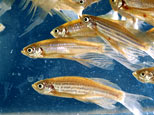
Scientists are studying insomniac zebra fish for clues about human sleep disorders


Most fish do sleep, and as with humans, they don't always get the shut-eye they'd like। A new study shows pet zebrafish can become insomniacs—especially when scientists mess with their biology.


Common aquarium pets, zebrafish have no eyelids and so scientists have wondered whether the fish get any sleep. The new research, detailed in the Oct. 16 issue of the journal PLoS Biology, suggests the fish do indeed take naps and can experience sleepless nights.
The findings have implications for understanding human sleep problems. The neurological disorder narcolepsy affects about one in 2,000 people in the United States, plaguing them with excessive daytime sleepiness, interrupted nighttime sleep, bouts of muscle paralysis that cause a narcoleptic to collapse, and dream-like hallucinations during sleep.
In past research, Emmanuel Mignot, a professor of psychiatry and behavioral sciences at Stanford University, found that narcoleptic Dobermans and Labradors with a malfunctioning "hypocretin" brain receptor showed signs of narcolepsy similar to the symptoms in humans।


Mignot, lead author Tohei Yokogawa of Stanford and their colleagues monitored zebrafish in aquaria, finding when the little swimmers dozed off they drooped their tails and spent most of the night beneath the water's surface or at the bottom of their tanks.
Then they monitored the snooze patterns of normal zebrafish and mutant zebrafish that lacked functional hypocretin receptors.
Overall, snooze times for the mutant zebrafish decreased by 30 percent compared with the normal zebrafish. And when the mutants did finally drift off, they remained asleep only half as long as normal fish.
The researchers say zebrafish will provide a cheap and powerful animal model for studying sleep disorders।

Friday, October 12, 2007

The cool hot news: 70-yr-old builds Innovative eco-friendly air conditioner


It was a hot summer day this June, the electricity had gone off at M B Lal’s Saket home and, sweating profusely, the septuagenarian thought up his first ‘invention’: an ice-cooler.
“The electricity department said it would take four or five hours to restore power; I thought I was going to melt,” says Lal. At 78, with large spectacles, and a frail frame, Lal doesn’t look like the mad inventor that movies and cartoon would like us to believe. Yet, he has devised this way to keep his room cool, even when the rest of the city seethes under the post-summer heat and humidity. Toying with the idea since that June day, Lal invented his ice-cooled air-conditioner over the past fortnight.
“I can’t take the Delhi heat any more,” he says. “That day, I asked my wife to bring me a tub of water but, instead, she brought all the ice from the fridge. And the entire room cooled down.”
It was then, Lal says, that he decided to harness ice as a cooling agent। A retired journalist who worked with The Statesman in Delhi for 31 years, Lal has no experience in engineering or manufacturing, yet he had to think of a way in which air could be optimally cooled without melting all the ice at once. “At that time I was thinking about desert coolers, so I decided to create a method by which air would be forced through ice and cool it down.”

That’s when the neighbourhood carpenter stepped in. “We took a wooden box and created spiral grooves in it,” Lal says. “We later put metal foil on them and placed a metal box full of ice in it.” With the help of a small but powerful fan, the air was forced to move around the cold metal box, in a spiral dictated by the grooves. “By the time the fan pushed out the air it was actually cold.”
But his experimenting didn’t stop there, for Lal wanted to make his contraption even more efficient. So, with further assistance from the carpenter, Lal was able to change the ice-cooler to fit it smugly into a large plastic drum. Today, it stands proudly in his room, blowing cold air with a reassuring hum.
“Everything I used was locally available. Even the fan, which is very powerful, uses less than half the energy of a 60-watt bulb.” Put together, the ice cooler is able to quickly bring down temperature by around seven degrees centigrade, for Lal that difference is a lifesaver.
“Getting the ice is also not a problem. If you can’t freeze it yourself, you can buy it from vendors; there are plentiful of those everywhere.”
Although ‘snow breeze’, as he has dubbed the ice-cooler, can chill a room for almost six hours on eight kilogrammes of ice, Lal says it can be used all over the country with minimal electricity। A Gandhian, Lal doesn’t want to patent his ‘snow breeze’. “Anyone can make one of these coolers, and only if they do will we know how to improve it.” View the video at Videos of blue waters