Showing posts with label Sea Squirt. Show all posts

Monday, May 31, 2010

Palaeontologists Solve Mystery of 500 Million-Year-Old Squid-Like Carnivore


A study by researchers at the University of Toronto and the Royal Ontario Museum sheds new light on a previously unclassifiable 500 million-year-old squid-like carnivore known as Nectocaris pteryx.

"We think that this extremely rare creature is an early ancestor of squids, octopuses, and other cephalopods," says Martin Smith of U of T's Department of Ecology and Evolutionary Biology (EEB) and the Department of Natural History at the ROM. "This is significant because it means that primitive cephalopods were around much earlier than we thought, and offers a reinterpretation of the long-held origins of this important group of marine animals."

The new interpretation became possible with the discovery of 91 new fossils that were collected by the ROM from the famous Burgess Shale site (Yoho National Park) in the UNESCO World Heritage Canadian Rocky Mountain Parks, British Columbia over the past three decades, and examined by PhD student Martin Smith along with U of T EEB and Geology assistant professor and ROM palaeontologist Jean-Bernard Caron.

"Previously, all knowledge of Nectocaris came from a lone specimen described in 1976. Due to the ambiguous characteristics evident on that specimen, Nectocaris has remained unclassified until now," says Smith, lead author of the study published in Nature. "Our study reveals that Nectocaris is similar to known members of the modern cephalopod group, which includes squid, octopus, cuttlefish and the nautilus, as well as common fossils such as ammonites and belemnites, which are now extinct."

"We know very little about the relationships between the major groups of molluscs, and the early history of the group," says Smith. "Fossils like Nectocaris help us to map out how the groups alive today might be related, and how they evolved. This tells us something about how biodiversity originated in the past, and helps us to understand the rich tapestry of life today."

The new specimens, between two and five centimetres long, show that Nectocaris was kite-shaped and flattened from top to bottom, with large, stalked eyes and a long pair of grasping tentacles, which the researchers believe helped it to hunt for and consume prey. Smith and Caron further suggest that the creature swum using its large lateral fins, and, like modern cephalopods, probably used its nozzle-like funnel to accelerate by jet propulsion. "Some of the specimens' large gills were choked with mud, suggesting that the animals were fossilized after being caught in an underwater mud-flow," says Smith.

"Our findings mean that cephalopods originated 30 million years earlier than we thought, and much closer to the first appearance of complex animals in the 'Cambrian explosion'" says Smith. Nectocaris does not have a mineralized shell, a fact that surprised the scientists. "It's long been thought that cephalopods evolved in the Late Cambrian period, when gradual modifications to the shells of creeping, snail-like animals made them able to float. Nectocaris shows us that the first cephalopods actually started swimming without the aid of gas-filled shells. Shells evolved much later, probably in response to increased levels of competition and predation in the Late Cambrian."

"Modern cephalopods are very complex, with intricate organs and startling intelligence. We go from very simple pre-Cambrian life-forms to something as complex as a cephalopod in the geological blink of an eye, which illustrates just how quickly evolution can produce complexity."

Smith says Nectocaris proves that there are still surprises in the fossil record. "Fossils can only ever tell us a part of the story," he says. "Exceptional soft-bodied fossils such as Nectocaris, combined with advances in developmental and molecular biology, still have a lot to bring to the table, and I'm sure that they will continue to help to refine and replace our current hypotheses."

The findings are presented in a paper titled "Primitive soft-bodied cephalopods from the Cambrian," to be published May 27, 2010 in Nature. The study was partially funded by a Natural Sciences and Engineering Research Council of Canada Discovery Grant awarded to Caron and U of T fellowships to Smith.

The above story is reprinted (with editorial adaptations by ScienceDaily staff) from materials provided by University of Toronto.

Wednesday, March 03, 2010

Sea Squirt Offers Hope for Alzheimer's Sufferers


Alzheimer's disease affects an estimated 27 million people worldwide. It is the most common form of age-related dementia, possibly the most feared disease of old age. There is no cure, and the available drugs only help to relieve symptoms without slowing progression of the disease. One of the characteristic changes in the brains of Alzheimer's patients is the accumulation of plaques and tangles; currently, the best hope for curing or at least slowing the disease lies in developing drugs that target this buildup. Some drugs are already in clinical trials, but there is still a pressing need for more research, and for more and better drugs directed against both known and novel targets.


One of the big problems in rapidly screening potentially useful drugs has been the lack of a good model system in which Alzheimer's plaques and tangles appear quickly. However, Mike Virata and Bob Zeller, scientists working at San Diego State University, California, have come up with a new, and perhaps unlikely candidate; the humble sea squirt, Ciona intestinalis.
Sea squirts are tunicates, marine organisms protected by an outer hard tunic with a soft body inside. Adults spend their lives attached to one spot on underwater structures like the pilings of piers, sucking in water through one siphon, filtering out small plants to eat, and squirting the water back out through another siphon. However, as long ago as Darwin, it has been recognized that sea squirts may be our closest invertebrate relatives; in their immature, tadpole form, they resemble proper vertebrates, and they share about 80% of their genes with us.
Bob Zeller has been a fan of sea squirt tadpoles since starting work with them in the 1990s, when he helped develop a way of introducing foreign DNA into fertilized sea squirt eggs with almost 100% efficiency, opening the way for their use as model organisms. He and his colleague Mike Virata decided to see whether it would be possible to model Alzheimer's disease in the tiny animals, which share all the genes needed for the development of Alzheimer's plaques in humans.
Incredibly, dosing the sea squirt tadpoles with a mutant protein found in human families with hereditary Alzheimer's resulted in aggressive development of plaques in the tadpoles' brains in only a day, and these, along with the accompanying behavioral defects seen in the tadpoles, could be reversed by treating with an experimental anti-plaque forming drug. This is an important breakthrough, as all other invertebrates tested have been unable to process the plaque-forming protein, and vertebrates take months or years to make plaques. These exciting results make it a real possibility that sea squirts are an excellent model for testing new drugs in the fight against Alzheimer's disease.
The study is published in Volume 3 Issue 5/6 of the research journal, Disease Models & Mechanisms (DMM), http://dmm.biologists.org/, published by The Company of Biologists, a non-profit organisation based in Cambridge, UK.

Friday, January 29, 2010

Squid, Glowing Companions March in Genetic Harmony


Most humans are blissfully unaware that we owe our healthful existence to trillions of microbes that make their home in the nooks and crannies of the human body, primarily the gut.

During evolutionary history, humans and bacteria have forged a mutually beneficial coexistence that provides the microbes' room and board in exchange for an array of biochemical services that help support everything from the digestion of food to a robust immune system.

But the intimate details of the relationship -- how the cells of the host and the cells of the bacteria coexist and interact -- are murky. Now, however, with the help of a diminutive Pacific Ocean squid and the bioluminescent bacteria that colonize its light-emitting, predator-fooling organ, scientists may have found a key to how animal hosts and their microbial symbionts maintain a healthy, rhythmic coexistence.

In a study published the week of Jan. 18 in the Proceedings of the National Academy of Sciences, researchers led by Margaret McFall-Ngai and Edward Ruby, professors of medical microbiology and immunology at the University of Wisconsin-Madison, chart the genetic interplay of symbiosis, revealing a daily molecular choreography that may well be characteristic of higher animals, including humans. If true, the insight would have important practical implications for human and animal health, as similar events occur when our tissues are colonized by the germs that make us sick.

"Nobody has a good handle on how the balance between host and symbiont is achieved," notes McFall-Ngai.

The Wisconsin researchers have studied the symbiotic interplay between the tiny Hawaiian bobtail squid, a two-inch creature common to the warm waters of the Pacific, and a glowing bacterium, Vibrio fischeri, for more than 20 years. The microbe colonizes and powers the animal's light organ, which serves to confuse squid predators lurking in the ocean depths at night when the squid is most active.

The idea behind the new study, explains McFall-Ngai, was to document the daily genetic dialogue between the bacterial symbionts and host-squid cells. Using microarrays that reveal which genes of the partners in an interaction are turned on or off, the group led by McFall-Ngai and Ruby found a daily pattern of activity that seems to show how host and bacterium maintain a healthy and balanced relationship.

"We found it is an extremely dynamic interaction, a profound daily rhythm on the part of both partners," says McFall-Ngai.

Several years ago, the Wisconsin researchers discovered that each day at dawn the bobtail squid expels about 90 percent of the bacteria that colonize its light organ. It had also been noted that the intensity of the bacterium's bioluminescence waxed and waned, with the most light produced at night when the squid is most active and most vulnerable to predators.

The new PNAS study assessed at different times of day the genetic activity of the squid host cells that support the bacterial symbionts as well as the bacteria themselves.

"Just before dawn, the animal turns on the majority of the genes associated with the cytoskeleton," the internal scaffolding of cells, according to McFall-Ngai. A close look at the tissues using electron microscopy revealed that the structure of the tissue colonized by Vibrio fischeri was dramatically disrupted at that time, with portions of the host-squid membranes shed into the spaces that the bacteria colonize.

Similar cytoskeletal changes have previously been observed in human pathogenesis, for example, in the destruction of intestinal tissues by E. coli 0157, which occurs in contaminated hamburger.

In the case of the squid, just after dawn and following the daily expulsion of the symbionts, the animal shuts down the genes of the cytoskeleton. As the residual symbionts begin to repopulate the tissues, the squid's cells regain their highly organized daytime condition. In response to the released host membranes, the bacteria turn on all the genes and pathways associated with using those membranes as food. Once that nutrient supply is exhausted, the squid then provide the symbionts with complex sugars for sustenance.

The bacteria, says McFall-Ngai, seem to be cycling through different metabolic states in response to different food sources provided by the host. The details teased out of the squid and its bioluminescent bacterium, says McFall-Ngai, may be more generally applicable to animal-microbial associations: "It is quite likely that such daily rhythms on the maintenance of animal-bacterial symbioses are more universal than in just this little squid."

The study was supported by grants from the W.M. Keck Foundation, the National Institutes of Health and the National Science Foundation.


Saturday, January 02, 2010

Giant squid invasion threatens Calif. rockfish


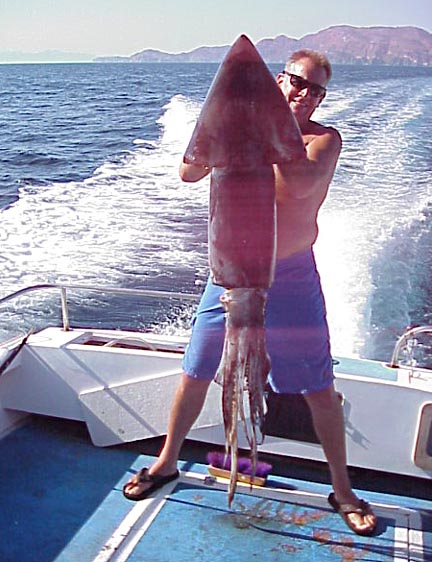
Like a horror show picture, giant squid seem to be invading the coast. From Fort Bragg to Monterey, giant Humboldt squid have shown up in massive numbers.

Every year, we see more giant cephalopods. The scary fact is that the squid are caught near the main habitat for deep-water rockfish.

"We have boated 5,500 squid this year, and the average is 40 pounds," reported Rick Powers, aboard the New Sea Angler in Bodega Bay.

Powers has seen squid up to 70 pounds this year, and he agrees that the number and size of squid are increasing. He has targeted the squid outside the Cordell Banks, which are a hotbed for protected rockfish. Most fishermen are worried that the rockfish will fall prey to the rapidly growing squid population.

In Half Moon Bay, Tom Mattusch, who runs the charter boat Huli Cat, encountered scary numbers of squid while on an experimental rockfish trip with the California Department of Fish and Game. While Mattusch fished for Chili Pepper rockfish, the squid tore the rockfish off the hooks so fast that the boat had to move from spot to spot to avoid them.

In past years, encounters with giant squid in these areas were almost nonexistent.

Recently, in Monterey Bay, squid have been caught along canyon edges in 1,000 feet of water.

Giant squid can be eaten if handled correctly, iced, cleaned and cooked properly, and most people enjoy them. There is no limit on giant squid, and there does not seem to be any worry at this point about overfishing. Some anglers hope a commercial fishery might be established to help reduce the numbers of squid.

"I will be running squid trips after the first of the year," reported "Captain Jimmy" Rubin from the Becky Ann.

On a happier note, though, crabs and sand dabs are still being caught.

Rubin has loaded up on Dungeness crabs. His most recent trip yielded 28 nice crabs for his passengers.

Meanwhile, Ken Stagnaro and the Velocity are running sand dab and whale-watching trips.

Gray whales are starting their southbound migration and are passing through the bay now. Trips for gray whales will last into May.

Finally, remember to get your new fishing licenses for 2010.

Mike Baxter has fished in the Monterey Bay Area since he was a boy and has been a licensed charter boat captain for more than 15 years. Contact him at
captmikebaxter@yahoo.com.

Wednesday, December 30, 2009

Squid Invasions Signal Changes in the Pacific Ocean


When large numbers of jumbo squid first showed up in California's Monterey Bay in 1997, scientists weren't sure what had brought the cephalopod that far north. An unusually strong El Niño event had warmed the eastern Pacific. But the squid, dubbed el diablo rojo – the red devil – in its native waters off the coast of Mexico, didn't typically venture farther north than Baja California.

nd indeed, within two years, the Humboldtsquid – Dosidicus gigas – had disappeared from central California waters.

But in 2002 – another El Niño year – they reappeared. This time, they took up permanent residence and pushed even farther north – past Oregon, Washington, and British Columbia, until, by 2004, fishermen near Sitka, Alaska, were hauling them in.

Tuesday, September 22, 2009

U.S. scientists net giant squid in Gulf of Mexico


U.S. scientists in the Gulf of Mexico unexpectedly netted a 19.5-foot (5.9-meter) giant squid off the coast of Louisiana, the Interior Department said on Monday, showing how little is known about life in the deep waters of the Gulf.Not since 1954, when a giant squid was found floating dead off the Mississippi Delta, has the rare species been spotted in the Gulf of Mexico.The squid, weighing in at 103 pounds (46.7 kg), was caught July 30 in a trawl net more than 1,500 feet underwater as it was pulled by a research vessel.The giant squid, which did not survive the rapid change in water depth when brought to the surface, was preserved and sent to the Smithsonian Institution's National Museum of Natural History for further study.Scientists aboard -- from the National Oceanic and Atmospheric Administration and the Interior Department's Minerals Management Service -- were participating in a pilot study on the diets of sperm whales."As the trawl net rose out of the water, I could see that we had something big in there ... really big," Anthony Martinez, a marine mammal scientist for the National Oceanic and Atmospheric Administration and the chief scientist on the research cruise, said in a statement.Remnants of giant squid have been found in the stomachs of its predators in the waters of the Gulf, Caribbean and Florida Keys so scientists were aware of their presence in the Gulf.The squid discovered by the researchers is significant because the species are difficult to catch, leaving much to be learned about them.Michael Vecchione, director of NOAA's Fisheries Service's National Systematics Laboratory, the squid was an important addition to the worldwide study of squids."This find illustrates how little we know about what is swimming around in the deep waters of the Gulf of Mexico," he said.Giant squid, which can be 40 feet long, are usually found in deep-water fisheries, such as off Spain and New Zealand."This is the first time one has actually been captured during scientific research in the Gulf of Mexico," he said.The joint NOAA-MMS pilot study responsible for the find is part of a two-year, $550,000 study to determine the abundance and diversity of the type of fish and squid that sperm whales seek as prey.

Monday, August 31, 2009

Ink found in Jurassic-era squid


The specimen is now in the British Geological Survey collection Palaeontologists have drawn with ink extracted from a preserved fossilised squid uncovered during a dig in Trowbridge, Wiltshire. The fossil, thought to be 150 million years old, was found when a rock was cracked open, revealing the one-inch-long black ink sac. A picture of the creature and its Latin name was drawn using its ink. Dr Phil Wilby of the British Geological Survey said it was an ancient creature similar to the modern-day squid. "The structure is similar to ink from a modern squid so we can write with it," he said. 'Medusa effect'The find was made at a site which was first excavated in Victorian times where thousands of Jurassic fossils with preserved soft tissues were found. Dr Wilby, who led the excavation, said: "We think that these creatures were swimming around during the Jurassic period and were turned to stone soon after death. It's called the Medusa effect." It is difficult to imagine how you can have something as soft and sloppy as an ink sac inside a rock that is 150 million years old Dr Phil Wilby Experts believe one possibility is that thousands of the creatures congregated in the area to mate before being poisoned by algae in the water. Remains of a different species of squid have also been found, suggesting the carcasses attracted predators to feed on them and they in turn also died. Dr Wilby said: "They can be dissected as if they are living animals, you can see the muscle fibres and cells. "It is difficult to imagine how you can have something as soft and sloppy as an ink sac fossilised in three dimension, still black, and inside a rock that is 150 million years old." The specimen is now in the British Geological Survey collection in Nottingham. Part of the ink sac has been sent to Yale University in America for more in-depth chemical analysis. BBC

Monday, August 03, 2009

Researcher Sheds Light On 'Man-eating' Squid


Researcher Sheds Light On 'Man-eating' Squid; Finds Them Timid, Non-threateningRecent news reports about scuba divers off San Diego being menaced by large numbers of Humboldt's or jumbo squid have raised the ire of University of Rhode Island biologist Brad Seibel. As a leading expert on the species who has dived with them several times, he calls the reports "alarmist" and says the squid's man-eating reputation is seriously overblown.For years Seibel has heard stories claiming that Humboldt squid will devour a dog in minutes and could kill or maim unsuspecting divers."Private dive companies in Mexico play up this myth by insisting that their customers wear body armor or dive in cages while diving in waters where the squid are found. Many also encourage the squid's aggressive behavior by chumming the waters. I didn't believe the hype, but there was still some doubt in my mind, so I was a little nervous getting into the water with them for the first time," Seibel said.Scuba diving at night in the surface waters of the Gulf of California in 2007, Seibel scanned the depths with his flashlight and saw the shadows of Humboldt squid far in the distance. After he got up his nerve, he turned off the light. When he turned it back on again 30 seconds later, he was surrounded by what seemed like hundreds of the squid, many just five or six feet away from him. Most were in the 3-4 foot size range, while larger ones were sometimes visible in deeper waters. But the light appeared to frighten them, and they immediately dashed off to the periphery.The URI researcher's dive was more than just a personal test. It was part of a scientific examination of the species some call "red devil" to learn more about their physiology, feeding behavior and swimming abilities.Humboldt squid feed in surface waters at night, then retreat to great depths during daylight hours. "They spend the day 300 meters deep where oxygen levels are very low," Seibel said. "We wanted to know how they deal with so little oxygen."Seibel said that while the squid are strong swimmers with a parrot-like beak that could inflict injury, man-eaters they are not. Unlike some large sharks that feed on large fish and marine mammals, jumbo squid use their numerous small, toothed suckers on their arms and tentacles to feed on small fish and plankton that are no more than a few centimeters in length.The highlight of Seibel's research cruise with colleagues from the Monterey Bay Aquarium Research Institute was diving with the impressive animals. Other divers participating were Lloyd Trueblood of URI, Steve Haddock of MBARI, and Alison Sweeney of the University of California, Santa Barbara.Seibel was surprised by the large number of squid he encountered, which made it easy to imagine how they could be potentially dangerous to anything swimming with them. Their large numbers also made Seibel somewhat pleased that they appeared frightened of his dive light. Yet he said the animals were also curious about other lights, like reflections off his metal equipment or a glow-in-the-dark tool that one squid briefly attacked."Based on the stories I had heard, I was expecting them to be very aggressive, so I was surprised at how timid they were. As soon as we turned on the lights, they were gone," he said. "I didn't get the sense that they saw the entire diver as a food item, but they were definitely going after pieces of our equipment."According to Seibel, there have been many active discussions among biologists and the dive community about the safety of diving with Humboldt squid. As a result of his experience, the URI scientist is preparing a formal report with his recommendations for safely diving with the squid, including suggestions to always carry a back-up dive light and to be tethered to a boat. Any time humans enter the habitat of a large animal, there is potential for dangerous interactions, he said, so divers should use caution."However, I want to spread the word that they aren't the aggressive man-eaters as they have been portrayed," Seibel said.University of Rhode Island

Thursday, July 16, 2009

Humboldt Squid


San Diego....An earthquake wasn't the only shock San Diego residents felt Saturday morning when dozens of dazed Humboldt squid washed up on La Jolla's sandy shores.The sea creatures measured up to four feet long and weighed around 40 pounds, appeared on the beach around 8:30 a.m. Pacific time — about an hour after a magnitude 4.0 earthquake shook the San Diego suburb.The earthquake was centered about 19 miles out to sea. It's still unclear whether it was the earthquake or the something lese that drove the huge Humboldt squid onto the beach.A spokesman for Scripps Institution of Oceanography said at this point they do not see a connection between the squid and the earthquake, but plan to look into it. The La Jolla Light's website reports that divers, Cynthia Velazquez and Roger Uzun of San Diego, armed with bright floodlights and a video camera, went searching for squid about 8:30 p.m. in 30-foot-deep water off La Jolla Shores on July 10. "They were already there waiting for us," said Velazquez, a veteran diver with extensive experience locally and in Mexico's Sea of Cortez. "At first there were about four of them, 4- to 5-feet long, and later there were probably like 10. They were very curious. They came right up to us: inches away from our faces," writes newspaper La Jolla Light.

Thursday, June 18, 2009

The cephalopods can hear you


Do Bigfin reef squid listen out for predatory whales?Octopus and squid can hear.The discovery resolves a century-long debate over whether cephalopods, the group of sea creatures that includes octopus, squid, cuttlefish and nautiluses, can hear sounds underwater. Compared to fish, octopus and squid do not appear to hear particularly well. But the fact they can hear raises the possibility that these intelligent animals may use sound to catch prey, communicate with one another or listen out for predators. The question of whether cephalopods can perceive sound has been controversial since the early 20th Century. Some experiments suggested that blind octopus seemed able to locate the sounds produced by boats or by tapping on the outside of a tank. But most cephalopods lack a gas-filled chamber, such as the swim bladders that fish can use to hear. That suggested they could not detect the pressure wave component of sound. However, sensory physiologist Hong Young Yan of the Taiwan National Academy of Science in Taipei, Taiwan suspected that octopus and squid might use another organ called the statocyst to register sound.An octopus's hearing is tuned to life on the seafloor The statocyst is a sac-like structure containing a mineralised mass and sensitive hairs. Fish also use it to detect sounds, and in previous research, Yan showed that prawns can use their statocysts to hear. "So we extended our work from prawns to cephalopods," says Yan. Yan's team tested the auditory capabilities of two species, the Common octopus Octopus vulgaris and the squid Sepioteuthis lessoniana, often called the Bigfin reef squid. They discovered that the octopus can hear sounds between 400Hz and 1000Hz. The squid can hear an wider range of sound from 400Hz to 1500Hz, they report in Comparative Biochemistry and Physiology, Part A. "That indicates that squid have a better hearing capability than the octopus," says Yan. "Interestingly though, both species hear best at a frequency of 600Hz." Yan's team had to overcome particular technical challenges to investigate the cephalopods' hearing ability. The usual way to prove that an organism can hear is to measure how its nervous system electrically responds to sound. But that can involve directly attaching electrodes to exposed nerves, an invasive procedure that could harm delicate cephalopods. So Yan invented a non-invasive method, which involves placing electrodes on an animal's body to measure the electrical activity in its brain. In this way, he could measure within just a couple of hours whether the brain of an octopus or squid responds to sound. Avoiding being eatenThe discovery could open up a new understanding of cephalopod behaviour. "The key question which I would like to investigate is what kind of sounds are they listening to?" says Yan. "Perhaps they listen to sound to evade predators and can eavesdrop to sounds made by their prey. Or, perhaps they even could make sounds to communicate among themselves." For example, because octopus or squid do not possess gas-filled chambers within their bodies, they cannot amplify sounds, limiting their hearing ability. But they can hear as well as invertebrates such as prawns, although less well than many species of fish and the toothed whales which often eat them.A Bigfin reef squid undergoes a non-invasive hearing test "Squid are heavily preyed upon by toothed whales including dolphins. So perhaps their hearing would aid them to avoid the pinging sounds made by dolphins," says Yan. He says the different abilities of the octopus and squid also reflect the environment they live in. The common octopus dwells on the seabed, which is covered by large rocks, boulders, coral reef and other features. In water, sounds above 1000Hz have a wavelength less than 1.5m. Such sound waves cannot in turn pass objects greater than 1.5m in size, and they get deflected, which could explain why the octopus doesn't need to hear them. Squid live in the open water where there are fewer obstacles, and therefore sounds pass uninterrupted over a greater frequency range.

Matt Walker Editor, Earth News

Sunday, January 11, 2009

Bizarre Reproductive Techniques Discovered For Deep-ocean Squid

Males that produce sperm packages that can penetrate deep into the skin. Females with bellies full of stored sperm. Males that seriously injure the females during mating. This is just a selection of the bizarre reproductive techniques that marine biologist Henk-Jan Hoving has discovered with different species of deep-ocean squid.
He will be awarded a PhD by the University of Groningen (Netherlands) on 19 December 2008.
‘Reproducing in the deep ocean is a real challenge’, says Hoving. The deep ocean is unbelievably huge – 80 percent of the seafloor lies at depths of two kilometres or more. It’s not easy to find a partner in that gigantic, pitch-black environment. So, once you find one, you have to seize the moment. Squids that live in the deep ocean have developed a wide range of fascinating reproductive techniques to this end.
Deep cuts
Hoving investigated the reproductive techniques of no fewer than ten different squids and related cuttlefish – from the twelve-metre long giant squid to a mini-squid of no more than twenty-five millimetres in length. Along the way he made a number of remarkable discoveries. Hoving: ‘Reproduction is no fun if you’re a squid. With one species, the Taningia danae, I discovered that the males give the females cuts of at least 5 centimetres deep in their necks with their beaks or hooks – they don’t have suction pads. They then insert their packets of sperm, also called spermatophores, into the cuts.’
Through the skin
With a different species, the Moroteuthis ingens, the spermatophores are introduced in a more peaceful way. ‘With this species the spermatophores penetrate the skin independently. They probably do that with the help of an enzyme-like substance that dissolves tissue.’ Hoving is the first to be able to prove that these sperm packets are able to penetrate the skin under their own steam. He discovered this when he experimentally placed spermatophores on the skin of just-caught individuals. His results are supported by an incident in Japan, where someone had to have an operation after eating squid to remove a spermatophore that lodged in his throat.
Sperm in reserve
When studying the mini-squid Heteroteuthis dispar, Hoving also made an extraordinary discovery. For the first time he found a squid that probably fertilizes its eggs internally. ‘The females have a pouch for storing sperm that is directly linked to the belly and the oviducts. This indicates that fertilization takes place within the body and not outside - which is more common for squid.’ Males fill the female’s pouch with a great deal of sperm. About three percent of the body weight of a female who has mated consists of stored sperm. This has a number of advantages. The females, who produce eggs over a long period, thus have a steady supply ‘in reserve’ which they can make use of. Another advantage is that when the pouch is full, no sperm from other males will fit.
Female characteristics
Hoving was also the first to discover male squid with female characteristics. ‘Usually, squid have separate sexes. There are no hermaphrodites, as with snails. But with one species, Ancistrocheirus lesueurii, some of the males turned out to have small glands that in females are involved in egg production. They also had significantly longer bodies than “normal” males.’ Hoving cannot explain this phenomenon. ‘It’s possible that it’s the result of hormones and hormone-like substances that end up in the surface water as a result of human action – for example use of the pill – and then sink down to the deep ocean. However, it may also be an alternative reproductive strategy and a way of getting closer to the females.’
Vulnerable ecosystem
Hoving’s research has produced a wealth of information about deep-ocean squid. ‘Previously, there was little known about these organisms. That was because they were very difficult to study. The deep ocean is very inaccessible. Diving to such depths is only possible with the help of advanced technology.’
In order to gain an understanding of the reproductive habits of squid he had to use dead individuals, which he got hold of in many inventive ways. ‘For example, I’ve joined scientific expeditions but have also used examples that were found in the 1960s and 1970s in the stomachs of commercially caught sperm whales.’ Hoving hopes that his research will contribute to sustainable exploitation of the deep ocean. ‘Fishing is taking place at deeper and deeper depths. The deep ocean is a very vulnerable ecosystem, however. We desperately need to learn more about this ecosystem.’
Adapted from materials provided by University of Groningen.

Friday, December 26, 2008

Ocean Acidification From Carbon Dioxide Emissions Will Cause Physiological Impairment To Jumbo Squid


The elevated carbon dioxide levels expected to be found in the world's oceans by 2100 will likely lead to physiological impairments of jumbo (or Humboldt) squid, according to research by two University of Rhode Island scientists.

The results of a study by Brad Seibel, URI assistant professor of biological sciences, and Rui Rosa, a former URI post-doctoral student now on the faculty at the University of Lisbon, Portugal, was recently reported in the Proceedings of the National Academy of Sciences.

The researchers subjected the squids (Dosidicus gigas) to elevated concentrations of CO2 equivalent to those likely to be found in the oceans in 100 years due to anthropogenic emissions. They found that the squid's routine oxygen consumption rate was reduced under these conditions, and their activity levels declined, presumably enough to have an effect on their feeding behavior.

Jumbo squid are an important predator in the eastern Pacific Ocean, and they are a large component of the diet of marine mammals, seabirds and fish.

According to Seibel, jumbo squid migrate between warm surface waters at night where CO2 levels are increasing and deeper waters during the daytime where oxygen levels are extremely low.

"Squids suppress their metabolism during their daytime foray into hypoxia, but they recover in well-oxygenated surface waters at night," he said. "If this low oxygen layer expands into shallower waters, the squids will be forced to retreat to even shallower depths to recover. However, warming temperatures and increasing CO2 levels may prevent this. The band of habitable depths during the night may become too narrow."

Carbon dioxide enters the ocean via passive diffusion from the atmosphere in a process called ocean acidification. This phenomenon has received considerable attention in recent years for its effects on calcifying organisms, such as corals and shelled mollusks, but the study by Seibel and Rosa is one of the first to show a direct physiological effect in a non-calcifying species.

The scientists speculate that the squids may eventually migrate to more northern climes where lower temperatures would reduce oxygen demand and relieve them from CO2 and oxygen stress. While it is possible, they say, that the squids could adjust their physiology over time to accommodate the changing environment, jumbo squids have among the highest oxygen demands of any animal on the planet and are thus fairly constrained in how they can respond.

"We believe it is the blood that is sensitive to high CO2 and low pH," Seibel said. "This sensitivity allows the squids to off-load oxygen more effectively to muscle tissues, but would prevent the squid from acquiring oxygen across the gills from seawater that is high in CO2."

While many other squid and octopus species have oxygen transport systems that are equally sensitive to pH, few have such high oxygen demand coupled with large body size and low environmental oxygen. Therefore the scientists believe that their study results should not be extrapolated to other marine animals.


Adapted from materials provided by University of Rhode Island, via EurekAlert!, a service of AAAS.

Tuesday, October 07, 2008

Invasive species is found on key shellfish habitat: eelgrass


Over the last 10 years, Mary Carman has documented how slimy sea squirts have invaded coastal New England, multiplying on rocks, docks, boat bottoms, moorings, and other hard surfaces. Their rubbery bodies create a nuisance and, perhaps more importantly, render some areas uninhabitable for native species of oysters, mussels, scallops, and other marine life.
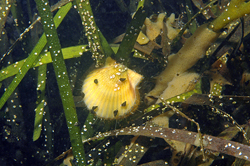
Until this summer, Carman had only rarely seen the creatures anchoring themselves to softer structures. So she did a double take when she spotted two sea squirts that she studies, known to scientists as Didemnum vexillum and Dipolsoma listerinum, clinging to acres of underwater eelgrass. The thick, waving meadows of eelgrass provide crucial nurseries for sea life, and are a prime habitat for prized shellfish—bay scallops.
Carman, a researcher at Woods Hole Oceanographic Institution, found sea squirts coating eelgrass in Sengekontacket Pond and Lake Tashmoo on Martha’s Vineyard, Mass. Under ordinary circumstances, juvenile scallops dangle from eelgrass blades like holiday ornaments, until they grow big enough to release their hold and then swim freely or rest in sediments. But in these spots at least, sea squirts were moving into the scallops' neighborhood.
Was this the first hint of a trend? Alarmed at the possibility, Carman contacted David Grunden, the shellfish constable in the island’s town of Oak Bluffs.
“We’re worried about it,” Grunden said. After seeing the sea squirts, he quickly agreed to partner with Carman to map their spread. “It’s a potential disaster if we find them growing on eelgrass in a large extent.”
(Mary Carman narrates a short video on her work mapping the spread of sea squirts that can have come from Europe and Asia and are crowding out native species of plants and animals. Watch the video »)
Clam copsMartha’s Vineyard shellfish fisheries are so important to the resort island off Cape Cod that each town has a shellfish constable. Locals sometimes jokingly call them “clam cops” and “shellfish sheriffs, ” but jobs like Grunden’s are serious—looking after bay scallops, oysters, clams, and other marine life that live in one of the nation’s most productive shellfish regions.
Though small in size, coastal Massachusetts is one of the top 10 producers of shellfish in the United States. Bay scallops have been important to its residents since colonial times, when settlers picked the shellfish by hand at low tide. At peaks in the 1980s, the state harvest exceeded 1,200 metric tons and was valued at $11 million. On Martha’s Vineyard, where people flock for summer vacations fueled by plates of fresh, garlic-and-butter-infused seafood, bay scallops remain ingrained in the island’s culture.
Since the 1980s, bay scallops—a species with a lifespan of just two years—have been in decline. Research suggests that an increase in nutrients (in the form of fertilizers and sewage from septic systems) that have flowed into coastal waters has spurred rampant growth of marine algae. This diminishes water quality and blankets the water surface, blocking sunlight from penetrating to eelgrass. An influx of sea squirts could make it even harder for bay scallop populations to survive.
One sunny Thursday morning before Labor Day weekend, Carman, Grunden, and several volunteers—including a concerned local fisherman, an underwater photographer, and Carman’s high-school-age daughter—motored into Major’s Cove in Sengekontacket Pond. Wearing snorkeling gear, they jumped overboard to find out just how much of the five-acre eelgrass meadow had been overtaken by sea squirts.
After diving about eight feet to the mucky bottom, Carman surfaced and gently spread several slender, bright green strands on the boat’s deck. Most of the blades were coated at least partially with sea squirts. They looked like rotten scrambled eggs and felt cold and slippery to the touch.
“Look how it is growing right next to the scallop,” she said, gesturing to a thumbnail-size shell attached to the plant. During the next two hours, she and the volunteers swam over the meadows, taking samples and marking locations using a handheld GPS unit.
“They are all the way to the beach, on both sides of the cove,” she said when she swam back to the boat. “They are definitely spreading. That’s not good.”
Sea squirt crusader Carman’s single-minded dedication to learning, and teaching others, about sea squirts began 10 years ago when she was a naturalist who coordinated youth education programs. To answer her students’ questions about the weird-looking, rubbery creature (which some kids called “alien vomit”), she began doing research. She quickly found no ready answers. Since then she has acquired grants and a place in the WHOI Geology and Geophysics Department.
Sea squirts feed on algae and bacteria, using one tube to suck in water and another tube to squirt it out (hence their name). They are tunicates, a name derived from a firm, rubbery outer covering called a “tunic.”
Of the nine types of sea squirts found on Cape Cod, six are invasive species introduced in the last 80 years from Asia and Europe. Carman’s research focuses on a species of the genus Didemnum, which forms dense mats from many small, linked individuals.
The creatures take over new areas in several ways, some traveling in from affected areas by clinging to boat bottoms or aquaculture gear, others by simply traveling from place to place by clinging to a piece of wood, a plastic bottle, or a blade of eelgrass.
“It’s a tremendous management challenge,” said James Carlton, a professor of marine sciences at Williams College in Connecticut. “We can tell the boater to scrub his boat bottom before he hauls it to new area, but how do you prevent grass with sea squirts clinging to it from rafting into new areas?”
On Martha’s Vineyard, with many connected waterways, Carman said it’s easy to imagine how easily they could move and settle into new areas.
“Everywhere I go on the Cape, I’m looking for them,” she said. Her daughter Mimi has been helping look for squirts since kindergarten. Now 16, she joins her mother on snorkeling excursions and can identify native and non-native sea squirts at a glance.
Growing concernOf their growth on Martha’s Vineyard, Carman said, “I’ve never see them in an open area like this and not to this extent.” In late September, she attended a workshop on aquatic invasive species where she confirmed with colleagues that Didemnum vexillum and Dipolsoma listerianum have not been previously documented growing on eelgrass. So far, Grunden said, sea squirts have not had a direct, negative impact on wild populations of bay scallops or on other shellfish that use eelgrass for habitat, such as oysters, quahogs, or clams. However, they are a nuisance to those in the aquaculture industry. They cling to aquaculture equipment, including cages used to encourage bay scallop spawning each year in several ponds on Martha’s Vineyard.
“Oyster farmers find Didemnum to be a pest species that impedes the flow of food and water, are time-consuming to remove, unsightly, and generally just a headache to deal with,” said Diane Murphy, who works with shellfish growers on Cape Cod and Martha’s Vineyard in her job with Cape Cod Cooperative Extension.
Fishermen also want to see less of them. Jeff Clements, a commercial shellfisherman in New England for 35 years, volunteered the use of his boat and time before Labor Day to help Carman’s research.
After toweling off in the boat, he said, “I’ve seen it over the years, but not in such quantities. It’s something I’m worried about.” —Amy E. NevalaFunding for Mary Carman's research came from the Sailors' Snug Harbor of Boston Foundation and the Link Foundation.

Thursday, August 28, 2008

New Zealand's colossal squid defies legends

New Zealand's mysterious colossal squid, the largest of the feared and legendary species ever caught, was not the T-Rex of the oceans but a lethargic blob, new research suggests. The 495 kilogramme (1,090-pound) female, accidently hauled in by a fishing boat in the Antarctic last year, was an overweight breeding machine, leading marine biologist Steve O'Shea told AFP Thursday.The colossal squid (Mesonychoteuthis hamiltoni), donated to the country's national museum, was probably quite docile when alive, said O'Shea."The colossal species has a reputation for being an aggressive and dangerous predator and have been feared and misrepresented in the past," O'Shea said."My research suggests they're not the T-rex of the sea, they get more docile as they mature, a strange phenomenon that has caught scientists off guard."We are looking at something verging on the incredibly bizarre. As she got older she got shorter and broader and was reduced to a giant gelatinous blob, carrying many thousands of eggs," he said."Her shape was likely to have affected her behaviour and ability to hunt. I can't imagine her jetting herself around in the water at any great speed, and she was too gelatinous to have been a fighting machine."It's likely she was just blobbing around the seabed carrying her brood of eggs, living on dead fish, while her mate was off hunting."The squid began to reveal its secrets to a team of fascinated scientists in April when it was thawed after being frozen on the fishing boat.They were struck initially by her beach ball-sized eyes, describing them as the biggest known in the animal kingdom.The enormous eyes would help the squid locate prey in the dark of its habitat 1,000 metres (3,300 feet) or more below the surface of Antarctic waters.Two long tentacles carry up to 25 rotating hooks each, while eight arms each contain up to 19 fixed hooks used to capture prey and bring it to the squid's beaked mouth.O'Shea and his colleagues believe larger squid still lurk in the southern ocean depths.The New Zealand squid's lower beak measures around 40 centimetres across, while other beaks have been found -- usually in the stomach of predator sperm whales -- measuring up to 49 centimetres.O'Shea said it is possible that colossal squid may grow to up to 750 kilograms but there was not yet enough information to be sure.The squid is expected to go on display in a special tank at Te Papa museum in Wellington later this year.She is believed to be the biggest complete adult of her species ever landed, and very little is known about the colossal squid because they live at extreme depths in Antarctic waters.But research suggests they have a penchant for tooth fish and are no strangers to cannibalism.

Friday, August 08, 2008

Little squirts' identity parade

Lift a rock at the low tide mark on any rocky beach in Northern Ireland and you'll find clumps of ascidians or sea squirts. These apparently unremarkable creatures all look very similar. Some will be translucent jelly-like fingers, some will be round blobs or even flat splodges, fastened to rocks or other solid objects. The big ones in particular have a habit of squirting out water when exposed to air and that's how they get their name. To the casual seaside visitor they are hard to tell apart. And that is why the Ulster Museum organised an international ascidian taxonomy workshop at Portaferry on Strangford Lough. For the best part of the week, they'll be examining local species and sharing their skills and experiences. Sea squirts are filter feeders - they suck in and squirt out the passing sea water and from it they get the small planktons and particles they need to live. But they weren't always static and stuck to some immovable surface; sea squirts start like as tadpole-like larvae and swim about. When they reach the rock of their choosing, they attach themselves to it and start to metamorphose or change into their adult form. An international ascidian taxonomy workshop is taking place To do so they eat their brains. In effect it is like a tadpole turning into a frog - the tadpole's tail is absorbed back into its body. Sea squirt larvae have a nervous system or cerebral ganglion which they absorb into their general cell structure as they mature. Dr Clair Goodwin of the Ulster Museum, who helped organise the workshop, said: "Sea squirts are absolutely essential to the marine ecosystem and this workshop will be key in developing our knowledge of these little-known yet highly important creatures." It is not easy to tell one sea squirt from another and often the exact identification has to be carried out in a laboratory. And that is only possible if you know what you're looking for. So international and UK experts had joined the workshop to share their expertise. One of those is Gretchen Lambert from the University of Washington. She's been studying sea squirts around the world for 40 years.
And after a morning's examination at low tide on Strangford Lough she had good news for our local species. "The only sea squirts we've seen here, I'm happy to say, are native species," she said. "We've not found any invasive or non-native species here today. And that's all to the good. I hope it stays that way." But the threat isn't that far away. Further north along the coast an invasive ascidian - or styela clava, was found in Larne Lough. Having the experts check out Strangford Lough gives scientists a head start on tracking down any future aliens. And at least they'll know what they're looking for.

Friday, August 01, 2008

What Do Squid Hear? Scientists Learn How Sensitive The Translucent Animals Are To Noise

ScienceDaily (July 31, 2008) — The ocean is a noisy place. Although we don't hear much when we stick our heads underwater, the right instruments can reveal a symphony of sound. The noisemakers range from the low-frequency bass tones of a fish mating ritual to the roar of a motorboat. The study of how underwater animals hear is a growing topic in marine science, especially with regards to naval sonar and whales.

This summer at the MBL, zoologist T. Aran Mooney will be the first scientist to look at cephalopod hearing, using the squid, Loligo pealeii, as a model. To learn how sensitive the translucent animals are to noise, he is monitoring squid brain waves as they respond to various sounds, specifically the echolocation clicks of its main predators: the sperm whale, beaked whale, and dolphin. In addition to the brain wave experiments, he also plans to condition squid to avoid certain sounds.

"Sound is one of the most important cues for marine animals. Light doesn't travel well through the ocean. Sound does much better," says Mooney, who is a Grass Fellow at the MBL and beginning postdoctoral research at Woods Hole Oceanographic Institution this fall. He predicts that squid probably hear very low-frequency sounds, which means they pick up on fish tones and boat traffic. A better understanding of what these animals hear could reveal how human-induced noise affects cephalopods and how their auditory system evolved separately from that of fish.

Sharing the Grass Lab with Mooney are two other fellows investigating animal behavior. Keram Pfeiffer of the University of Marburg in Germany is training bees to respond to polarized light and Gwyneth M. Card of Caltech is recording how flies decide to initiate flight. They are among nine people to receive 2008 fellowships from the Grass Foundation to conduct summer research in neurobiology at the MBL.


Adapted from materials provided by Marine Biological Laboratory.


Thursday, April 26, 2007

Sea Squirt produce Regenerative Medicine


Findings described in a new study by Stanford scientists may be the first step toward a major revolution in human regenerative medicine -a future where advanced organ damage can be repaired by the body itself. In the May 2007 issue of The FASEB Journal, researchers show that a human evolutionary ancestor, the sea squirt, can correct abnormalities over a series of generations, suggesting that a similar regenerative process might be possible in people.


"We hope the mechanisms underlying this phenomenon will ultimately lead to new insights regarding the potential of cells and tissues to be reprogrammed and regenerate compromised organs in humans," said Ayelet Voskoboynik, Ph.D., of Stanford University and first author of the study.
Missing limbs, scarred hearts, broken spines, and wounded muscles always try to repair themselves, but often the result is invalidism or disease. Even some tumors try to revert to normal, but are unsuccessful. If the genetic sequence described in the sea squirt applies to humans, this study represents a major step for regenerative medicine.
The sea squirt is more closely related to humans than many would expect. It may appear similar to a sea sponge, worm, or plant, but it is actually not closely related to any of these organisms. Sea squirt larvae have primitive spinal cords, distinguishing them in the greater chain of life and on the evolutionary ladder. Specifically, sea squirts, like humans, belong to a group of animals called chordates (organisms with some level of spinal cord development), and many scientists believe that sea squirts approximate what the very first human chordate ancestor may have been like 550 million years ago.
By studying this modern day representative of our evolutionary ancestor, researchers are able to identify fundamental principles of complex processes, such as healing and organ regeneration, on which new treatments are based.
"The aim of biomedical science is to understand life so we can defend our bodies against injury, deformity, and disease. The ultimate medical treatment would be to change an abnormal organ or tissue back to its vibrant, normal state," said Gerald Weissmann, M.D., Editor-in-Chief of The FASEB Journal. "This study is a landmark in regenerative medicine; the Stanford group has accomplished the biological equivalent of turning a sow's ear into a silk purse and back again."
Note: This story has been adapted from a news release issued by Federation of American Societies for Experimental Biology.