Showing posts with label Seals. Show all posts

Tuesday, June 15, 2010

Harbor Seals' Whiskers as Good at Detecting Fish as Echolocating Dolphins, Researchers Find


When a hungry harbor seal sets off in pursuit of a fish diner, the animal has a secret weapon in its tracking arsenal: its whiskers. Detecting hydrodynamic trails in water with their sensitive whiskers, seals easily track passing fish even in the most turbid conditions. Wolf Hanke from the University of Rostock, Germany, explains that blindfolded seals can track passing mini-submarines for a distance of 40m before the wake peters out. However, the hydrodynamic trails left by subs are different from those produced by fish fins, so how long could a seal track a trail generated by a moving fin before the turbulence became too faint to follow?

Hanke and his colleagues published their discovery that the seals can pick up fin trails as long as 35 seconds after the fin passed by in The Journal of Experimental Biology.

PhD student Sven Wieskotten, together with Hanke, Guido Dehnhardt, Björn Mauck and Lars Miersch, decided to find out how 6-year-old Henry, a harbor seal living at the Marine Science Centre, Germany, would respond to aging hydrodynamic trails. Isolating a section of calm water in a subsurface enclosure, Wieskotten and Hanke covered Henry's eyes with a blindfold and trained him to poke his head into the Perspex box a few seconds after they had swept a small rubber fin through the still water. Then they trained Henry to indicate which direction he thought the fin had moved by rewarding him with a tasty fish snack whenever he was correct.

After two months of training, Henry was ready to tell the team which direction he thought the fin was moving. Guided only by his whiskers, the team allowed Henry to swim into the enclosure 5s after the fin swept through the water and was delighted when Henry successfully identified which direction the fin had moved with over 90% accuracy. Gradually increasing the length of the delay, Wieskotten and his colleagues were amazed that even after a 35-second delay Henry was able to tell them which direction the fin had passed with 70% accuracy. However, after a 40-second delay, Henry lost the trail.

Curious to find out more about the fin's decaying trail, the team added microscopic spheres to the water and filmed them as they swirled through a plane of laser light. Analysing the particles' movements, they found spinning vortices producing jets of water that were very similar to those found in genuine fish wakes. Also, the wake became more dispersed as it decayed, covering a width of 20 cm 5 seconds after the fin swept past and expanding to 50 cm 30 seconds later. And when the team filmed the wake's interaction with Henry's whiskers, they could see Henry twitch his head in the direction that the fin had moved within 0.5 second of the plume touching his whiskers. The wake only had to brush over the seal's whiskers for him to know which direction the fin had passed.

The team suspects that harbor seals sense the structure of the wake's vortices and jets to determine which direction a fin moved and is amazed that the animals can still detect a fin's motion over half a minute later. "A fish can cover tens and hundreds of meters in that time, so vibrissae [whiskers] compare well with the performance of whales and dolphins by echolocation," says Hanke.

Wieskotten, S., Dehnhardt, G., Mauck, B., Miersch, L. and Hanke, W. Hydrodynamic determination of the moving direction of an artificial fin by a harbour seal (Phoca vitulina). Journal of Experimental Biology, 2010; 213: 2194-2200

Monday, June 14, 2010

Seal whiskers sense faraway fish


Seals use their super-sensitive whiskers to track movements in the water Harbour seals may be able to detect fish up to 100m (328ft) away using only their whiskers, say scientists.

Researchers used an artificial fish in their experiment, to create a "trail" in the water that a seal could detect.

The described how a trained seal, named Henry, was able to indicate, with a twitch of its head, whether the fish moved to the right or to the left.

The team described the study in the Journal of Experimental Biology.

The seal wore a mask and headphones for the experiment The study was led by Wolf Hanke of the Marine Science Centre at the University of Rostock, Germany. He explained how the seal wore a blindfold and headphones during the experiment to ensure that it could only pick up sensations from the water with its whiskers.

"The animals are actually enthusiastic to wear the mask because it means play time and [food rewards]," explained Dr Hanke.

He and his colleagues carried out the experiment in an open-air pool in a zoo in Cologne.

"We had a small box in the pool to achieve calm water conditions," he explained. "The seal was trained to wait at a ball target and, when signalled, it entered the box."

Inside the box, the scientists created a trail with their artificial fish, which was essentially a rubber fin on a stick that created a trail similar to the swimming motion of a real fish.

They operated the fin from outside the box, moving it from left to right or from right to left. The seal responded to the movement by turning its head in the direction that the fin had moved.

The seal was able sense and indicate the direction in which the fin travelled up to 35 seconds after the movement had stopped.

"A fish can cover tens and hundreds of metres in that time, so whiskers compare well with the performance of whales and dolphins by echolocation," Dr Hanke explained.

He believes that seals may also be able to "analyse" the structure of a trail to "work out" more about its source.

He and his colleagues have already embarked on experiments using different shapes of fin to create different water disturbances.

"They seem to be able to discriminiate between different shapes, which might even mean they discriminate between different species of fish," he told BBC News.

"And we had a surprising result from an experiment with one seal following another," he said.

"The trail left by the first seal was two metres wide, and the second, following seal was able to stay right in the middle of it, so it seems they can analyse the internal structure of a trail."

The researchers are now embarking on experiments using live fish, to see how closely seals are able to follow their complex trajectory.
By Victoria Gill
Science reporter, BBC News

Wednesday, June 09, 2010

Seal Bulls in the Service of Science


"Gustavo" is an imposing bull always in search of the best feeding grounds. The elephant seal weighing 3 tons and measuring 4 metres in length belongs to a group of 14 animals that serve researchers of the Alfred Wegener Institute as scientific assistants since recently.

At the beginning of the Antarctic winter -- from mid-March to the end of April -- the mighty elephant seal bulls were tagged with state-of-the-art satellite transmitters at the Dallmann Laboratory on King George Island. In the coming months marine biologists Dr. Joachim Plötz and Dr. Horst Bornemann will follow (from their desks in Bremerhaven) where the animals migrate, where they find prey at what depth and under what oceanographic conditions the food supply is good in the Southern Ocean.

"We have just returned from the Antarctic Peninsula and still have fresh impressions of the incredible experience when you have numerous elephant seal bulls with their loud deep roar in front of you and imagine attaching a satellite transmitter the size of your palm to some of these huge creatures," Joachim Plötz describes a not entirely everyday situation even for the experienced seal researcher. Every year from March to April the males of the only reproduction colony of the Southern elephant seal in the Antarctic come to the South Shetland Islands, a group that also includes King George Island, for moulting. The scientists from the Alfred Wegener Institute for Polar and Marine Research in the Helmholtz Association took advantage of this narrow time window to furnish some of the animals with transmitters that operate using the satellite-aided ARGOS location system. Once moulting is over after three weeks, the bulls go back to their migratory life and do not return to land until six months later to mate with the females in the Antarctic spring.

During the annual migrations to their oceanic feeding grounds elephant seals cover thousands of kilometres. They dive down to depths of over 2000 metres and remain under water for periods of over an hour. When a seal with a transmitter dives, it collects data -- even under the ice -- and then appears on the surface again to breathe after some time. While it breathes fresh air, the recorded data package is sent to a satellite that passes on the signals received. With a little luck the transmitter will continuously transfer data for a year. When the next moulting takes place, the wonder of microelectronics developed by the Scottish Sea Mammal Research Unit will then fall off. Immediately after evaluation the measured data from this German-Argentinian-South African joint project will be made available to other world data centres via the Publishing Network for Geoscientific & Environmental Data (PANGAEA) at the Alfred Wegener Institute and used by various international cooperative scientific ventures.

During the extended travels through the Southern Ocean the transmitters not only send the geographic position and diving depth of the respective seal, but at the same time data on the temperature and salt concentration of the body of water through which the animal is swimming and thus important physical parameters from which, for example, conclusions can be drawn on the currents in the ocean. "Elephant seals mainly feed on fish and squid," Plötz's colleague Horst Bornemann explains why the researchers can draw conclusions regarding the spatial and temporal distribution of particularly productive zones in the Southern Ocean based on seal migrations. "They lead a nomadic life in the ice desert of the Antarctic Ocean and are always looking for regions with ample prey. Based on seasonal changes in the migration behaviour of seals, we thus obtain indications of when, where and at what depth exceptionally high numbers of fish and squid occur and with what oceanographic conditions a good supply of food correlates."

Even though the transmitters can hold out for a year, the data in the coming months are especially sought after. During this period the Antarctic winter prevails, the Southern Ocean is covered with ice and continuous measured data, particularly from the winter months, are rare. "Research vessels cannot yet sail continously in the Antarctic Ocean at this time. Our seals," say Plötz and Bornemann full of conviction, "are therefore genuine pioneers of research."

The above story is reprinted (with editorial adaptations by ScienceDaily staff) from materials provided by Helmholtz Association of German Research Centres.


Tuesday, March 23, 2010

Rare Hawaiian Monk Seal Brought to Marine Lab for Study and Treatment


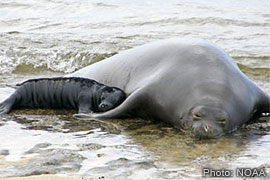
A young Hawaiian monk seal that was removed from the wild last year for treatment and rehabilitation is providing researchers at the University of California, Santa Cruz, with a rare opportunity to study the physiology of this critically endangered species.Ultimately, the information from these studies can be used to help monk seals in the wild, according to Terrie Williams, a professor of ecology and evolutionary biology at UC Santa Cruz, who is overseeing the research in coordination with the NOAA Fisheries Service's Marine Mammal Health and Stranding Response Program, the Marine Mammal Center in Sausalito, and other researchers."No one has ever had the opportunity to conduct these kinds of basic physiological studies with a tropical seal," she said. "The monk seal population is in trouble, and we hope that these studies will help us to better understand their habitat requirements."The seal--named Hô'ailona and also known by its field identification number, KP2--is currently being evaluated at UCSC's Long Marine Laboratory and may need eye surgery to treat cataracts in both eyes. Hô'ailona was abandoned by his mother a few days after his birth in May 2008. Rescued from a beach on the island of Kauai, he was cared for by scientists from the NOAA Fisheries Service and released back to the wild on the island of Molokai in December 2008.But Hô'ailona did not adapt well to life in the wild. Habituated to humans, he began hanging out at a popular wharf and interacting with people in the water and on the beach. Hô'ailona soon became a celebrity on Molokai, playing with and being fed by people instead of learning how to live as a wild monk seal. As he grew larger, his interactions with people began to pose a risk to his own welfare as well as to public safety.To address these concerns, NOAA officials removed Hô'ailona from the wild in November 2009 with the intention of relocating him to a remote area in the Hawaiian Islands where there are numerous seals for him to interact with and very few people. During a veterinary evaluation in preparation for his relocation, however, it was discovered that Hô'ailona had a degenerative eye condition that would seriously hamper his ability to care for himself in the wild. Therefore, NOAA officials decided that it was best for Hô'ailona to be kept under expert care and not released back into the wild.A team of marine mammal scientists and veterinarians from UCSC and elsewhere are currently evaluating Hô'ailona to assess his overall health and determine the appropriate treatment for his eyes. UCSC's Long Marine Laboratory is one of the leading marine mammal research centers in the world and has the facilities to do surgery on a marine mammal if that proves necessary. Such facilities are not available in Hawaii."We've created a little Hawaiian environment here by heating the water and putting a cover over the pool for protection from the wind and the elements," Williams said. "Hô'ailona is doing very well. He was a little thin when he arrived, but he's been rapidly putting on weight and is learning how to participate in our studies."Williams is particularly interested in conducting basic metabolic studies that will help researchers understand how much energy a monk seal has to expend to find food and thrive in different environments. In the controlled environment at Long Marine Lab, researchers can measure Hô'ailona's oxygen consumption and calculate how much energy he expends per swimming stroke. They can also study his responses to different water temperatures.This information, when combined with data from electronic tags that record the dives of wild monk seals, will enable researchers to evaluate the suitability of different habitats for wild seals. By counting the number of strokes an animal takes to hunt or dive, researchers can assign an energy "cost" to each of those activities."It's a powerful noninvasive tool that we have used to study Antarctic seals. Now we can use it to determine what it costs to be a monk seal living under tropical conditions," Williams said. "The goal is to use this information to guide sound management decisions for the conservation of monk seals based on the best available science."By studying Hô'ailona's responses to different water temperatures, Williams hopes to learn how sensitive monk seals are to changes in ocean temperature. This is important for understanding how vulnerable the species may be to climate change, she said.The current population of Hawaiian monk seals is only about 1,100, and their numbers have been declining at a rate of about 4 percent per year. Most of the population is in the Northwestern Hawaiian Islands, while a smaller subpopulation is found in the main Hawaiian Islands.The long-term plan for Hô'ailona is to return him to Hawaii to be kept at a facility where he can be seen by the public. Currently, Hô'ailona is not on public display at Long Marine Lab, where he is under quarantine to minimize the risk of disease or infection. Plans to return him to Hawaii would be jeopardized if he contracted an illness on the mainland.In the meantime, this rare Hawaiian monk seal is serving as an important scientific ambassador for his species, Williams said.

Wednesday, December 02, 2009

Whales save seal from orcas


There are plenty of stories of cetaceans saving humans. Indeed, Jonah was rescued by a whale when he was thrown overboard, and there have been tales of dolphins assisting swimmers in distress or shielding them from circling sharks.Killer whales, however — themselves a species of dolphin — didn't get their name for nothing. Early Basque whalers called them whale killers when they saw them attacking other whales. Hunting like a pack of wolves, orca know no fear. They'll tear the throats from grey whale calves, and have even been known to take chunks out of sperm whales — the largest predators that ever lived.But here's a sight to gladden the eye. Earlier this year, Californian scientists Robert L Pitman and John W Durban sailed to the Antarctic in search of killer whales. They were looking for a possible new species, known to hunt Weddell seals — one of the plumpest of the pinnipeds (the suborder that includes seals and sea lions) — by washing them off ice floes with their wake.That's what was happening here — until a group of humpback whales arrived on the scene. Unlike orca, which are odontocetes or toothed whales, humpbacks are mysticetes, harmless leviathans with only baleen plates in their mouths.Doubtless open-mouthed themselves, Pitman and Durban — along with a film crew from the BBC Natural History unit — watched as one seal, swept into the water by the orca, swam towards the humpbacks.As the killer whales moved in, the plucky pinniped leapt on to the vast ribbed belly of a humpback, and nestled in the animal's armpit. Not only that, but when a wave threatened to return the seal to danger, the humpback used its massive flipper (at five metres, the longest in the animal kingdom) to nudge it back on."Moments later the seal scrambled off and swam to the safety of a nearby ice floe," wrote the scientists. They believe the seal triggered a maternal defence mechanism in the humpbacks. Whatever the truth, it's a heartening tale. But spare a thought for the orca. They've got kids to feed, too.

Saturday, July 25, 2009

San Diego will seek lifting of seal removal order


The city of San Diego said Tuesday it will go to court to ask a state judge to lift an order requiring the immediate removal of a colony of federally protected harbor seals from a La Jolla cove.The announcement by City Attorney Jan Goldsmith was the latest development in an emotional and yearslong battle over who should have exclusive use of the protected cove - children or seals - in the posh seaside neighborhood of La Jolla.On Monday, a San Diego Superior Court judge ordered the city to begin chasing away the creatures from the cove, called the Children's Pool, by Thursday or face heavy fines in order to comply with a 2005 ruling in a lawsuit brought by a disgruntled swimmer.The city said it would blast recordings of barking dogs to scare away the pesky pinnipeds at the cost of $688,000 a year. San Diego cannot use force because the seals are a federally protected marine species.But just hours later, Gov. Arnold Schwarzenegger signed a bill that added a marine mammal park to the list of permissible uses for the Children's Pool - giving the city a legal tool that could allow the seals to stay put.Goldsmith said the city will go to court on the matter Thursday."It's like saying the seals in the zoo are a nuisance," he said.Children's Pool was created by a sea wall built in 1931 through a gift by philanthropist Ellen Browning Scripps. The state, which owns the cove, subsequently placed the beach in a trust and granted the trust to the city of San Diego. The trust lists several possible public uses for it, including a children's beach and a park.At a pro-seal rally Tuesday evening, a few dozen supporters lined the cove and shouted, "Take a stand, share the sand." Several dozen harbor seals lounged below them in the late afternoon sun.Supporter Jennifer Rogge, 43, who lives nearby, said she was horrified by efforts to remove the seals."We should let them have it," she said. "They've been having their babies on this beach now for 15 years. It's a little late now to start shooing them off when there's generations of pups that don't know any other place to go."Sukey Rice Ridgway, 65, who also lives nearby, said she remembered swimming in Children's Pool before the seals took over. She opposes their presence, even though she swam with the seals as a child."This was a beautiful pool and it was fabulous to swim down here and learn to snorkel and everything," she said. "It's unnatural now, it's man-made. It should not be for the seals."Goldsmith said litigation over the cove's use has cost San Diego millions of dollars and could drag on for many more years unless the newly worded bill is allowed to take precedent.Attorney Paul Kennerson, who represents the disgruntled swimmer, said Senate Bill 428 does not absolve the city of its responsibility to maintain the cove exclusively for the use of children.Thursday's hearing is scheduled just 90 minutes before the city's deadline to begin chasing the seals away.If the order is allowed to stand, Goldsmith said the city will be ready to begin removing the seals while simultaneously filing an emergency writ with California 4th District Court of Appeal.Attorneys representing pro-seal groups have also filed emergency legal papers in both federal and state courts.

Monday, July 06, 2009

Seal's close call with killer whale in Patagonia


A killer whale, or orca, narrowly missed out on catching a young seal off the coast of Patagonia.

An astonishing sequence of images showed the orca emerging from shallow icy waters towards the shore in an attempt to feed on the seal pup. Rob Lott , a photographer and conservationist, travelled to Patagonia to study and photograph the foraging behaviour of a pod of 18 orcas. "We spent a month watching this pod of 18 orcas near Ponte Note in Patagonia," he said. "Despite their numbers only seven of the Orcas have mastered the stranding behaviour where the orca enters the shallow surf to feed on seal pups. "On one occasion we spotted Mel, a 50 year-old who had previously been studied by David Attenborough in his "Trials of Life" documentary. We identified him due to his large two metre dorsal fin ad it was great to see him in action." Orcas are the largest member of the dolphin family. Growing to a length of up to 27 feet, adults weigh as much as 10 tons. They are known to be opportunistic feeders, preying on virtually any large marine animal. Aside from hunting in the waters, orcas are known to leave the water to grab seals and sea lions from the shore. "Seal pups are often born in January of each year and as they grow older they become more brave and courageous and head down towards the shallow surf," said Mr Lott. "Over the years the orcas have figured this out and it is not uncommon for the orcas to feed on the tiny seal pups. Mel is known to be an expert hunter and he will often take a seal from the shore before taking it back to the pod for feeding. "On this occasion, however, the pup got away, but it made for some spectacular images." Telegraph.co.uk

Saturday, June 20, 2009

Polar Bear And Walrus Populations In Trouble, Stock Assessment Report Suggests


The U.S. Fish and Wildlife Service has released reports documenting the status of polar bears and Pacific walrus in Alaska. The reports confirm that polar bears in Alaska are declining and that Pacific walrus are under threat. Both species are imperiled due to the loss of their sea-ice habitat due to global warming, oil and gas development, and unsustainable harvest.


“Polar bears and walrus are under severe threat, and unless we act rapidly to reduce greenhouse pollution and protect their habitat from oil development, we stand to lose both of these icons of the Arctic,” said Brendan Cumming, oceans program director at the Center for Biological Diversity.
The reports, issued pursuant to the Marine Mammal Protection Act, summarize information on population abundance and trends of polar bears and walrus, threats to the species, and include calculations of human-caused mortality and whether that mortality is sustainable.
There are two polar bear populations in Alaska: a Southern Beaufort Sea stock, which is shared with Canada, and a Chukchi/Bering Sea stock which is shared with Russia. The Pacific walrus occurs in the Bering and Chukchi seas and is shared with Russia.
For the Southern Beaufort Sea polar bear stock, the Fish and Wildlife Service estimated a minimum population of 1,397 bears and an annual human-caused mortality of 54 animals, well above the calculated sustainable rate of 22 animals per year. The stock assessment states that “the Southern Beaufort Sea population is now declining.”
For the Chukchi/Bering Sea polar bear stock, the Service estimated a minimum population of 2,000 bears and an annual human-caused mortality of 37 animals from Alaska and between 150-250 bears killed per year in Russia. The calculated sustainable rate of harvest is 30 animals per year. The stock assessment states that “the population is believed to be declining” and is “reduced based on harvest levels that were demonstrated to be unsustainable.”
For the Pacific walrus, the Service estimated a minimum population of 15,164 animals and an annual human-caused mortality of between 4,963 and 5,460 animals. The calculated sustainable rate of harvest is 607 animals per year.
Of the three population estimates, only the estimate for the well-studied Beaufort Sea polar bears is considered reliable. The Chukchi/Bering Sea polar bear population is based on incomplete data and could be an overestimate, while the walrus estimate is an underestimate as it only represents surveys in about half of the walrus habitat and does not account for walrus not counted because they were in the water rather than hauled out on ice.
“These reports publicly confirm what scientists have known for several years: Polar bear and walrus populations in Alaska are in trouble,” added Cummings. “And even if the population numbers are not precise, we know that without their sea-ice habitat they are likely doomed.”
The Marine Mammal Protection Act requires that the secretary of the interior and the secretary of commerce prepare stock assessments for marine mammals. The assessments are meant to be used as the basis for management decisions such as permitting the killing or harassment of the animals from commercial fisheries, oil and gas exploration, boating and shipping, and military exercises.
To ensure that decision-makers have the most accurate information, stock assessments are supposed to be revised every year for endangered marine mammals and every three years for other species. While the National Marine Fisheries Service – the agency responsible for whales, dolphins, and seals – has largely complied with this requirement, the Fish and Wildlife Service, responsible for polar bears, walrus, sea otters, and manatees, had completely ignored it.
In 2007 the Center sued the Wildlife Service and obtained a court order requiring the release of updated reports. Stock assessments for the Florida manatee were released last week, while sea otter reports were issued last year.
The polar bear is currently listed as threatened under the Endangered Species Act as a result of a petition and litigation by the Center for Biological Diversity. The Fish and Wildlife Service is under court order to make a finding on the Center’s petition to protect the Pacific walrus under the Endangered Species Act by September 10, 2009.
A copy of the stock assessments released June 18 can be found at http://alaska.fws.gov/fisheries/mmm/reports.htm
Adapted from materials provided by Center for Biological Diversity.

Friday, June 19, 2009

Canadian seal hunt 'collapsing'


The market price for a seal pelt has plummeted in recent years Canada's annual seal hunt has ended with only a quarter of the quota of seals being caught.The quota had been set at 273,000, but fishermen in Newfoundland and Labrador, eastern Canada, took some 70,000 seals. They blame plummeting prices for seal pelts and an impending European Union ban on seal products, which is expected to come into effect in October. Some local fishermen are wondering if this could be the beginning of the end for the centuries-old practice. Uphill battleMany hunters from fishing communities in eastern Canada, did not even bother taking their boats out for this year's seal hunt. The market price for a seal pelt is about $12, a steep decline from a peak of $100 a pelt a few years ago. The depressed value of the Russian Rouble and the subsequent erosion of one of Canada's largest markets for seal products, is partially to blame for the decline in numbers. China is another major customer, also reeling from the global recession. But it is clear that the prospect of a EU ban on seal products and growing international disdain for the hunt is becoming a major factor in its near collapse. The European Parliament passed the ban in May, but it still needs the backing of EU governments. That is expected to be a formality. Canadian fisheries officials admit that they have an uphill battle in what has become an emotional international debate. Animal rights groups have successfully campaigned for decades against the seal hunt. The annual kill has been a source of critical seasonal income for fishing communities already hit hard by dwindling fish stocks. By Lee Carter BBC News, Toronto

Friday, June 12, 2009

Hawaiian Islands named habitat for endangered seal


The federal government on Friday will significantly expand the critical habitat for endangered Hawaiian Monk Seals to include beaches and waters of the main Hawaiian Islands, officials said.Environmentalists say the added habitat is needed to reverse the plight of the Monk Seals, which are among the most endangered marine mammals in the world with fewer than 1,200 remaining.Previously, the critical habitat was limited to the remote and largely uninhabited Northwestern Hawaiian Islands, where it was first established in 1986.The enhanced designation means greater protection of seal habitat under the Endangered Species Act. It does not affect or restrict access to Hawaii's beaches or fishing. But the designation limits federal government activities, which must undergo reviews to ensure they do not harm the seal or the habitat.The announcement to be published Friday in the Federal Register is the result of a petition filed a year ago by the Center for Biological Diversity, KAHEA: The Hawaiian-Environmental Alliance, and Ocean Conservancy."It will give this species a fighting chance," said Vicki Cornish, wildlife policy director at Ocean Conservancy. "When we protect critical habitat for Monk Seals, we are also protecting the larger ocean ecosystem on which we all depend."Miyoko Sakashita, an attorney with the Center for Biological Diversity, said the seals are "teetering on the edge of extinction ... and the forces are against them with rising sea levels flooding their beaches, derelict fishing gear entangling them and foraging grounds running dry."She called the expanded protection "essential" for the recovery of the seals.Environmental groups point to the Caribbean Monk Seal as proof of what could happen to their Hawaiian relatives.A year ago, the National Oceanic Atmospheric Administration's Fisheries Service confirmed Caribbean Monk Seals were extinct. The seals once had a population of more than 250,000, but they became easy game for hunters because they often rested, gave birth or nursed their pups on beaches. The last confirmed sighting was in 1952.The Hawaiian Monk Seal population is declining at a rate of about 4 percent annually, according to NOAA. The agency predicts the population could fall below 1,000 in the next three to four years.When the numbers of any species fall to such small numbers, the population gets unstable and is more vulnerable to threats like disease."We cannot afford the extinction of a creature so sacred in Hawaiian culture and endemic to these islands," said Marti Townsend, KAHEA's program director. "And we cannot expect to save the seals without meaningfully protecting critical habitat."

Thursday, June 11, 2009

Unmanned Aircraft Helping Scientists Learn About Alaskan Ice Seals


NOAA's Fisheries Service scientists and their partners have launched an unmanned aircraft to mount the vehicle’s first search for ice seals at the southern edge of the Bering Sea pack ice during the Arctic spring, in an effort to learn more about these remotely located species.

On May 13, the NOAA research vessel McArthur II departed Kodiak, Alaska, and headed for the Bering Sea to launch the ScanEagle, an unmanned aircraft that is being used to collect images and video along the ice edge.

NOAA's Fisheries Service scientists from the Alaska Science Center’s National Marine Mammal Laboratory, in cooperation with the University of Alaska’s Cooperative Institute for Arctic Research, will use the images, taken during the month-long expedition, to evaluate whether unmanned aircraft could be useful for estimating the abundance and distribution of ice seals. In 2008, NOAA determined that ribbon seals should not be listed under the Endangered Species Act. NOAA was also petitioned to list spotted, bearded and ringed seals, and is gathering information and preparing status reviews for those species.

“The distributions of ice seals are broad and include areas very far from shore,” said Michael Cameron, NOAA's Fisheries Service’s lead scientist on the expedition. “Using traditional, manned aircraft to survey all of the sea ice habitat in Alaskan waters would be challenging, expensive and potentially dangerous. We hope that the ScanEagle will provide a safe and efficient way to collect information in this remote environment.”

The ScanEagle, owned and operated by the University of Alaska Fairbanks, weighs less than 27 pounds. When loaded with fuel and survey equipment it can fly for about 20 hours at a cruising speed between 48 and 75 knots.

The small aircraft is recovered through a modified "skyhook" system—a catch line, hung out over the water using a large deck crane, caught by airframe-mounted hooks on the ends of the ScanEagle wings.

“We tested the ScanEagle from two NOAA vessels, the Dyson and the McArthur II, in Puget Sound near Seattle,” said Robyn Angliss, deputy director of NOAA’s National Marine Mammal Laboratory. “It performed well and we expect the same in the far north.”

There are many potential applications of this technology in the North Pacific. In addition to surveys for ice seals and other easily visible marine mammals such as walrus, the system could potentially be used to study near surface oceanography, sea ice conditions and movements, and to collect information on atmospheric and weather conditions.

Collecting data on seals and sea ice will improve the agency’s understanding of seal habitat preferences and sensitivity to climate change.

Greg Walker and Don Hampton from the University of Alaska Fairbanks will be piloting their ScanEagle system from the McArthur II. Other key partners who have been pivotal in making this project successful are Insitu, the aircraft’s manufacturer, their subcontractor Evergreen, and the U.S. Navy.

NOAA understands and predicts changes in the Earth's environment, from the depths of the ocean to the surface of the sun, and conserves and manages our coastal and marine resources.


Adapted from materials provided by National Oceanic and Atmospheric Administration.


Thursday, May 21, 2009

Rare white seal caught on camera


The young elephant seal rests alongside another of normal colour (R Reisinger).A white southern elephant seal has been spotted on a sub-Antarctic beach.It is the first confirmed sighting of such an animal. Eared seals, which include sea lions and fur seals are more usually seen sporting unusual colours, but not true seals, a group which includes elephant seals. Details of the seal, which has creamy white fur but normal brown eyes and nose, have been published in the journal Polar Biology. "It's quite something in a species which is well-known," says Ryan Reisinger of the University of Pretoria in South Africa, one of the researchers who discovered the animal on Marion Island. For example, southern elephant seals from many colonies were hunted for decades within the nineteenth and twentieth centuries. In more recent times, scientists have also extensively studied the animals. "Yet this is the first confirmed case of leucism in the species," says Reisinger. The white seal, a young female, is leucistic, rather than albinistic. Albino animals lack pigment in just their eyes, or in their eyes, skin and hair, and they inherit the condition. Leucistic animals have little pigment and appear white all over, but with dark coloured eyes.White fur but normal brown eyes (R Reisinger). The white seal has a uniformly creamy white coat of fur, with normal dark brown eyes and nose. Its whiskers, eyebrows and fingernails on its flippers are also light coloured compared to the species' usual dark colour. "To our knowledge, we're the first to provided detailed evidence of such an animal anywhere," says Reisinger. The research team sighted the white seal on 23 August 2008 on Whale Bird beach on Marion Island, which lies in the sub-Antarctic region of the Indian Ocean. On 30 August, the researchers saw the seal again and got close enough to confirm its leucism, tag it and take a skin biopsy. They estimate the animal was between one and two years old, and was likely born either on nearby Prince Edward Island or further afield on Iles Crozet. Reisinger says it's impossible to say precisely how rare the animal is. "We can't put it in terms of one in a million, or one in a hundred thousand." But he and his colleagues have been monitoring and tagging elephant seals for years on the island without having seen one. While there have been a few rare previous records of lighter coloured elephant seals, none have been confirmed as leucestic.The young seal resting on Marion Island (R Reisinger). The researchers were actually on the look out for leucestic Antarctic fur seals when they spotted the white elephant seal. Antarctic fur seas are usually grey and brown, but numerous white Antarctic fur seals have been spotted before. Last year five unusually coloured Antarctic fur seals were seen on Livingston Island, including one partially leucistic pup that had fur like a tiger's stripes and another piebald individual, the first time such coat patterns have been seen. In February 2007, researchers also spotted the first known leucestic South American sea lion on the coast of Paso Shag, near the Magellan Strait in Chile.BBC

Wednesday, May 06, 2009

Fewer endangered Saimaa seal pups born this winter


Finnish conservation biologists said Tuesday fewer pups of the rare Saimaa seal were born this winter compared to 2008, a move which sparked the government to promise tighter fishing restrictions.Finland's biggest lake, Lake Saimaa in eastern Finland covers 4,400 square kilometres and is home to some 260 Saimaa seals, according to government figures from 2008.In this spring's seal cubs calculations only 43 cubs were found, which is eight less than a year ago said Metsaehallitus, the state agency, which looks after state-owned land and water areas."This is alarming because we had two warm winters with small number of pups and now we had another small age group. This will slow the growth of the population in the future," biologist Tero Sipilae from Metsaehallitus told AFP.The decline in the number of pups born may seem small, but up to 30 percent of the cubs die during their first year mainly because they get tangled up in fishing nets when they learn to swim and fish.The seals feature on the European Union's endangered species list as it has suffered from man's action such as pollution in the 1960's and nowadays from warmer winters and dangerous fishing equipment.Metsaehallitus data shows the seal population increased from 189 in 1990 to 280 in 2005, although that number fell to 260 last year.Environmental organisations such as the Finnish Association for Nature Conservation have criticised the government for not imposing tighter fishing restrictions in April-June in areas where seals live.The ministry of agriculture and forestry said it would start to prepare a ban on fishing nets in Saimaa and the law would come into force next year."We will soon present a change in the fishing law, which would enable banning fishing nets to protect the Saimaa seal," Sirkka Anttila, the minister of agriculture and forestry, said in a separate statement.

Friday, May 01, 2009

Arctic Council snubs EU as observer over seal dispute


The Arctic Council on Wednesday snubbed the EU, China, Italy and South Korea in their bid to become permanent observers on the council due to a row between Canada and the EU over the seal hunt.In a final declaration issued after the Arctic Council's ministerial meeting in the northern Norwegian town of Tromsoe, the eight members of the body "decided to continue discussing the role of observers in the Arctic Council."The seal hunt, an issue of particular importance to Canada, weighed heavily in the talks, members of several delegations said.The 27 member states of the European Union are preparing to ban products derived from the commercial seal hunt, especially furs, to protest against hunting methods which they consider cruel.The European Parliament is expected to vote on the ban in early May."Some European institutions have shown a lack of understanding with respect to the fundamental interests of Arctic people and states," Canadian Foreign Minister Lawrence Cannon told delegates Wednesday."I very much regret, therefore, that the European Parliament and Council (of European ministers) are currently considering an EU-wide ban on trade in seal products," he said."It is particularly disappointing that such a ban is being pursued despite clear evidence that the hunting of seals in Canada is sustainable, humane and well managed," he said.The Arctic Council is the only regional cooperation body in the Arctic, founded in 1996 and made up of eight members: Canada, Denmark, Finland, Iceland, Norway, Russia, Sweden and the United States.Britain, France, the Netherlands, Poland and Spain are permanent observers, while China, Italy, the EU and South Korea are ad hoc observers, meaning their presence at each meeting must be approved by member states.The next council meeting is due in 2011 in Denmark.Canada and Norway have threatened to submit complaints to the World Trade Organisation if the EU bans the import of seal-related products."Norway shares that view with Canada. But for Norway, that's yet another reason to invite the observers in," Norwegian Foreign Minister Jonas Gahr Stoere said.Canada is the biggest seal-hunting country with a quota of 338,000 this year. Norway has authorised the killing of 47,000 adult seals in 2009.Greenland, Iceland, Namibia, Russia and the United States also hunt seals.

Wednesday, April 29, 2009

Killer whales seal decline link


Killer whales could be partly responsible for the decline of Scotland's common seal population. A report by the Special Committee on Seals found numbers continue to fall in the Northern Isles, where the whales' predatory behaviour is increasing. The population is also in decline by as much as 50% in the Firth of Tay and has spread to Strathclyde. The study found competition for food from more stable grey seal population could also be a significant factor. The report revealed there are around 164,000 grey seals in Scotland, 44,000 more than previously thought. The study said this could be explained by improved research techniques, rather than a spurt in numbers. It estimated there are a minimum of 20,000 common seals, or harbour seals. This represents a decline of almost half in the Firth of Tay since 2000, between 40-50% in Orkney, and more than 40% in Shetland. The latest figures also show common seal numbers in Strathclyde are down by around 25%. Professor Ian Boyd, director of the Sea Mammal Research Unit (SMRU) at the University of St Andrews said: "We are getting mixed messages from our studies of seal populations. "On the one hand, we still have healthy populations of grey seals even though the increases of the 1990s are not being sustained. "On the other hand, the causes of the recent decline in the common seal population are not understood." Formidable animal A team of research scientists from Aberdeen University studied the behaviour and feeding habits of killer whales around Shetland over the last two summers. Andrew Foote, who led the study, said it appeared the killer whales were travelling over from Iceland during the common seal pupping season, from May to July, to feed. He said: "When we've been following the killer whales they seem as intent on grey seals as common seals, but grey seals are a more formidable animal and can it can take hours to kill them. "Nearly all the seals killed were pups, so I think naivety plays a part as they're more vulnerable." Mr Foote said the predatory behaviour by the killer whales could hamper the common seal population's recovery. He said measures to minimise the impact of man-made impacts, such as reducing the number of shooting licenses could help boost their number. Environment and Rural Affairs Secretary Richard Lochhead said the report could influence a review of legislation regarding seals, which is almost 40 years old. He said: "Our proposals will significantly increase protection for seals but allow for limited seal management for fisheries and fish farms under licence. "They recognise the need for increased protection in respect of declining common seal numbers but acknowledge the continuing need to defend fisheries and fish farms from seals."

Friday, April 24, 2009

Arctic fossil shows how seals went from land to sea


Scientists in Canada's Arctic have discovered the fossil of a previously unknown web-footed carnivore that helps explain how seals developed from land-based mammals, a member of the team said on Wednesday.The very primitive animal, measuring around 110 cm (43 inches) from nose to tail, had a body similar to that of an otter, with a skull more closely related to a seal.It lived in and around fresh water lakes about 20 million to 24 million years ago.The mammal, named Puijila darwin, could move easily on both land and water and is a member of the pinniped family, which groups seals, sea lions and walruses.The science team has dubbed it "a walking seal", although it is not the direct ancestor of any modern seal.The most primitive pinniped previously discovered was Enaliarctos, an animal that lived around the same time but was already fully flippered and had a streamlined marine body."It (Enaliarctos) doesn't tell us anything about how that lineage came to be. We know they came from land mammals," said Natalia Rybczynski of the Canadian Museum of Nature."Our animal fills that transitional gap between the land form and the marine flippered form we're familiar with today," she told Reuters in an interview.Details of the expedition will be published in the latest edition of Nature magazine.The team found the fossil in 2007 during an expedition on Devon Island in the Canadian Arctic territory of Nunavut. Unusually, it is about 65 percent complete.Puijila was a carnivorous mammal with large canine teeth, a short snout and a powerful jaw. It had an elongated streamlined body, webbed feet and a tail that enabled it to move through the water at speed.The team -- which hopes to return to the Arctic this year to continue the investigation -- is particularly interested in why and how the Puijila came to lose its long tail."Other mammals that went from land to sea, like whales and manatees, retained and made good use of their tails, (which) became propulsive structures. For some reason the pinniped lineage didn't do that, and now we know they had had the option ... they had the tail but didn't use it," said Rybczynski.Scientists had previously thought pinnipeds evolved from animals such as Enaliarctos, which lived along the western coast of North America and had gradually moved into the ocean."The idea hasn't been that there was this phase where they were living on the continent in streams and lakes. So that changes our idea about how these animals came to be," said Rybczynski. At the time, the Arctic was forested and much warmer than it is today.One explanation could be that Puijila gradually moved further south, or that the animal found in the Arctic had come originally from the west coast. Parallel evolution -- the same process taking place in another part of the world at the same time -- is also a theory, said Rybczynski."We do have this most primitive form that we're finding in the Arctic so we also must consider the hypothesis that the Arctic was a place where these things could have been deriving from as well," she said.

Otter-like fossil reveals early seal evolution

Scientists say they've found a "missing link" in the early evolution of seals and walruses — the skeleton of a web-footed, otter-like creature that was evolving away from a life on land.Those feet and other anatomical features show an early step on the way to developing flippers and other adaptations for a life in the sea, the scientists said.One expert called it "a fantastic discovery" that fills a crucial gap in the fossil record.The 23 million-year-old creature was not a direct ancestor of today's seals, sea lions and walruses, a group known collectively as pinnipeds. It's from a different branch. But it does show what an early direct ancestor looked like, said researcher Natalia Rybczynski.The fossil was found on Devon Island in the Canadian Arctic, bolstering the notion that the far north was an early center of pinniped evolution, she said.Rybczynski, a researcher at the Canadian Museum of Nature in Ottawa, and colleagues from the United States report the find in Thursday's issue of the journal Nature.They named the creature Puijila darwini ("pew-YEE-lah dar-WIN-eye"). That combines an Inuit word for "young sea mammal," often a seal, with an homage to Charles Darwin. The famed naturalist had written that a land animal "by occasionally hunting for food in shallow water, then in streams or lakes, might at last be converted into an animal so thoroughly aquatic as to brave the open ocean."Scientists already knew that pinnipeds evolved from land animals. But the earliest known fossil from that group already had flippers. So Puijila shows an earlier stage of evolution, the researchers said.Puijila measured about three feet from its snout to the tip of its long tail. It resembled a river otter but had a short snout, large eyes and a thinner tail, Rybczynski said. It could hunt on land or in water, where it was apparently "a pretty darned good swimmer," she said.The fossil was discovered in sediments of what had been a lake when the Arctic was much warmer, showing Puijila was at home in fresh water as well as on land. Besides eating fish, it probably ate rodents and ducks with dog-like teeth set in powerful jaws, Rybczynski said.Annalisa Berta, a biology professor at San Diego State University who wasn't involved in the work, welcomed the find."This is a fantastic discovery that fills a critical evolutionary gap (from) when terrestrial carnivores traded limbs for fins and moved from land to sea," she wrote in an e-mail.Apart from the poorly preserved ribs, researchers recovered about 65 percent of the skeleton. Berta said this completeness will help scientists sort out the order in which key pinniped features appeared.Puijila's fossilized remains were found in 2007 and 2008. Its Arctic location was "completely unexpected" because most scientists believed pinnipeds evolved on the west coast of North America, Rybczynski said. The discovery lends some credence to a hypothesis that the Arctic was an early center for these mammals' evolution, she said.Not all experts agreed. Maybe Puijila arrived in the Arctic from elsewhere, finding an area where its competitors could not survive, said Tom Demere, curator of paleontology at the San Diego Natural History Museum.He noted that an older fossil that the study authors consider a pinniped had been discovered in Mongolia. (That fossil included only head and jaw remnants and so its body features are not known).So the new evidence for Arctic evolution is "inconclusive at best," he said.But Demere, who didn't participate in the Nature paper, called the discovery exciting because it provides direct evidence for what early pinnipeds in the land-to-water transition looked like.

Thursday, April 16, 2009

Killing Time by Killing Seals


Live From the IceFollow HSI/Canada's Rebecca Aldworth as she documents Canada's commercial seal kill, and take action to end this bloody business»Posted 4:30 PM ESTI remember the first time I saw the seal slaughter. Standing on the ocean on a pan of ice, I watched in horror as sealers descended on helpless pups in front of me. I froze, mouthing the word "stop" over and over, to no avail. Clubs raised and fell in a sick rhythm, blood splattering the ice all around. >From the ice, the violence of the kills, the sounds of the clubs and crying seals, and the smell of the blood surround you. Your senses are overwhelmed—you can barely absorb what you are seeing, and it is everything you can do to point your camera, try to hold it steady, and shoot. But your proximity to the killing provides an illusion—no matter how baseless—of the power to intervene. >From the air, it's different. You hang, a thousand feet above the killing, watching hopelessly through a lens as sealers run toward unsuspecting pups. You call out for the pups to get into the water, knowing they cannot hear. You curse the sealers as they deliver yet another agonizing death to a helpless baby seal. But your distance from it all makes your helplessness devastatingly apparent. Only weeks ago, we stood on the ice floes in the Gulf of St. Lawrence, surrounded by life. Mother seals and their pups touched noses. Pups nursed, slept, and played on the ice. On Saturday, the ProtectSeals team filmed the deaths of these seals, and our only ammunition against the cruelty was our high powered camera. As our helicopter approached, we saw the shrimp and crab boats on the horizon, positioned to kill the seals. These fishermen are Canada's sealers. They are killing time by killing seals until the fisheries—which contribute virtually all of their incomes—are open.They are not marksmen. The bullets spray across the ice, missing the seals by feet, terrifying the pups. And then the bullets tear through flesh, and the seals die slowly as their blood spills across the ice. The northern Gulf is turned crimson as the seals' nursery is turned into a slaughterhouse. One seal was shot at in open water, over and over again as she tried to save her life, desperately thrashing around. But the bullets kept coming. They killed her in the end, and a sealer leaned over the side of the boat and stabbed her with a gaff to drag her onto the deck. An agonizing death for a seal whose life was worth only 15 Canadian dollars to a sealer.Another seal was shot and dragged across the ice, still moving. He was sliced open and tossed like garbage into a small boat, full of dead seals and blood. For minutes we filmed from the air, as the pup continued to move, sliding around in the blood-soaked pile of dead seals in the filthy bottom of this small vessel. Still another pup was shot and wounded, and he crawled into the water. The sealing boat came close, and a sealer leaned over the side with a gaff. He stabbed the pup through her chest and pulled her out. Even from hundreds of feet in the air, we could see the seal was crying out in pain. They dragged her on board the vessel and clubbed her on the deck, ready to slice off her skin. At the back of the boat, sealers tossed the carcasses into the ocean—the bodies hold no value to them. One seal slipped into the water after being shot on the ice, his blood spreading on the water's surface. The sealer ran over to fish around in the cold ocean with his club, but the mortally wounded seal was gone—just another statistic in this bloody slaughter. For weeks, we have born witness to the suffering of these seals. And despite the public relations efforts of the Canadian government, our footage clearly shows that Canada's commercial seal hunt is the same cruel, needless, and wasteful kill it has always been. At long last, the ProtectSeals team left this area yesterday, and we did so with the knowledge that our work has just begun. We must end this slaughter before it opens next spring, and we will work around the clock to achieve that goal.The good news is that we are very close to stopping the commercial seal hunt for good. Our campaign to close markets for seal products is succeeding and, as predicted, most fishermen are not bothering to kill the seals as a result. Tens of thousands of seals have already been spared this year because of the low prices for seal fur. All across the United States, people and businesses are using their purchasing power to stop the slaughter, refusing to buy Canadian seafood until the seal hunt is ended for good. Soon, sealers will make the logical choice and protect their primary source of income—seafood exports—by turning in their sealing licenses. We can win this, if we all work together. Thank you for standing with the ProtectSeals team throughout our expedition to document the Canadian seal hunt—I know you will be there as we work to put a final end to this cruelty in the coming year. Rebecca Aldworth is director of Humane Society International Canada (HSI Canada). For more than a decade, she has observed firsthand Canada's commercial seal hunt—escorting more than 100 scientists, parliamentarians and journalists to the ice floes to bear witness to the largest marine mammal slaughter on Earth.

Saturday, March 28, 2009

More than 19,000 seals culled in Canada


Sealers taking part in Canada's controversial yearly hunt have slaughtered some 19,411 seals so far this year, reaching their full kill-quota, fisheries officials said Thursday."It's been calm and orderly," said Phil Jenkins, a spokesman for Canada's fisheries and oceans department, describing the first leg of the annual commercial cull, which ended Wednesday.Some 350 Canadian sealers in 20 vessels and on the shores of the Magdalen Islands have taken part in the annual seal kill.Weather permitting, a small hunt of 1,500 animals around Cape Breton Island, Nova Scotia, will take place on Friday, Jenkins said.Otherwise, the commercial hunt would resume next month off the west coast of Canada's island Newfoundland province and near Quebec's lower northshore, targeting some 63,000 seals.Thereafter, the main hunt off the northeast coast of Newfoundland will kick off, said Jenkins. Some 188,600 seals are expected to be slaughtered during this phase.Canada is home to the world's largest annual commercial seal hunt. Harp seals also are hunted commercially off the coasts of Greenland, Norway, the United States, Namibia, Britain, Finland and Sweden.The seals are hunted mainly for their pelts, but also for meat and fat, which is used in beauty products.The Canadian hunt has been fiercely criticized by animal rights groups, who say it is cruel.The Canadian government countered that the 350-year-old hunt is crucial for some 6,000 North Atlantic fisherman who rely on the seal hunt for up to 35 percent of their total annual income.In April, the European parliament is to vote on a proposed prohibition on seal products that would ban products derived from seals from being imported, exported or even transported across the 27-member bloc.The measure still has to be approved by EU governments before it can be implemented.Ottawa has said it would fight any curbs on the international trade of seal products.

Friday, December 05, 2008

Harbour seals' decline 'alarming'


Drowning, not waving - harbour seal numbers have halved in some areas Harbour seals, or common seals, are familiar faces along coastlines across the northern hemisphere. But they are now vanishing in the UK at an alarming rate, warn scientists from St Andrews University. Numbers have halved in the hardest hit area, the Orkney Islands, since 2001 - falling almost 10% each year. There will soon be "no harbour seals left" in some areas if the mysterious decline continues, said Professor Ian Boyd, of the Sea Mammal Research Unit. Marine biologists are baffled by the disappearances and have begun investigating possible causes, which include illegal hunting and disease. We're worried that over the next 10 years, there will be no harbour seals left in their core area in Europe Professor Ian Boyd, St Andrews University"The change in numbers is well outside normal limits and the decline appears to be accelerating," said Professor Boyd. "We're worried that over the next 10 years, there will be no harbour seals left in the core area for the animals in Europe." The harbour seal (Phoca vitulina) is found in cold and temperate waters throughout much of the northern hemisphere. The UK is home to 40% of the European population. Also known as the common seal, they are a familiar sight around the UK's coasts - much more so than their more elusive cousin, the grey seal. However, the latest report shows dramatic decreases in the numbers around most of Scotland. Harbour seals are the most common seal species in the northern hemisphereWhen compared with figures from 2001, counts in 2007 showed drops of 56% in Orkney, 42% in Shetland and 30% in Strathclyde. Researchers have seen similarly worrying declines along the Scottish east coast, and along the North-East coast of England. "We really don't know what's behind this," Boyd admits. "It looks like the problems are likely to be complex and the decline in numbers is probably down to a combination of factors. "It could be a change in the ecosystem. We know that the grey seal is moving into harbour seal territory and this might be having an effect on the harbour seal. "But we don't really know the nature of the competition between the two species. We do know that both feed on sand eels, which are also in decline." Worrying trend The decline in harbour seals reflects a similar trend in North Sea marine life. There is no evidence so far that disease is responsible for the decline Puffin numbers have fallen 30% over the past five years, according to a recent study on the Isle of May, off Scotland's east coast, by scientists from the UK Centre for Ecology & Hydrology. And a decline in sand eels has been reported by the Fisheries Research Service, in Aberdeen. There is no evidence, so far, of any kind of parasite-mediated infection of harbour seals. Grey seal populations seem to be healthy, but Professor Boyd added that grey seals could be more robust than harbour seals, which seem to be more susceptible to disease. In 1988, an outbreak of phocine distemper virus (PDV) killed around 18,000 harbour seals in European waters, over half the population in some areas. Disappearing Act The population had recovered fully by 2002, when a second outbreak began, in which several thousand seals died. There is no cure or prevention for the disease. Common seal numbers are monitored annually in the UK, with funding from the Natural Environment Research Council, which published the results of the latest survey. NERC advises the UK government on the size and status of the British seal population under the Conservation of Seals Act, 1970. Some environmental groups want the Scottish government to use powers under the proposed marine bill for Scotland to legally protect harbour seals, by abolishing the Act. At the moment, it is legal to shoot harbour seals that come near fisheries.