Showing posts with label marine protection. Show all posts

Friday, February 12, 2010

Marine Protected Areas : A Solution for Saving the Penguin


Researchers from the Centre d'écologie fonctionnelle et évolutive (CNRS/Universités Montpellier 1, 2, 3/Montpellier SupAgro/CIRAD/EPHE) and the University of the Cape in South Africa (1) have shown that closing fishing zones in the ocean has a beneficial effect on Cape penguins, an endangered species endemic to Southern Africa, which feeds exclusively on fish.

This result comes from a unique experiment carried out by the researchers on two penguin colonies, with the collaboration of government authorities and the South African fishing industries.

These results are published on 10 February 2010 on the website of the journal Biology Letters.

The Cape penguin Spheniscus demersus (the only African penguin) is endangered as a result of the 60% decline in its worldwide population between 2001 and 2009. This decline can be attributed to a dearth of food, due to displacement of the banks of sardines and anchovies which these birds feed on. Competition with the fisheries which exploit the last remaining fish around the South African penguin colonies exacerbates the threat to the species. Faced with this crisis situation, and working with researchers and the South African fish industries, the South African governmental agency overseeing fisheries (Marine and Coastal Management) closed to fishing in January 2009 a 20-km radius ocean area around the largest Cape penguin colony (on the island of St Croix, Algoa Bay). A "witness" zone around another penguin colony (Bird Island), 50 km east of St Croix in the same bay, has remained open to fishing in order to enable researchers to compare penguin feeding behaviors.

The researchers studied the food-seeking behavior of 91 birds in these two colonies, thanks to GPS recorders, in 2008 and 2009, namely before and after the area was closed to fishing. The miniature recorders, in watertight hydrodynamic boxes, were attached to the feathers at the base of the birds' backs with adhesive. The goal was to record the latitude and longitude of the birds every minute, and the hydrostatic pressure (diving depth) every second. These data made it possible to calculate the effort each bird expended in searching for food, in terms of the length of time spent traveling, the distance covered, the number, depth and location of dives.

The results are striking: In 2008, before the area was closed to fishing, the St Croix penguins mainly fished (75% of dives) more than 20 km from their colony, covering up to 150 km in two days in their search for food. In 2009, on the other hand, only 3 months after the area had been closed to fishing, 70% of dives were less than 20 km away, within the protected marine area. The time devoted to searching for food also decreased by 30%, which reduced their daily energy expenditure by 40%. By way of comparison, the area within which the Bird Island penguins (the control colony) searched for food remained the same both years, with the penguins even expending more energy searching for food in 2009.

This experiment shows the immediate benefits of the creation of a Marine Protected Area for the preservation of an endangered top marine predator species. The study confirms the negative impact of industrial fishing on feeding conditions for African penguins and also demonstrates the crucial importance of Marine Protected Areas (2) on endangered species conservation. When appropriately defined, these areas can facilitate the restoration of ocean ecosystems (3) damaged by the combined effects of climate change and overfishing.

(1) Of the Percy FitzPatrick Institute of African Ornithology.

(2) The 1992 Rio convention stipulates that 10% of marine surfaces be protected. Nonetheless, only 0,8% of these surfaces is currently reserves. In this context, the creation of Marine Protected Areas (MPA) which help preserve marine predators which feed on mobile prey such as ocean fish, is urgent. This strategy is nonetheless controversial, as it is difficult, in open water, to clearly delimit PMAs which aim to preserve species as mobiles as superior predators and their prey. The general principle is that these reserves must be very large in order to encompass the vast habitats of marine predators; this makes it more difficult to set them up and manage them.

(3) Plankton, both phyto and zoo, fish (notably sardines and anchovies), all living organisms in the water column between the ocean surface and bottom and which play a central role in the marine ecosystem.

Tuesday, September 29, 2009

Sharks: New regulations proposed

Florida seeking to save its sharks Capt. Derrick Jacobsen, a Port Charlotte resident and owner of Florida Light Tackle Charters, remembers when, in the late 1980s, commercial shark fishing suddenly became popular.The jump in interest was traced to Asian markets, where shark fins are popular delicacies, according to Jacobsen and Florida Fish and Wildlife Conservation Commission spokesman Lee Schlesinger.During that time period, shark fins garnered $10 to $15 a pound, while the rest of the shark could be sold for 80 cents per pound, Jacobsen said.Jacobsen, 39, was among the commercial fishermen who started hunting for sharks. Unlike some, however, he and his family didn't just hack the fins off the sharks they caught and then throw them back into the water."We believed in selling the whole shark," said Jacobsen, a fourth-generation fisherman and guide.Protecting speciesBack then, Florida took the lead in protecting sharks from overfishing. Now the FWC is considering even more regulations designed to keep the shark population healthy.The proposed regulations would prohibit the harvesting of sandbar, silky and Caribbean sharpnose sharks from state waters. The FWC also is considering a 54-inch fork length minimum size limit for all sharks, excluding the Atlantic sharpnose, blacknose, bonnethead, finetooth and blacktip sharks and smooth dogfish. The proposed protections also call for limiting all shark catches to hook and lines, as well as using only circle hooks, rather than traditional J-shaped hooks. The circle hooks lessen the chances a fish will be gut-hooked.Wildlife staff will meet with anglers and other stakeholders to discuss other regulation options. Commissioners are scheduled to hold a final hearing about the new restrictions at their meeting in Clewiston Dec. 9 and 10.The fact the state is considering new regulations to protect sharks shouldn't be surprising, since Florida long has been a leader among Atlantic Coast states in enacting them. In 1992, for example, Florida wildlife officials recognized the pressure placed on shark species due to the growing market value of shark fins and popularity of shark fin soup, Schlesinger said. The 1992 restrictions called for a daily limit of one fish per person and a two-fish-per-vessel daily bag limit for all recreational and commercial harvesters. The state also established a prohibition on catching two dozen overfished or rare shark species.The state enacted those protections even though commercial shark fishing, Schlesinger said, was never a large industry in Florida, compared to other states.The federal government also has started moving to protect sharks. Since 2000, for example, a federal law prohibits "finning," or cutting fins off sharks and throwing them back into the water. That practice was a direct response to the Asian desire for fins, which were prepared by stringing them together on a rope to sun dry until they had the consistency of potato chips.Slow to reboundThose protections almost came too late. According to U.S. National Marine Fisheries statistics, in the early 1980s, commercial and recreational anglers harvested 400,000 to 600,000 large coastal shark species annually. But in 1988 and 1989, more than 20 million sharks were caught -- more than 10 million in each of those two years. Since the early 1990s, with the federal government and states instituting protections, the number of sharks caught has dropped. In 2001, the federal fisheries reported 282,000 shark catches.Florida Marine Institute researcher Brent Winner said 50 of the more than 350 shark species worldwide swim in Florida's offshore and coastal waters. The bull shark, common to Charlotte Harbor waters, he said, is the only species that can cross the "salt-freshwater barrier" and has been reported up the Mississippi River as far as St. Louis.Generally, Winner said, shark species are slow to reach sexual maturity; some of the larger coastal species take up to 10 or 15 years to mature.Sharks may give birth to as few as two pups, he said. The gestation period averages nine to 12 months, but the spiny dogfish takes 24 months to give birth. Many shark species average between six to eight pups per reproduction cycle. However, hammerheads and tiger sharks can give birth to large broods, as many as 50 or more pups, Winner said. Sharks also often skip reproduction cycles."With some species, decreases (in populations) will take decades to rebound," Winner said.The new regulations, if enacted, won't have much of an effect locally because commercial shark fishing was never a big industry in Charlotte County and its waters."We'd bring home six to 10 sharks (a week)," Jacobsen said, recalling how one day might be devoted to fishing short lines for sharks. "And there were only 5,000 licensed commercial fishermen in the entire state."Local recreational shark fishing, especially for hammerheads and other large species, doesn't compare to other areas, Jacobsen said. Out of 250 to 300 charters, he might have 10 anglers seeking to fish for sharks specifically. And those anglers who don't mind catching a few sharks prefer catching 2- to 4-foot blacktip and other sharks, rather than monster hammerheads or bull sharks. The majority of sharks are released back into the water.Boca Grande Pass offers premier tarpon fishing, but it is also a haven for large sharks that follow tarpon schools. In 2006, Bucky Dennis caught a world-record female hammerhead shark, more than 14 feet long and weighing more than 1,000 pounds. According to Sun reports, the shark was pregnant with 55 pups."It's a two-edge sword," said Capt. Mark Futch, secretary for the Boca Grande Fishing Guide Association. With light-tackle tarpon tournaments, the battle between man and fish takes longer than when heavier tackle is used. The tarpon end up exhausted, which makes them appealing prey for larger sharks. Futch said, "It's been wreaking devastation (on tarpon fishing)."But when it comes to conservation, Futch said the guide association supports preservation of the resources, including sharks.Futch could recall a Venice fishing club that traditionally came to Boca Grande years ago specifically to fish for sharks.Despite that, he said, shark fishing has never gained the popularity it has seen elsewhere. Most recreational anglers prefer to hook tarpon, snook, redfish, speckled sea trout and other fish species.sun herald

Thursday, September 03, 2009

Smalltooth sawfish protection could limit marinas, dredging in Southwest Florida


They are not cute and cuddly, but the smalltooth sawfish is getting more federal protection in Southwest Florida waters.The National Oceanic and Atmospheric Administration announced Monday that it is designating more than 840,000 acres of critical habitat between Charlotte Harbor and Florida Bay for the endangered marine fish.The designation, which takes effect Oct. 2, doesn't restrict fishing or boating access, but projects such as marinas or dredging must clear another federal permitting hurdle if they are proposed within the critical habitat boundary."Species such as the smalltooth sawfish have a much greater chance at recovery once critical habitat is designated," said Miyoko Sakashita, an attorney representing the Center for Biological Diversity in San Francisco.The group sued the federal government for missing a deadline to establish critical habitat for the smalltooth sawfish. A 2007 settlement resulted in the critical habitat designation.Scientists do not know how many smalltooth sawfish are left, but historic catch records show they once ranged from Texas to New York. South Florida is their last stronghold.In 2003, the animal named for its saw-like snout, or rostrum, became the first marine to be listed as an endangered species.A relative of sharks and rays, the smalltooth sawfish was overharvested as a curiosity. Its rostrum also makes it vulnerable to entanglement in fishing nets.The critical habitat designation seeks to protect the shallow estuaries that are important nursery grounds for juvenile sawfish and key to their survival, biologists say.The designation covers 221,000 acres in the Caloosahatchee River, San Carlos and Estero bays, Charlotte Harbor and Pine Island Sound and covers 619,000 acres in the Ten Thousand Islands south of Marco Island to Florida Bay.Shark researcher Patrick O'Donnell has caught 20 or so of the sharp-nosed creatures in the past 10 years."It doesn't surprise me, but it gets the whole crew excited that's for sure," said O'Donnell, an environmental specialist with the Rookery Bay National Estuary Research Reserve between Naples and Marco Island.Regulators drew the critical habitat boundaries to include red mangrove shorelines and waters less than 3 feet deep and marked by wide variations in salinity."We're going to try to protect these features and minimize the impacts to them," NOAA Fisheries smalltooth sawfish biologist Shelley Norton said.Without the designation, projects that need federal permits or get federal funding have needed only to prove that they would not jeopardize the continued existence of the smalltooth sawfish.For example, federal reviewers required a Sanibel Island dredging project to use a cut with side slopes to mimic natural conditions, Fort Myers marine engineer Hans Wilson said.Wilson, vice president of the Southwest Florida Marine Industry Association, said attorneys afraid of being sued by environmental groups have too large a role in permitting decisions."I'm not sure it's about biology," he said.It's too early to say how big a hurdle the critical habitat designation might pose, Florida Marine Contractors Association past president Mike Jones said."We don't really need another layer of regulation at this time and with the way that the economy is and all," Jones, a Fort Myers marine contractor, said.naplesnews.com

Tuesday, April 21, 2009

New Framework For Efficient Management Of Protected Marine Areas

An international team of scientists led by the University of Alicante has established a new conceptual framework which identifies the indicators of the fishing and tourist industry, evaluating the effectiveness of the Protected Marine Areas (PMA). The model applied to three marine zones reveals the existence of many deficiencies, due to legal loopholes and the lack of scientific information.The study, which was recently published in Ocean & Coastal Management, identifies, defines and debates the ecological and socioeconomic variables to establish indicators that evaluate the efficiency of the Protected Marine Areas (PMA). This new framework arises as a political response to conserve and restore fishing and marine biodiversity, since today less than 10% of these areas comply with objectives.¨This new model, which is an amplification of the previous one, assumes that human activity exerts pressure on nature and produces changes to the environment and economics to which society responds with actions,¨ explains Celia Ojeda to SINC, main author and researcher from the Department of Ocean Sciences and Applied Biology at the University of Alicante.The tool, which is based on the Driving Force, Pressure, State, Impact and Response (DPSIR) model, established by the Organización para la Cooperación y el Desarrollo Económico (Organization for Cooperation and Economic Development) (OCDE) in 1994, allows for evaluating all of the operation of a PMA. In order to verify if the management methods utilized in these protected areas yield the desired results, the scientists have established cause-effect relationships between the model's components.¨If a PMA is established in which it is permitted to fish with a fishing rod in all of its zones, but the biomass of the target species is decreasing, it is clear that the first management method does not work, and that it should be changed; for example, by limiting the zones or establishing a closed season,¨ indicates Ojeda.The conceptual framework developed reveals that the fishing industry has to be regulated and establish regulations for these zones. To this is added the increase in scuba divers, tourists and recreational boats attracted by the PMA's characteristics who also ¨should be regulated in order to conserve the environment¨.In order to define the ecological, fishing and social indicators, the researchers applied the model to three PMAs in Alicante: Tabarca, The Cape of San Antonio and Sierra Helada, and the isles of Benidorm.Researchers obtained 149 variables from fishing and tourism components. Measuring the effectiveness of a PMA would be more efficient if, for example, the number of fishing boats, the daily number of visitors, the quantity of organic material spilled into the ocean by recreational boats, the number of tons dumped into the ocean, the quantity of key species, the number of affected food chain categories, the changes in water quality, the total budget invested by governments in the areas, and the annual number of research projects, among others, were used as indicators.The model is framed by the EMPAFISH project, which studies the effectiveness of PMAs in different European countries. These areas have extended throughout the planet's oceans by 5.2% annually in the last two decades. Currently, close to 2.2 million km2 are protected, or 0.6% of oceans, and 1.5% of all marine areas under national jurisdiction.Although these areas reflect scientific and ethical concerns for health and the conservation of marine ecosystems, their populations and habitat are not always created for their ecological or socioeconomic characteristics, but rather for opportune human factors.

Thursday, April 09, 2009

Marine Protected Areas too small for whales and dolphins


Current Marine Protected Areas (MPAs) are too small to adequately serve whales and dolphins according to the Whale and Dolphin Conservation Society (WDCS). The international organization is calling for a global network of MPAs to save the ocean's most beloved inhabitants. "A worldwide effort must be made urgently to identify and define whale and dolphin critical habitats and hot spots," said WDCS Research Fellow, Erich Hoyt. "Then we need to map this information with other species and data to create networks of Marine Protected Areas (MPAs) in national waters and on the high seas. It is like creating a sort of worldwide web for whales and dolphins but connecting not just the animals, but the special places where they live, and the people there too." Whales migrate thousands of miles annually. In fact, the humpback whale holds the world record for the longest migration. Dolphins are wide-ranging and will follow food sources. According to WDCS, 40 percent of the 300 existing MPAs for marine mammals are too small to offer any protection to whales and dolphins. "Probably less than 1 percent of the world's marine mammal critical habitat has been identified much less protected," added Hoyt. "We have discussed strategies for cost-effective measures to attack this huge workload with surveys and other studies. Clearly the emphasis will need to be on rare and endangered species, but we also need to protect healthy populations so that they don't join the endangered ranks." WDCS made the statement last week at the first international conference on marine mammal protected areas held on the island of Maui Hawaii. The conference included over 200 marine mammal scientists, MPA managers and other experts from 40 countries.

Friday, June 27, 2008

Dry Tortugas Show Positive Trends: Protected Area Slowly Rebounding


A team of 38 research divers from the University of Miami (UM) Rosenstiel School of Marine and Atmospheric Science, NOAA Fisheries Service, the Florida Fish and Wildlife Conservation Commission, the National Park Service, REEF, and the University of North Carolina at Wilmington recently completed a successful 20-day biennial census to measure how the protected status of the Florida Keys National Marine Sanctuary's Tortugas Ecological Reserve and Dry Tortugas National Park's Research Natural Area are helping the regional ecosystem rebound from decades of overfishing and environmental changes.


The unprecedented collaboration allowed the team to complete more than 1,700 scientific dives, which will now help to further establish a baseline for the state of reef fish stocks and coral reef habitats in Florida's dynamic marine ecosystem.
According to Jerry Ault, Ph.D., professor of marine biology and fisheries at UM's Rosenstiel School and chief scientist on the cruise. "We are very encouraged to see that stocks have slowly begun to recuperate since the implementation of 'no-take' marine protected areas in the region. We noted particular improvements in the numbers of snapper, grouper, and coral recruits. We are currently crunching the data collected to see what adjustments may need to be made in order to help guide future management decisions to address the issues of biodiversity protection, restoration of ecological integrity, and fishery management which are critical to this area."
This year, the team documented changes in fish abundance and habitat quality in this region, which was hit by six major hurricanes since 2004. By statistically comparing this year's findings to previous survey information collected, scientists can determine what effects intense hurricane activity had on this marine environment.
The Dry Tortugas, a remote area about 70 miles to the west of Key West, Fla., is known for its extensive coral reefs, fish, sharks, lobsters and other marine life. In 2001, after an extensive designation process the Florida Keys National Marine Sanctuary implemented the Tortugas Ecological Reserve, consisting of 151 square nautical miles of protected marine habitat.
A complete report on the expedition is anticipated to be available in September 2008.
Dry tortugas research expedition
Preliminary Statistics or 2008 Mission
Total length of expedition = 20 days
Number of research divers = 38 total
Number of research dives or surveys = 1,710 -- a new record for the team
Types of dives = 1,245 RVC (reef fish visual census); 306 lobster; 80 coral-benthic - (plus another H 250 on NPS Vessel Fort Jefferson during the same time period)
Number of dives on which video was captured = 72
Dives broken out by entity = UMiami 541; NOAA 515; FWRI 461; NPS 63; REEF 76.
Average dives per day = 86
Cumulative total bottom time = 1,109.4 hours (or 46.2 24-hour days) underwater
Cubic feet of 36% Nitrox Gas = 2,691,740
Cumulative depth of dives = 18.91 miles or 99,876 feet undersea (equivalent to 1.53 times the distance from the depths of the Mariana's Trench to the top of Mount Everest)
Surveyed 336 primary sampling units (200 m x 200 m) classified grid cells
Coral reef habitat surveyed in the Dry Tortugas region = 229,348 square meters (m2)
Breakdown of area surveyed = Fish: 221,788 m2; Lobster 6,120 m2 ; Corals-benthic 1,440 m2
Total domain actually visited = 0.07% of the total
Statistical survey design achieved a coefficient of variation (CV ) of about 15% for population abundance estimates for about 280 species of fish.
Adapted from materials provided by University of Miami Rosenstiel School of Marine & Atmospheric Science, via EurekAlert!, a service of AAAS.

Thursday, February 28, 2008

World's Largest Marine Protected Area Created In Pacific Ocean


The small Pacific Island nation of Kiribati has become a global conservation leader by establishing the world's largest marine protected area – a California-sized ocean wilderness of pristine coral reefs and rich fish populations threatened by over-fishing and climate change।


The Phoenix Islands Protected Area (PIPA) conserves one of the Earth's last intact oceanic coral archipelago ecosystems, consisting of eight coral atolls and two submerged reef systems in a nearly uninhabited region of abundant marine and bird life. The 410,500-square-kilometer (158,453-square-mile) protected area also includes underwater mountains and other deep-sea habitat.
Kiribati first declared the creation of PIPA at the 2006 Conference of the Parties to the Convention on Biological Diversity in Brazil. On January 30, 2008, Kiribati adopted formal regulations for PIPA that more than doubled the original size to make it the largest marine protected area on Earth.
Kiribati and the New England Aquarium (NEAq) developed PIPA over several years of joint scientific research, with funding and technical assistance from Conservation International's (CI) Global Conservation Fund and Pacific Islands Program. The CI support for PIPA is part of the Coral Reef Initiative in the South Pacific (CRISP).
"Kiribati has taken an inspirational step in increasing the size of PIPA well beyond the original eight atolls and globally important seabird, fish and coral reef communities," said Greg Stone, the NEAq vice-president of global marine programs. "The new boundary includes extensive seamount and deep sea habitat, tuna spawning grounds, and as yet unsurveyed submerged reef systems."
Located near the equator in the Central Pacific between Hawaii and Fiji, the Phoenix Islands form an archipelago several hundred miles long. They are part of the Republic of Kiribati, which comprises three distinct island groups (Gilbert Islands, Phoenix Islands, and Line Islands) with a total of 33 islands to make it the largest atoll nation in the world.
"The creation of this amazing marine protected area by a small island nation in the Pacific represents a commitment of historic proportions; and all of this by a country that is under serious threat from sea-level rise attributed to global warming," said CI President Russell A। Mittermeier. "The Republic of Kiribati has now set a standard for other countries in the Pacific and elsewhere in the world. We are proud to be associated with this effort that helps the people of Kiribati, and we call on governments and private conservation groups everywhere to support Kiribati in its efforts and make similar commitments to protect their own natural systems."


Three NEAq-led research expeditions since 2000 found great marine biodiversity, including more than 120 species of coral and 520 species of fish, some new to science. Some of the most important seabird nesting populations in the Pacific, as well as healthy fish populations and the presence of sea turtles and other species, demonstrated the pristine nature of the area and its importance as a migration route.
Protecting the Phoenix Islands means restricting commercial fishing in the area, resulting in a loss of revenue that the Kiribati government would normally receive from issuing foreign commercial fishing licenses. NEAq and CI are helping Kiribati design an endowment system that will cover the core recurring management costs of PIPA and compensate the government for the foregone commercial fishing license revenues. The plan allows for subsistence fishing by resident communities and other sustainable economic development in designated zones of the protected area.
Keeping oceans and marine ecosystems intact and healthy allows them to better resist the impacts of climate change and continue their natural role of sequestering atmospheric carbon that causes global warming.
Adapted from materials provided by Conservation International.

Thursday, October 18, 2007

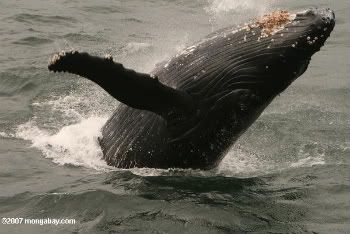
Programs protects Alaskan humpbacks


Visitors to Glacier Bay National Park and Preserve were in for a treat this summer: A record number of humpback whales were sighted either in Glacier Bay or in waters just outside the stunning marine wilderness in southeast Alaska।


The 3.3-million-acre park, with its wealth of whales, snowcapped mountains, tidewater glaciers and deep fiords, is increasingly popular with humans, too. Last year, the park welcomed 413,000 park visitors, 54,000 more than the previous year.
Chief park ranger Randy Larson said more visitors were expected this year.
The popularity of the park is testing measures updated this year to keep whales away from boat traffic. The vessel management program is working well, park officials say, with no whales reported struck by boats inside the park this summer.
Humpback whales, which can grow to 50 feet long and weigh more than 35 tons, were once hunted nearly to extinction. They have been listed as endangered under the Endangered Species Act for more than three decades, and have been protected internationally since 1966.
There are now an estimated 30,000 humpback whales worldwide, with between 6,000 and 8,000 in the North Pacific, according to the National Marine Fisheries Service.
An estimated 1,000 humpbacks are in northern southeast Alaska waters, although that number is believed to be low, said University of Alaska Southeast marine biologist Jan Straley.
They gather in summers in Glacier Bay to feed on schooling fish.
The North Pacific population is growing by up to 7 percent a year, Straley said.
It was a good summer for humpbacks in and near Glacier Bay. From early June to the end of August, 161 individual humpback whales were identified by their tail flukes, including 17 females with calves — more than in any previous year.
"It gets more and more gratifying all the time," said Chris Gabriele, a whale biologist at Glacier Bay। "We have mothers, grandmothers and great-grandmothers."


During the cruise ship season, thousands of visitors arrive each day in the park. This summer, two cruise ships were allowed in the park almost every day, increasing the number of cruise ship visits to 225, up from 206 in 2005.
The park, reachable only by plane or boat, also is popular with charter and recreational boaters. A limit of 36 vessels are allowed in the park each day.
There were no reports of boat strikes this summer, but fatal boat strikes do happen. In 2001, a 45-foot pregnant whale was found floating at the mouth of Glacier Bay. It was later determined the whale died of massive head injuries after being struck by a cruise ship.
In 2004, a young whale was found dead and beached. It also had blunt force trauma, and a boat strike was suspected, Gabriele said.
The vessel management program arose from the belief in the late 1970s that excessive boat noise was chasing the whales from the park. In those days, there were fewer than 20 whales in Glacier Bay, and less boat traffic.
Now, three to four dozen whales are in the park on any given summer day.
The vessel management program requires boat operators to attend a 20-minute orientation in which they view a film and talk to a ranger about how to safely navigate around the whales.
Another component of the program is to get boats to slow down: a study found whales were more likely to survive a collision when vessels were going less than 14 knots. Vessel operators also may be required to stay mid-channel because most humpbacks are found close to shore.
Vessel operators are also prohibited from coming within a one-quarter nautical mile of a humpback whale. The park had restrictions in place this summer from May to early October.
The National Park Service put observers aboard almost every cruise ship coming into Glacier Bay this summer to gather information on how close whales come to ships. The data will be used to assess the risk of a whale colliding with a ship.
The National Marine Fisheries Service, which has jurisdiction outside park boundaries, said so far this year there have been five confirmed reports of boats, most of them smaller boats, hitting whales.
Between 1978 and 2006, 62 large whales were struck by boats in Alaska. Forty-six were humpback whales and most were in the southeast, said Aleria Jensen, a fishery biologist and marine mammal stranding coordinator with NMFS.
In 2001, the agency adopted regulations prohibiting boats from coming within 100 yards of a whale and requiring operators to adopt a slow, safe speed. It is up to boat operators to determine what that speed should be.
"I think there is greater awareness in general in the maritime community about the risk," Jensen said.
One whale was found dead outside park waters this summer near Juneau. It had a grotesquely swollen tongue, leading observers to first suspect the whale may have died from a severe infection. A necropsy showed the animal more likely died of blunt force trauma.

Saturday, March 03, 2007

WWF launches marine protection campaign in the Southern Ocean

Southern Ocean, Antarctica – With the official launch of the International Polar Year today, WWF is looking to stop unsustainable fishing, marine pollution and climate change in the Southern Ocean.In particular, the global conservation organization wants to create a network of marine protected areas in the southern waters by 2012, including the Ross Sea near Antarctica.The Ross Sea is a physically and ecologically unique part of the Southern Ocean and home to many species including the colossal squid, the world’s largest invertebrate. “An ecologically coherent network of protected areas in the Southern Ocean will protect habitats and wildlife,” said Constance Johnson, Director of WWF’s Antarctic and Southern Oceans Programme. “It will increase the ocean’s resilience to climate change by lowering stress on the system, and enhance fisheries management by protecting spawning and nursery areas and providing refuges for exploited species.” Full story at

Tuesday, December 26, 2006

EU Environmental Ministers Agreed on Protection of Marine Environment

EU Environmental Ministers Agreed on Protection of Marine Environment

Tiistai 19.12.2006 08:03 Kauppalehti Online

PRESS RELEASE 18.12.2006

Ministry of the Environment

EU ENVIRONMENTAL MINISTERS AGREED ON PROTECTION OF MARINE ENVIRONMENT

The environment ministers of the European Union reached a political
agreement on the marine strategy directive. The directive aims to
achieve or maintain good environmental status in the marine
environment by year 2021.

"The directive is a major step in marine protection. Seas and oceans
have during the centuries been an important source of European well-
being. The deterioration of marine environment has caused great
concerns. It is our task to improve marine protection, also for the
sake of the future generations. The political agreement reached
today is an encouraging sign on that we will be able to bear our
responsibility", states Mr. Jan-Erik Enestam, Finland's Minister
of the Environment, President of the Council.

"I am very satisfied with the progress made and the result achieved.
The marine environment directive has been one of the Presidency
priorities. What makes the result even more valuable is that the
negotiation process was quite complex and many of the details remained
open until the very final stages. The Presidency has worked in a
determined and persistent manner to reach the goal", Mr. Enestam
stressed.

The directive establishes an integrated approach and common goals for
protection of the European marine environment. The marine problems
will be addressed in each marine region taking into account the
specificities of the region.

Full story at