Showing posts with label Octopus. Show all posts

Friday, March 05, 2010

A Convincing Mimic: Scientists Report Octopus Imitating Flounder in the Atlantic


On the open sand plains of the Caribbean seafloor, where soft-bodied animals are routinely exposed to predators, camouflage can be key to survival. Perhaps no group of animals is quite as adept at blending in with its surroundings as cephalopods, including cuttlefish and squid, which have evolved a unique skin system that can instantaneously change their appearance.


In the February 2010 issue of The Biological Bulletin, MBL Senior Scientist and cephalopod expert Roger Hanlon and his colleagues report the exceptional camouflage capabilities of the Atlantic longarm octopus, Macrotritopus defilippi, whose strategy for avoiding predators includes expertly disguising itself as a flounder. While Hanlon and others have documented two other species of octopuses imitating flounder in Indonesian waters, this is the first report of flounder mimicry by an Atlantic octopus, and only the fourth convincing case of mimicry for cephalopods.
Comparing still photographs and video footage from five Caribbean locations collected over the last decade, Hanlon and co-authors, MBL graduate students Anya Watson and Alexandra Barbosa, observed uncanny similarities between the small and delicate octopus and the peacock flounder, Bothus lunatus, one of the most common sand dwellers in the Caribbean. They compared not only coloration, which in each animal resembled the sandy seafloor, but swimming speed and form.
Just like flounder, the octopuses contoured their bodies to hug the wavy seafloor, tapering their arms behind them. They also swam with the same fits and starts as flounder at the same speeds. Interestingly, the octopuses mimicked flounder only when swimming, when movement would compromise their camouflage. How well the animals blended in with their background differed. The octopus showed more highly controlled and rapid skin patterning than the flounder, whose camouflage was slower and less precise.
"We were equally impressed with the remarkable camouflage of this small octopus species even when it was stationary yet entirely exposed on top of the open sand," says Hanlon. "The apparent match in pattern, color, brightness, and even 3-dimensional skin texture was noteworthy even when compared to other changeable cephalopods. They also demonstrated an unusual form of disruptive camouflage."
So why do Atlantic longarm octopuses choose to imitate flounder as a way to avoid the threat of predators? More study of cephalopod mimicry is needed, but a possible explanation, according to Hanlon and his team, could be that predators who could easily take a bite out of the small, soft octopus might find a rigid flatfish like the flounder too much of a mouthful and avoid them.
This research was supported by grants from the Sholley Foundation, Office of Naval Research, Our World-Underwater Scholarship Society, and Fundacao para a Ciencia e a Tecnologia, Portugal.

Hanlon, Roger T., Anya C. Watson, and Alexandra Barbosa. A mimic octopus: in the Atlantic: flatfish mimicry and camouflage by Macrotritopus defilippi. The Biological Bulletin, February 2010

Monday, February 22, 2010

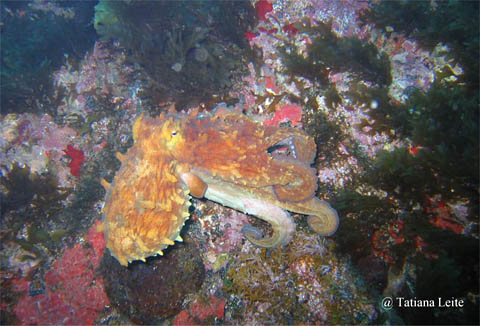
New Octopus


The medium-sized Octopus insularis was described based on material collected in shallow equatorial waters around the oceanic islands of Fernando de Noronha Archipelago, Rocas Atoll, St Peter and St Paul Archipelago, and the mainland of northeastern Brazil (Leite et al, 2008). This species is commercially important and accounts for a large percentage of octopus fisheries from Para (01o 28´N, 48o 29´W) to Bahia States (12o 56´N, 38o 31´W) in Brazil. This recently described species differs both morphologically and genetically from Octopus vulgaris in the Mediterranean, Venezuela and Southern Brazil. It has relatively short and stout arms, rugose reddish brown skin in preserved specimens, 8 to 11 gill lamellae on the outer demibranchs, small ligula, characteristic symmetrical radula, spermatophore and beak, small eggs and high fecundity (213000 oocytes under 1.5 mm diameter). The Octopus insularis diet in Fernando de Noronha Archipelago includes at least 55 species of crustaceans (70%), bivalves (17.5%) and gastropods (12.5 %); however, only 4 species accounted for half of the occurrences: the small crabs Pitho sp. (26.8%) and Mithrax forceps (23.9%), the bivalve Lima lima (5.3%) and the gastropod Pisania pusio (4.9%). The large proportion of two species of small crabs in den remains, the intense search for food during short hunting trips, and the intense use of cryptic body patterns during foraging trips, suggest that this species is a `time-minimizing` forager instead of a 'rate-maximizing’ one (Leite et al, 2009). Body colour of living animals in the environment varying from yellow to red-brown, usually cream-brown. The most common body patterns observed for this species were Mottle, Blotch, Dorsal Light-Ventral Blue-Green and Uniform Dark (Leite & Mather, 2008). It is found on reefs, bedrock, rubble, gravel and sand beds and rocky bottoms, regardless of the presence of algae, but never on sandy and muddy bottoms. Interestingly, Octopus insularis was the only octopus recorded in the minute St Peter and St Paul Archipelago (Leite & Haimovici, 2006). The low diversity of the Archipelago may be explained by its isolation, the small area of shallow water less than 50 m in depth (less than 0.5 km2) and poor diversity of habitats. It also suggests a higher adaptability of O. insularis to this environment when compared to other highly fecund tropical octopuses with small eggs. Futher studies, which are being carried out, may clarify this point.

Friday, December 18, 2009

Coconut-Carrying Octopus: Tool Use in an Invertebrate


Scientists once thought of tool use as a defining feature of humans. That's until examples of tool use came in from other primates, along with birds and an array of other mammals. Now, a report in the December 14th issue of Current Biology, a Cell Press publication, adds an octopus to the growing list of tool users.

The veined octopus under study manages a behavioral trick that the researchers call stilt walking. In it, the soft-bodied octopus spreads itself over stacked, upright coconut shell "bowls," makes its eight arms rigid, and raises the whole assembly to amble on eight "stilts" across the seafloor. The only benefit to the octopus's ungainly maneuver is to use the shells later as a shelter or lair, and that's what makes it wholly different from a hermit crab using the discarded shell of a snail.

"There is a fundamental difference between picking up a nearby object and putting it over your head as protection versus collecting, arranging, transporting (awkwardly), and assembling portable armor as required," said Mark Norman of the Museum Victoria in Australia.

Julian Finn, also of the Museum Victoria, said the initial discovery was completely serendipitous.

"While I have observed and videoed octopuses hiding in shells many times, I never expected to find an octopus that stacks multiple coconut shells and jogs across the seafloor carrying them," he said.

In recalling the first time that he saw this behavior, Finn added, "I could tell that the octopus, busy manipulating coconut shells, was up to something, but I never expected it would pick up the stacked shells and run away. It was an extremely comical sight -- I have never laughed so hard underwater."

After 500 diver hours spent "under the sea," the researchers observed the behavior of 20 veined octopuses. On four occasions, individuals traveled over considerable distances -- up to 20 meters -- while carrying stacked coconut shell halves beneath their body.

"Ultimately, the collection and use of objects by animals is likely to form a continuum stretching from insects to primates, with the definition of tools providing a perpetual opportunity for debate," the researchers concluded. "However, the discovery of this octopus tiptoeing across the sea floor with its prized coconut shells suggests that even marine invertebrates engage in behaviors that we once thought the preserve of humans."

The researchers include Julian K. Finn, Museum Victoria, in Melbourne, Australia, Zoology, La Trobe University, Bundoora, Australia, Tom Tregenza, University of Exeter, Cornwall Campus, Penryn, UK; and Mark D. Norman, Museum Victoria, in Melbourne, Australia.

Friday, April 17, 2009

All Octopuses Are Venomous


Researchers knew that the blue-ringed octopus packed venom. Now they say all octopuses and cuttlefish, and some squid are venomous. In fact they all share a common, ancient venomous ancestor, the study indicates, and the work suggests new avenues for drug discovery. While the blue-ringed octopus species remain the only group that are dangerous to humans, the other species have been quietly using their venom for predation, such as paralyzing a clam into opening its shell. "Venoms are toxic proteins with specialized functions such as paralyzing the nervous system" said Bryan Fry of the University of Melbourne. "We hope that by understanding the structure and mode of action of venom proteins we can benefit drug design for a range of conditions such as pain management, allergies and cancer." While many creatures have been examined as a basis for drug development, cephalopods (octopuses, cuttlefish and squid) remain an untapped resource and their venom may represent a unique class of compounds. Fry obtained tissue samples from cephalopods ranging from Hong Kong, the Coral Sea, the Great Barrier Reef and Antarctica. The team - scientists from the University of Brussels and Museum Victoria - then analyzed the genes for venom production from the different species and found that a venomous ancestor produced one set of venom proteins, but over time additional proteins were added to the chemical arsenal. The origin of these genes also sheds light on the fundamentals of evolution, presenting a prime example of convergent evolution where species independently develop similar traits. The team will now work on understanding why very different types of venomous animals seem to consistently settle on the similar venom protein composition, and which physical or chemical properties make them predisposed to be useful as toxin. "Not only will this allow us to understand how these animals have assembled their arsenals, but it will also allow us to better exploit them in the development of new drugs from venoms," Fry said. "It does not seem a coincidence that some of the same protein types have been recruited for use as toxins across the animal kingdom." The study was published in the Journal of Molecular Evolution and announced today

Thursday, March 19, 2009

Cretaceous Octopus With Ink And Suckers -- The World's Least Likely Fossils?


New finds of 95 million year old fossils reveal much earlier origins of modern octopuses. These are among the rarest and unlikeliest of fossils. The chances of an octopus corpse surviving long enough to be fossilized are so small that prior to this discovery only a single fossil species was known, and from fewer specimens than octopuses have legs.


Even if you have never encountered an octopus in the flesh, the eight arms, suckers, and sack-like body are almost as familiar a body-plan as the four legs, tail and head of cats and dogs. Unlike our vertebrate cousins, however, octopuses don't have a well-developed skeleton. And while this famously allows them to squeeze into spaces that a more robust animal could not, it does create problems for scientists interested in evolutionary history. When did octopuses acquire their characteristic body-plan, for example? Nobody really knows, because fossil octopuses are rarer than, well, pretty much any very rare thing you care to mention.
The body of an octopus is composed almost entirely of muscle and skin, and when an octopus dies, it quickly decays and liquefies into a slimy blob. After just a few days there will be nothing left at all. And that assumes that the fresh carcass is not consumed almost immediately by hungry scavengers. The result is that preservation of an octopus as a fossil is about as unlikely as finding a fossil sneeze, and none of the 200-300 species of octopus known today has ever been found in fossilized form. Until now, that is.
Palaeontologists have just identified three new species of fossil octopus discovered in Cretaceous rocks in Lebanon. The five specimens, described in the latest issue of the journal Palaeontology, are 95 million years old but, astonishingly, preserve the octopuses' eight arms with traces of muscles and those characteristic rows of suckers. Even traces of the ink and internal gills are present in some specimens. '
"These are sensational fossils, extraordinarily well preserved," says Dirk Fuchs of the Freie University Berlin, lead author of the report. But what surprised the scientists most was how similar the specimens are to modern octopus: "these things are 95 million years old, yet one of the fossils is almost indistinguishable from living species." This provides important evolutionary information. "The more primitive relatives of octopuses had fleshy fins along their bodies. The new fossils are so well preserved that they show, like living octopus, that they didn't have these structures." This pushes back the origins of modern octopus by tens of millions of years, and while this is scientifically significant, perhaps the most remarkable thing about these fossils is that they exist at all.
Journal reference:
Fuchs et al. New Octopods (Cephalopoda: Coleoidea) from the Late Cretaceous (Upper Cenomanian) of Hakel and Hadjoula, Lebanon. Palaeontology, 2009; 52 (1): 65 DOI: 10.1111/j.1475-4983.2008.00828.x
Adapted from materials provided by The Palaeontological Association, via EurekAlert!, a service of AAAS.

Tuesday, August 19, 2008

Octopuses more arms than legs

How many legs does an octopus have? The answer should be easy. But not any more. For new research suggests they are not really eight-legged denizens of the deep, as popularly assumed; instead they use their front limbs more like arms -- and can even tackle a Rubik's Cube.Octopuses use their back two limbs largely for propulsion and use the front six for a variety of tasks, with the front two doing most of the exploratory work, said Alex Gerard, the curator of the Sea Life centre in Brighton on the southern English coast.Some 16 Sea Life centre aquariums across Europe in Britain, Germany, Belgium, Finland, Ireland and the Netherlands studied their Giant Pacific, Common and Lesser Octopuses in coordinated tests."We've found that in all the tests, they do tend to favour particular limbs, which tends to give them a legs and arms sort of layout," Gerard told AFP Wednesday."Their front two tentacles will be used for a lot of exploratory work and then the ones immediately behind them will then be used also if further investigation is needed."Then the further back you go, the more the limbs are used for propulsion and movement."From what we've seen, all the limbs basically have the same capabilities. But they seem to favour this system and it works well for them."With live prey it does help them when sneaking up, with the front limbs ready to pounce and using the back ones for propulsion," he explained."They have that facility, unlike humans where if we tried to grab our food with our feet we might fail miserably."However, he does not believe octopuses -- named after the ancient Greek for eight footed -- will have to be give a new name."The name's pretty good and they would have to rename James Bond movies," he said.He added that though, like humans, some favour their left or right limbs more, "it just seems to be an individual preference".Gerard conducted tests on Popeye, a Lesser Octopus at the Brighton centre."Octopuses do have very strong personalities. They do develop their own favourite toys," he explained."My octopus hates the colour red -- that's quite a natural response in nature -- but he particularly likes yellow. We're starting to build a profile for different octopus," Gerard added.And during the tests, the octopuses got to play with some particularly challenging toys, namely Rubik's Cubes -- though none have managed to solve one yet."A happy octopus is one that's being constantly entertained," Gerard said. "We wanted objects that would withstand an octopus exploring it but would also stimulate them. Things that were colourful were helpful. "With a Giant Pacific Octopus, which is largest species in the world, it had ability to move sections of the Rubik's Cube." The results are expected to be finalised and published in scientific journals.

Tuesday, June 10, 2008

Persistent Man-made Chemical Pollutants Found In Deep-sea Octopods And Squids


New evidence that chemical contaminants are finding their way into the deep-sea food web has been found in deep-sea squids and octopods, including the strange-looking “vampire squid". These species are food for deep-diving toothed whales and other predators.


In a study to be published in the journal Marine Pollution Bulletin, Michael Vecchione of NOAA Fisheries’ National Systematics Laboratory and colleagues Michael Unger, Ellen Harvey and George Vadas at the Virginia Institute of Marine Science of The College of William and Mary report finding a variety of chemical contaminants in nine species of cephalopods, a class of organisms that includes octopods, squids, cuttlefishes and nautiluses.
“It was surprising to find measurable and sometimes high amounts of toxic pollutants in such a deep and remote environment,” Vecchione said. Among the chemicals detected were tributyltin (TBT), polychlorinated biphenyls (PCBs), brominated diphenyl ethers (BDEs), and dichlorodiphenyl-trichloroethane (DDT). They are known as persistent organic pollutants (POPs) because they don't degrade and persist in the environment for a very long time.
Cephalopods are important to the diet of cetaceans, a class of marine mammals which includes whales, dolphins and porpoises. Cephalopods are the primary food for 28 species of odontocetes, the sub-order of cetaceans that have teeth and include beaked, sperm, killer and beluga whales and narwhals as well as dolphins and porpoises.
Recent studies have reported the accumulation of POPs in the blubber and tissues of whales and other predatory marine mammals as well as in some deep-sea fish. Other investigators had speculated that the pollutants in marine mammals had resulted from feeding on contaminated squids. However, almost no information existed prior to this study about POPs in deep-sea cephalopods. Vecchione and colleagues wanted to see if whales had a unique capacity to accumulate pollutants or if they were simply one of the top predators in a contaminated deep-sea food web.
The researchers collected nine species of cephalopods from depths between 1,000 and 2,000 meters (about 3,300 to 6,600 feet) in 2003 in the western North Atlantic Ocean using a large mid-water trawl. Species were selected for chemical analysis based on their importance as prey and included the commercially important short-finned squid Illex illecebrosus, as well as cockatoo squid, “vampire squid”, and the large jelly-like octopus Haliphron atlanticus.
Twenty-two specimens were analyzed for a variety of contaminants. One of the chemical pollutants, TBT, is an additive used to control growth of organisms and is found in antifouling paints for boats, wood preservatives, and many other products. TBT is an endocrine disrupting compound and has been detected in whales and dolphins. It has been regulated worldwide since the late 1980s, but has been a concern because of its extreme toxicity to marine invertebrates in the coastal environment.
Other chemical contaminants found in the specimens include polycyclic aromatic hydrocarbons (PAHs), found in all the samples, diphenyl ether (DPE), polychlorinated biphenyls (PCBs), and brominated diphenyl ethers (BDEs). The researchers also detected DDT, a pesticide banned in the U.S. in the 1970s but still used on a limited basis in some parts of the world to control diseases like malaria.
PCBs are a class of human-produced compounds used to insulate electrical transformers and capacitors and in coatings, sealants, adhesives, paints, wood floor finishes, and even in carbonless copy paper. PCB production was banned in the U.S. in the 1970s. BDEs have been used as flame retardants in a variety of household products, from plastics to foam in furniture and fabrics.
“The cephalopod species we analyzed span a wide range of sizes and represent an important component of the oceanic food web,” Vecchione said. “The fact that we detected a variety of pollutants in specimens collected from more than 3,000 feet deep is evidence that human-produced chemicals are reaching remote areas of the open ocean, accumulating in prey species, and therefore available to higher levels of marine life. Contamination of the deep-sea food web is happening, and it is a real concern.”

Wednesday, March 05, 2008

Six-legged 'hexapus' claimed as world first in Britain

British marine experts have found what they claim is a world first -- a six-legged octopus, or "hexapus," whom they have christened Henry. The unique sea creature, which has two limbs fewer than a normal octopus, is believed to be the result of a birth defect rather than an accident, say his keepers at the Blackpool Sea Life Centre in northwest England."We've scoured the Internet and talked to lots of other aquariums and no-one has ever heard of another case of a six-legged octopus," said supervisor Carey Duckhouse.Henry was discovered in a lobster pot off the north Wales coast two weeks ago, and was one of eight creatures that Sea Life staff picked up from a local marine zoo there -- where staff hadn't noticed his missing legs.It was only when he attached himself to the inside of a glass tank that Sea Life staff noticed he was two limbs short of a full set. Octopuses are renowned for having three hearts and blue blood, but not usually six legs."He's a lovely little thing," said a spokeswoman, adding that he will go on display to the public later this month.

Wednesday, November 14, 2007

Octopus inspire new camouflage strategies for military Applications


Researchers are studying the remarkable shape- and color-changing abilities of the octopus and its close relatives in an effort to understand one of nature's most remarkable feats of camouflage and self-preservation।


Eventually, such knowledge could lead to new and improved camouflage strategies for military applications, according to an article scheduled for publication in Chemical & Engineering News.
In the article, C&EN associate editor Bethany Halford points out that cephalopods, which include octopus, squid, and cuttlefish, are experts in the art of camouflage and renowned for their ability to make themselves look like fish, rocks, coral and other objects in an effort to hide from predators.
By studying the various layers of skin of these creatures, particularly the chemicals in these layers that are behind their color transitions, scientists hope to develop similar camouflage strategies.
In the article, Halford describes the specialized skin cells involved in the creatures' color transformations, including the leucophore layer, which serves as a veritable base coat, another layer with chromatophores that are filled with pigments, and yet another layer sporting iridophores that reflect light in curious ways.
The journal article, "Hide and Seek: Cephalopod camouflage inspires materials research," is scheduled for publication November 12 in C&EN.
Adapted from materials provided by American Chemical Society.

Friday, October 19, 2007

Deep Sea Discoveries Off Canada's East Coast


Researchers from Fisheries and Oceans Canada and Memorial University of Newfoundland took part in an exciting survey of unexplored depths of the Atlantic Ocean during a three-week mission in July 2007। Deep water corals were a primary focus of the research.


Researchers onboard the Canadian Coast Guard Ship Hudson surveyed deep water animal life off the coasts of Nova Scotia and Newfoundland using an underwater robot known as ROPOS (Remotely Operated Platform for Ocean Science). With ROPOS, they collected samples and images at depths of 2,500 metres; and transmitted live underwater video footage to researchers at various land locations.
The mission revealed that life in these waters is much more diverse than previously realized. Researchers captured over 3,000 high quality photographs that displayed this diversity, including an octopus with large fins near its eyes, known as "Dumbo," a potentially new species of scallop, and a single-celled organism previously unknown in this region.
Research based on the mission’s findings will continue for the next year at the Bedford Institute of Oceanography in Dartmouth, Nova Scotia and its partner universities. The role of the newly discovered species in the marine food chain will be one of the prime areas of study; findings could also have implications for conservation efforts and medicine.
More images are available at http://www.dfo-mpo.gc.ca/media/infocus/2007/20070926/albumphoto_e.htm

Adapted from materials provided by Fisheries And Oceans Canada.

Thursday, June 28, 2007

Fishing for octopus on Indian Ocean isle

Wading through water up to her thighs, Marie-Claire Louis pauses and, one hand clutching a spear, studies the seaweed-covered rocks below her. Then she sinks both hands under the waves. She brings them up again, grappling with a large pink-grey octopus, her prey's dripping arms writhing and winding themselves around her wrists."The octopus is beautiful," the 34-year-old mother-of-four says. "But it is our food, so we have to kill it."On the tiny, hilly island of Rodrigues, some 560 km (350 miles) northeast of Mauritius in the Indian Ocean, the main employment opportunities are farming, tourism and fishing.Octopus fishing requires only a pair of tough-soled shoes, a spear and a keen eye to spot the eight-armed creatures which camouflage themselves with ease.Most octopus hunters are women, who traditionally earned extra income while their husbands were fishing on boats."It can poke one eye out of its den, or both, change color or even its shape," Louis says, with clear admiration for her prey. "I feel sad when I kill an octopus."As she scans the seafloor, the fisherwoman -- who learnt her trade from her mother some 22 years ago -- drags behind her two octopuses threaded on a fishing line, buoyed by a blue float.The octopus take a long time to die. Back on Rodrigues' volcanic beach, she turns their heads inside out and washes out the ink, all the time chatting with other fisherwomen.It is a hard life for Louis and her friends. Most octopus fisherwomen earn less than a dollar a day, one survey found, and many have no other income to support their families. And the stock of octopus is falling.SERIOUS DECLINELouis' husband Clarel sometimes gets work on the big fishing boats. But to find those jobs he has to travel to the Mauritian mainland, and he has not had any offers for a year now.Meanwhile, he helps his wife with her hunting and enjoys her octopus curry -- cooked over a smoking woodfire with onions, tomatoes and spices and washed down with rum.Their way of life is in serious decline. Octopus catch estimates fell by more than 60 percent to 285 tonnes in 2004 from 775 tonnes in 1994, according to official estimates.The octopus -- whose sex can be learned by looking at the third arm on its right -- produces around 1,000 eggs but gets just one chance to do so before dying a month or so later, aged about one year.The male octopus has a thicker tentacle, which he uses to insert sperm into the female at arm's length: some female octopuses have been seen eating their mates after reproduction. Most females die after the eggs have hatched."This rapid growth and production of a lot of young means they are very vulnerable to overfishing," said Emily Hardman, a marine conservationist with SHOALS Rodrigues, a non-governmental organization."But if they are protected, we hope they would be able to recover fairly quickly," she told Reuters. In nearby Madagascar, people saw large increases in octopus numbers just months after introducing fishing bans in some areas. But unable to afford school for all her children and now teaching one of her daughters to fish, Louis says she does not have time to wait for the octopus stock to recover. A year ago, she started selling elaborate and colorful cushion covers, stitched while sitting in the shade of her concrete home as goats munched the yellowing grass outside. Her handicrafts earn her about 600 rupees ($19) a month, more than the 350 rupees she makes from selling octopus. "We used to live off the octopus in the sea, but now we have nothing," says another fisherwoman, Violette Ravina, wearing a straw hat and cloth round her face to guard against the sun. "The poverty is hard, hard, hard."

Friday, December 22, 2006

Octopus Study Shows Way to Save Fish Stocks

Octopus Study Shows Way to Save Fish Stocks
KENYA: December 19, 2006

NAIROBI - Protecting marine areas for even relatively brief periods can
significantly restore depleted fish stocks, scientists said on Monday,
citing a study of octopus catches in Madagascar.

The researchers found that after an area off the coast of the Indian Ocean
island nation was closed to fishermen for seven months, the number of
octopus caught later rose 13 times while the total weight of the octopus
catch jumped 25 times.
"The increase ... was far greater than we ever expected," said Alasdair
Harris, scientific director of Blue Ventures, the marine conservation group
that conducted the fieldwork.

"This study shows MPAs (marine protected areas) not only serve as a powerful
conservation tool helping species thrive, but can also be a powerful
economic tool helping fisheries remain productive and profitable," he said
in a statement.

Experts say nearly 75 percent of fish stocks, from tuna to cod, are caught
faster than they can breed as more and more people depend on them for food
and livelihoods.

Full story at